Introduction
Today, the UK’s housing market symbolises a critical point that has taken birth to specific challenges, like growing rental prices, increased affordability issues, and, more significantly, the demand for accessibility to housing, which is rising yearly. The challenges themselves are, most notably, deeply interjoined with broader economic and social shifts within the country, manifested in the densely populated urban areas of London, Manchester, and Birmingham, where unrelenting population growth increases pressures on housing. This essay briefly overviews the dynamics in a complex UK housing market. Then, it appraises the potential of some policy interventions to redress the housing access and affordability landscape. The present report, trying to adopt a holistic approach toward the study, will include in-depth case studies and rigorous data analysis, besides applying theoretical frameworks, to reflect an overanalysed look.
Of the myriad of policies being considered to deal with these housing problems, this paper will discuss two areas that are considered critical issues: Rent Controls and the Expansion of Social Housing. Rent controls are controversial for ensuring that the increase in rent does not spoil the stabilisation of neighbourhoods; on the other hand, they protect tenants’ rights. Otherwise, expanding social housing acts as another policy to enhance the supply of affordable units. The two policies harbour merits and demerits that can hugely affect the socioeconomic fabric of the UK. Both policies carry, about their merits and demerits, the potential. This report seeks to give a balanced assessment of those policies with the help of case studies carried out in several geographical contexts, relevant data analysis, and a theoretical foundation to make policy recommendations. The report, therefore, aims to provide inputs and make suggestions for UK housing policy, which will be considered comprehensive in this regard.
Background and Context
The housing issue in the UK, and as both Prime Ministers admit themselves, the most pressing issue, is based on its trajectory: an escalation of housing prices, more apparently noticed in cities, but that significantly outpaces growth in average incomes. This widening gap has left a considerable portion of the population grappling with housing affordability issues. However, the median house price-to-earnings ratio has increased starkly over the last 20 years in London, Manchester, and Birmingham (Broome et al.,2023). As a result, ownership is now out of reach for many potential buyers and renters. This out-of-reach is made worse by an endemic problem associated with the supply of houses, in which there is too much competition, pushing the prices of available property up. The rental market is often left to overprotect and overburden the tenants. These tendencies will reflect not only the dynamics of the housing market but also indicate more profound problems within society, among which can be named the increase of inequality and difficulty in providing most citizens with a decent standard of living.
The need for robust and effective housing policies in the UK has never been more pronounced. The national approach to housing has changed dramatically during history, from the post-war expansion of social housing focusing on providing cheap homes for all to one of the later preoccupations with private home ownership and market-led solutions (Lord Taylor of Goss Moor, 2022). However, current challenges show that these approaches must be revised to address today’s housing needs. It is within this context, then, that the new policy direction by the government brings to the fore the need for a comprehensive assessment of the likely effect. This context includes the policies’ narrow impact on housing affordability and availability in the short run for some and their broader impact on economic stability and social justice for all in the UK. This report critically evaluates the selected housing policies based on two fronts: first, their impact on the housing market; second, and perhaps more importantly, the effectiveness of the policies towards broader societal objectives.
Rent Controls
Advantages of Rent Controls
Rent controls have been an essential intervention in bringing down the cost of housing, particularly in urban areas, where the growth of rents has been many times greater than wages (Albon and Stafford, 2024). Therefore, the purpose of setting a cap on how much landlords can charge is to save the tenants from arbitrary and huge increments in rent, more so for people in the lower-income bracket, who may not afford the financial burden imposed by highly high rents. In many of the world’s great cities whose influence has reached even today, part of that permanence is found in permanent housing provided by impacted institutions, like Paris. Research in these geographical areas shows benefits accruing not only to the individual, for example, in terms of reduced financial pressure, but also to broader society. This benefit is significant to the community, as rent control does not violently kick residents out of their neighbourhoods, mainly arising from rent hyperinflation or gentrification. This policy is of further importance in providing economic help to tenants (Rajasekaran, Treskon and Greene, 2019). It also helps develop stable and integrated communities within which the local populations of tenants maintain their social relations and remain active in local networks that contribute to the health and stability of urban environments.
Disadvantages of Rent Controls
Even though rent control policies have always been looked at with appreciation for the intentions of their protection toward tenants, in reality, they have been criticised for their effects. Most criticism targets the control’s effect on landlords, especially in maintaining and upgrading properties. Meanwhile, this may further severely affect the quality of housing. Conversely, if such rent control measures become rigid, they may become a deterrent and scare off any potential investment in the rental housing sector, worsening existing housing shortages (Albon and Stafford, 2024). New York City provides the best example of this situation in that rent controls have been associated with several adverse outcomes (Teresa, 2019). These included reduced mobility in the housing market due to tenants’ much lower turnover of rent-controlled units, leading to misallocation in housing availability vis-à-vis the tenants’ needs and poor property maintenance standards. Such dynamics reflect the complex balance that must be met with rent control policies: they imply protection for the tenants but, at the same time, do not potentially induce market inefficiencies and quality degradation of housing stock, which can undermine the entire objectives of housing policy.
Case Study Analysis – Berlin’s Rent Control Experience
Berlin’s experiment with rent control should be instructive on the complexities rent control policies raise. Experimental rent control was begun in Berlin in 2020 through a five-year rent freeze. The policy was mainly informed, rather than inspired, by ever-higher rents that had caused increased public displeasure. Rent control was to be experimental beginning in 2020 when Berlin went ahead with a five-year rent freeze by capping the existing rents and restricting the increase on new leases. Implementing the rise of rental property brought much-needed relief to numerous tenants plagued by the housing price that was always on the rise. However, as the policy was rolled out, unintended side effects emerged, including a decline in the availability of rental properties (Mense, Michelsen and Kholodilin, 2019). With the falling income potential from the properties, it was not likely that landlords would put them on the rental market or get them into good repair. This fall, in turn, spiked the demand for the now-scarce rental units, which has presented a considerable challenge to individuals who want to stay in the city. The Berlin experience re-emphasises a crucial aspect of rent control policies. Although they might offer some short-term relief from runaway rents, their use has to be calibrated very carefully so that they do not cause detrimental effects on the housing market, like reducing housing stock or quality.
Expansion of Social Housing
Advantages of Expanding Social Housing
Supporters of social housing argue that social housing is an effective way of increasing the supply of cheap housing. Important as this strategy is, its relevance is to support the demographic groups, such as low-income families, the aged, and people with disabilities, who are often left at a disadvantage in finding appropriate housing in the private market (Byrne and Norris, 2022). The experience of such countries as Sweden, where social housing is mainly in the market, will prove that it can be easily adapted to provide quality housing at an affordable price to as many people as possible (Granath and Lundgren, 2019). Other larger goals in expanding social housing are encouraging community diversity and balance and meeting housing needs. The social housing expansion was meant to be in a position to contribute to broader social goals, which included those of reducing poverty and achieving social inclusion. However, stable housing has been undermined as an underlying step toward bettering other aspects of life, such as education and employability opportunities, that lead to optimising a community’s well-being and social stability.
Disadvantages of Expanding Social Housing
Such expansions in social housing would greatly benefit the overall progress; however, significant challenges are associated with such an exercise and require careful consideration and planning. The most severe issue is the sizeable public outlay needed for developing and maintaining such housing projects—a demand that is felt acutely when the economy stumbles (Flanagan et al., 2020). One can imagine a palpable risk: rather than ‘housing integration,’ such projects can turn into the ‘enclaves of the poor,’ reinforcing social divides rather than eliminating them. In the UK, social housing must be managed to avoid such a concentration of poverty and other social ills. It could, therefore, be that due to poor planning and management, the stigma and overall community welfare would have been negatively impacted. That highlights the case for a balanced, inclusive way of expanding social housing: one that responds not only to the compelling need for cheap homes but to community development that is inclusive and well-integrated.
Case Study Analysis – Netherlands’ Approach to Social Housing
The Netherlands represents a fascinating case regarding the policy implementation of social housing. This year, 2022, the share in the total social housing stock covers about 29% of all dwellings, constituting proof of its significant influence on the market of houses. Salient features of the Dutch approach include the wide dispersion of social housing among the regions and different income groups. These features suggest one characteristic of the Dutch approach: wide dispersion that reduces the stigma known for following social housing and increases the social cohesion of varied communities. Besides the number of dwelling units supplied, the Dutch approach is quality and sustainability, with several pitfalls in this model (Eikelenboom, Long and de Jong, 2021). Such issues warrant careful planning and judicious management because the waiting list for social housing could be very long, which might lead to a congregation of people with low incomes forming in a particular locality. The Dutch experience, therefore, emphasises the sector’s possibilities in easing housing affordability and increasing the quality of life. It thus accentuates the need to be comprehensive in planning and having efficient administration to mitigate social segregation resulting from waiting times and complexities.
Data Presentation and Analysis
According to this, the housing markets of Berlin and London over the last five years are shown in Figure 1. Any observer from the graph can draw valuable observations concerning the population dynamic and rental trends. Figure 1 shows the steady growth of the population of Berlin in green colours and how the city was and is becoming very attractive to youth as the centre of creativity and media business. Berlin produces moderate gross rental and varies from 2.87% up to 4.95%, indicating opportunities for investment within the rental market (Global Property Guide, 2024). The yellow line is for Berlin—a unique rent control experiment in which a legislative intervention to stop the inflation of rental prices was ruled unconstitutional, leading to a significant policy U-turn. The blue line for London shows an unending increase in population. However, the overall general growth rates for the city’s rental market show a marked spike, especially inside and outside of the city, in reflection of the diverse demands of a population now sitting at around 9 million. It showed that while there has been a plateau in rents outside London at 0.2% to £1,280 per calendar month on average, this has been a sharp climb for the inner city, to reach a new average of £2,631 per calendar month (Rightmove, 2024). This nuanced painting shows further how complicated and challenging the two big European urban housing markets are.
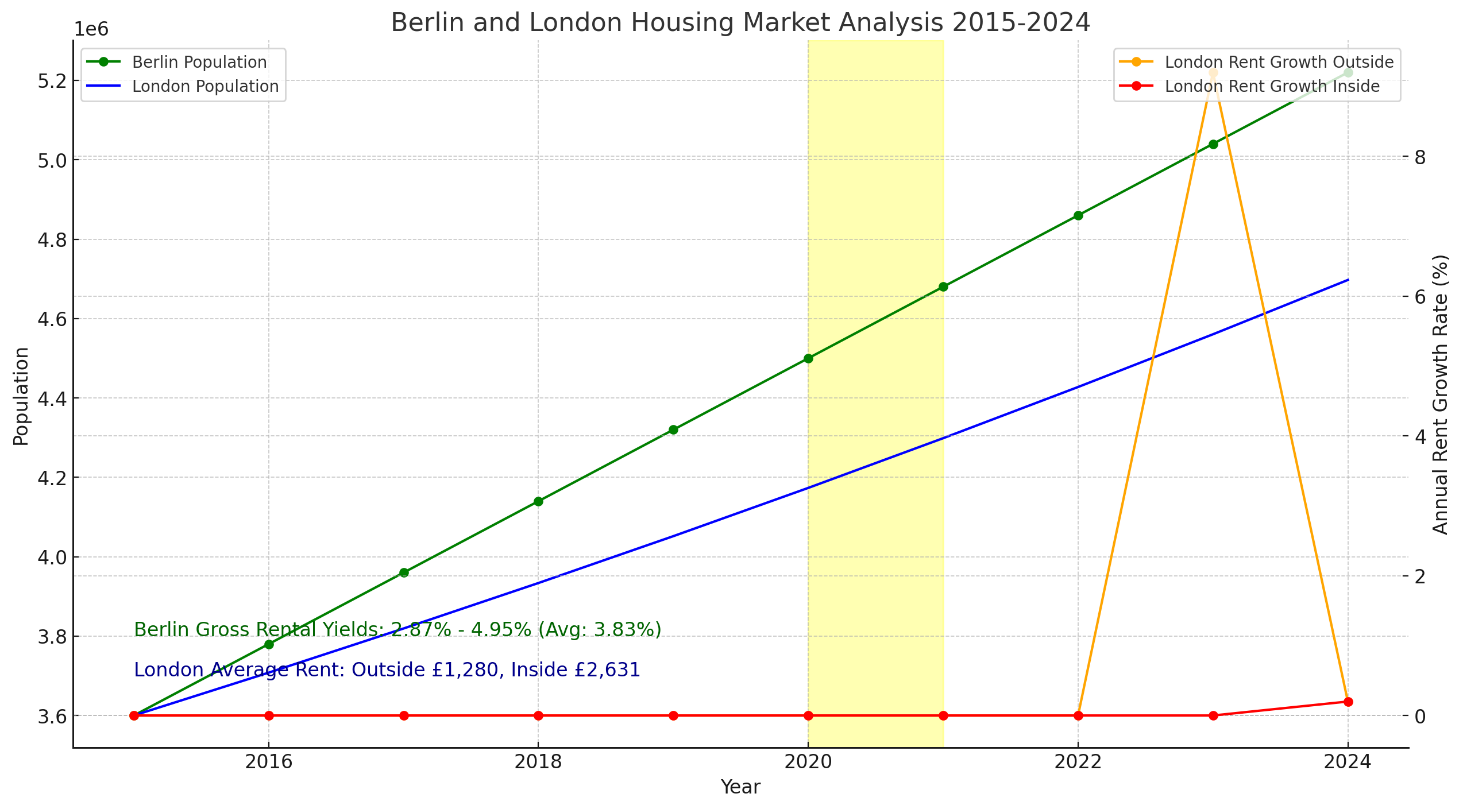
Figure 1: Comparative Analysis of Population Growth and Rental Market Trends in Berlin and London, 2015-2024.
Rent Control and Market Stability
This rent control and market stability could be compared to examining rent prices in cities with rent control measures versus those without such regulations. The dataset “Rental Market Regulation Index” gives a basis for this analysis that looks at how major UK cities compare to European cities in the context of rent control. As can be deduced from Figure 1, such differences in year-on-year rent changes are more accentuated, particularly when compared with Berlin’s Rent Cap period and when the bulk of the market experienced steady rental market growth. It is Berlin that had a rent cap to ease off the burdening costs to the tenants; the final court-ordered annulment of that rent cap and the after-effects showing skyrocketing rental prices give a real-time case of its effects on rent control. Tenant satisfaction surveys could improve this data by explaining broader social ramifications of rent control, such as the tenant’s security and quality of life. Overlaying this with housing market trends may find a connection, or the need for it, between trends of rent control to both housing quality and market availability.
The Role of Social Housing in Urban Livability
Figure 2 below shows this trend and the worrying direction in England’s social housing sector from 2000 to 2023. Figure 2 further shows the annual movement percentage rate of socially rented households as part of the total market for houses, perennially suggesting a declined figure that has been ongoing for the last two decades. Having started at 19.5% at the turn of the millennium, the proportion of households living in socially rented accommodation fell continually to 16.4% by 2023 (Statista Research Department, 2024). This development shows a transformation in the housing landscape that calls for strategic action to revert. Figure 2, therefore, serves as a call to action for the policymakers and lays down a quantitative benchmark of the reviving efforts that must be taken up under the UK social housing policy. This perspective is only when a revitalisation strategy starts to be that which seeks to arrest this decline, increase quality and integrate social housing into the broader community when this approach becomes paramount.
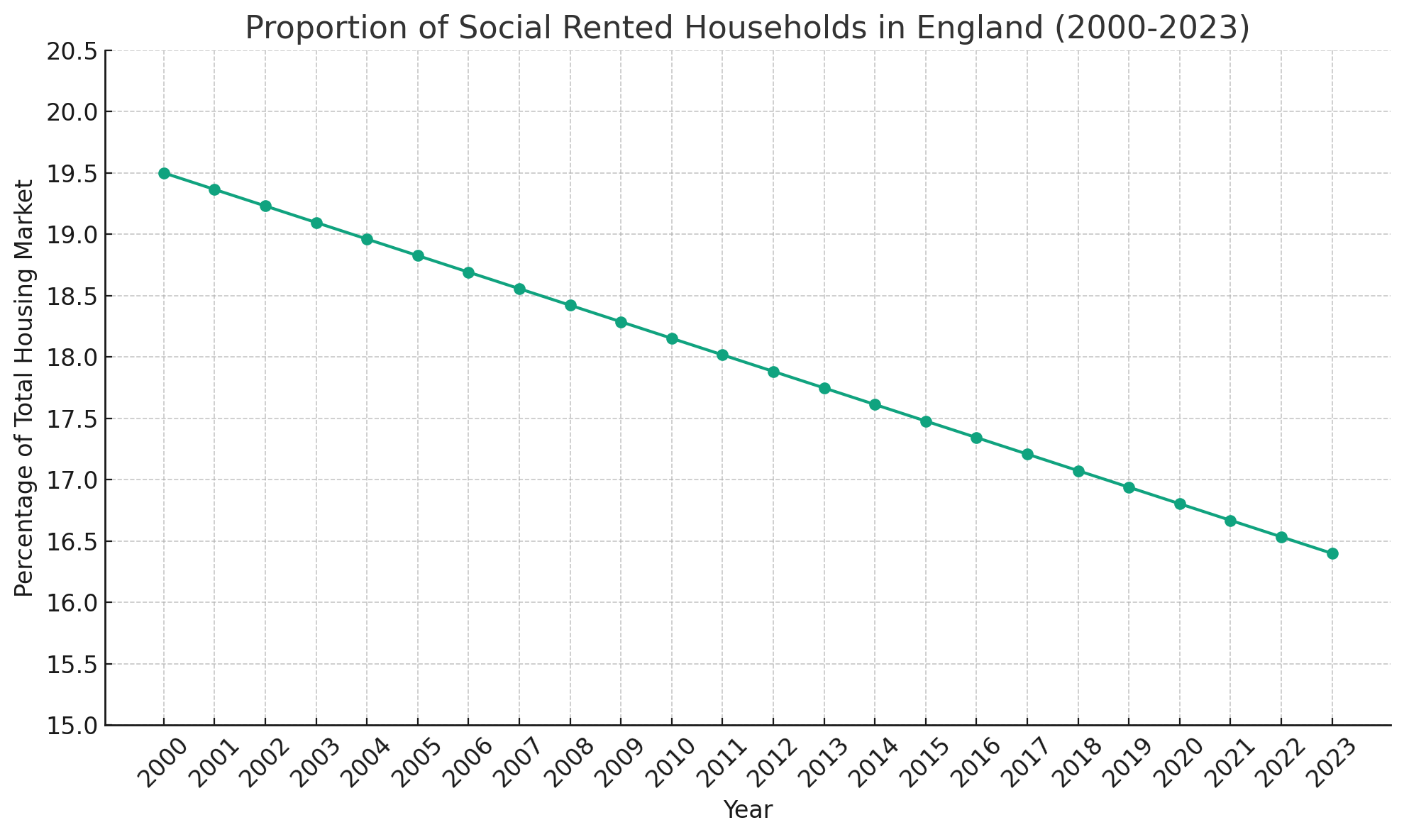
Figure 2: Proportion of Social Rented Households in England (2000-2023)
Policy Recommendations
Recommendations for Rent Controls
Comparative analysis of cities like London and Berlin has found that rent controls could go some way in damping down the extremes in the rental market volatility, especially in an urban setting where extremes in rental market volatility may well be manifested. However, learning from such challenges experienced in places like New York implies that any rent control system in the UK has to be sensitive and flexible enough to go through periodic adjustments as the market conditions change (Gibb, Soaita and Marsh, 2022). Such a system would balance the tenants’ affordability in accessing housing and the landowner’s need to raise adequate incentives to continue maintaining and investing in properties. This system would create a very effective and fair rent control system by implementing robust monitoring to keep the black market away. In addition, success with rent controls could be bolstered by complementary policies: tax incentives for landlords that complied with rent-control regulations and subsidies for tenants living in high-cost areas. Mitigating circumstances could contribute to redressing potential disadvantages in the rental market landscape, implying relatively fair dealing.
Recommendations for Expanding Social Housing
Comparing social housing trends in the UK and the Netherlands, the UK needs modernisation and expansion of its social housing sector on a large scale. However, this expansion includes far more than merely the number of units available, narrowing down to strategic integration and enhancing social housing quality. Therefore, the focus shifts to new projects in the social housing strategic plan that must focus on fostering mixed-income communities to avert the likely problems with housing segregation (Marcus and Sarkissian, 2023). The strategic difference in social housing should be located in each project’s different neighbourhoods and diverse typologies. The former is essential in catering to a broad spectrum of income groups; hence, they would nurture and develop diversified and all-inclusive communities. This catering is cardinal in developing a balanced social housing system.
Other management requires much attention, like that in social housing, which calls for establishing suitable governance structures that sustain the quality of social housing and extend essential support services to residents. This attention is meant to include ongoing maintenance and timely modernisation, so social housing will not be an obligation but a desirable place for its residents. Opportunities such as these may only be realised with joint efforts between the government, private developers, and non-profit organisations, which diversify the funding mechanisms and administration models of social housing. In addition, overly long waiting lists, in a pronounced way, constitute an integral part of enabling equal access to social housing (Marcus and Sarkissian, 2023). These encompass reviewing eligibility criteria, deploying efficient allocation systems, and a solid commitment to continuous and sustainable investment in social housing development. This focus highlights the efforts likely to alleviate the pressing current housing crisis challenges and those charting a path for lasting social and economic stability.
Conclusion
The report highlights that only the best-designed rent controls and the most substantial increase in social housing may offer the best way forward in dealing with the challenges, labyrinthine as they are, in the UK housing market. It could be deduced from this analysis that flexible rent control policies that protect the interest of both the tenant and the landlord may be instruments in stemming runaway, out-of-control rental hikes in urban areas. Simultaneously, following successful models such as that of the Netherlands, the setting up social housing is emerging as one of the most crucial policies to improve accessibility to housing and affordability. This development has to be quality-focused and integrated into the communities; it is more than essential to avoid the quantity increase that may deepen the social rifts. This quality-focused approach answers how a more equitable and stable housing environment in the UK may ultimately be forged: the development of adaptable, informed policies sensitive to the socioeconomic landscape. In doing so, such policies are worthy of housing affordability improvements in the long run and broad social cohesion, benefiting society.
References
Albon, R. and Stafford, D.C., 2024. Rent control. Taylor & Francis.
Broome, M., Corlett, A., Hale, S., McCurdy, C. and Pacitti, C., 2023. An intergenerational audit for the UK: 2023. Luxembourg Income Study (LIS), asbl.
Byrne, M. and Norris, M., 2022. Housing market financialisation, neoliberalism and everyday retrenchment of social housing. Environment and Planning A: Economy and Space, 54(1), pp.182-198.
Eikelenboom, M., Long, T.B. and de Jong, G., 2021. Circular strategies for social housing associations: Lessons from a Dutch case. Journal of Cleaner Production, 292, p.126024.
Flanagan, K., Levin, I., Tually, S., Varadharajan, M., Verdouw, J., Faulkner, D., Meltzer, A. and Vreugdenhil, A., 2020. Understanding the experience of social housing pathways.
Gibb, K., Soaita, A.M. and Marsh, A., 2022. Rent control.
Global Property Guide, 2024. Germany: Price history. Available at: https://www.globalpropertyguide.com/europe/germany/price-history (Accessed 4 April 2024).
Granath Hansson, A. and Lundgren, B., 2019. Defining social housing: A discussion on the suitable criteria. Housing, Theory and Society, 36(2), pp.149-166.
Lord Taylor of Goss Moor, Essex, S. and Wilson, O., 2022. Solving the housing market crisis in England and Wales: from New Towns to garden communities. Geography, 107(1), pp.4-13.
Marcus, C.C. and Sarkissian, W., 2023. Housing as if people mattered: Site design guidelines for planning medium-density family housing, Vol. 4. Univ of California Press.
Mense, A., Michelsen, C. and Kholodilin, K.A., 2019. Rent control, market segmentation, and misallocation: Causal evidence from a large-scale policy intervention.
Rajasekaran, P., Treskon, M. and Greene, S., 2019. Rent Control. The Urban Institute.
Rightmove, 2024. Rental Price Tracker. Available at: https://www.rightmove.co.uk/news/rental-price-tracker (Accessed 4 April 2024).
Statista Research Department, 2024. England: social rented households 2023. Available at: https://www.statista.com/statistics/286509/england-number-of-social-rented-households/ (Accessed 4 April 2024).
Teresa, B.F., 2019. New dynamics of rent gap formation in New York City rent-regulated housing: Privatisation, financialisation, and uneven development. Urban Geography, 40(10), pp.1399-1421.
 write
write