The visual adornment of the body, along with the tattoos and piercings, has been waking up among the American youth recently, and this may be a sign of cultural changes and attitudes that society is experiencing toward self-expression. This phenomenon mirrors a deep-seated cultural evolution where they may need to use their personal externalities/appearances to represent themselves. Formerly, having a tattoo was considered part of body art inappropriate or rude; in fact, now, it is a very common thing, and its acceptance is growing as a significant part of the population is demonstrating a new attitude by contrasting with traditional norms of the workplace clothing and appearance (Wu et al., 2022). Given that Human Resource executives are the custodians of ensuring organizational balance and supervision during the changing trends, it is essential to assess the effects of visual body adornment on the workplace and implement policies that will meet individual expression and the organization’s values and, expectations and objectives. This informal analytical report explores the current nature of visual body adornment in U.S. and global business offices and the ethical considerations that should be considered.
Current Trends and Considerations
One of the emerging trends is the change in the mindset of different generations today towards wearing tattoos and piercings. The younger audiences, particularly the millennials and Gen Z, are evolving as the possible future generation with higher tattoo adoption compared to the older demographics. As revealed by the Harris Poll and the Pew Research Center survey, around 40% of U.S. citizens in the 18-29 age group have applied for tattoos, indicating the booming changes in viewpoints of people on this topic (Nash, 2020). The CEO John Challenger’s statement emphasizes the significance of new hiring sets of thinking for many employers. Relatively younger job candidates must realize that they will not have to stick exclusively to traditional workplace appearance standards, which other workers will follow. There is evidence that this diagram of industry would not interfere with the job seekers’ opportunities who may have piercings or tattoos as opposed to the previous generation who had the opposite effect. Although the awareness of acceptance has generally increased, industries still perceive a divide regarding the tolerance of particular body markings (Wu et al., 2022). While some new industries, such as Information Technology (I.T.) and even Retail, can be more liberal in their approach to body modifications like tattoos and piercings, others, like banking and law, may retain strict standards.
Ethical and Global Considerations
The emergence of ethical perspectives concerning visual body adornment, such as tattoos and piercings in present-day workplaces, assumes great importance. As one of the organizations that work on developing a culture of pluralism, tolerance, and fairness, it is necessary to consider this problem and possible ways to solve it. The principles of adequate treatment and equality are central to ethical concerns. Classifying individuals here, given their looks, contradicts the ideologies the company upholds. Therefore, institutes and organizations should assess employees based on their attributes, such as competence, qualification, and performance, rather than their superficial traits (Wu et al., 2022). Consequently, regarding ethical issues, embracing diversity becomes an ideal procurement strategy because it is the right thing to do and enriches the workplace experience by being more vibrant and inclusive.
Recommendations
Cooperate with stakeholders in creating broad instructions encompassing all types of visual adornment of the human body. These guidelines should set forth what forms of body art can be applied, their location and most importantly, their manner. Ensure the rules are inclusive enough and provide for cultural diversity, as any group member should feel comfortable with the form of dress code being implemented. Include training programs where all employees are educated and the managers are told the importance of being professional in the workplace; however, some parts of body adornment will be necessary for the formation of opinions. This part of the program must focus on the company’s dedication to diversity, inclusion and involvement in individual self-expression. Be willing to acknowledge that views on body adornment usually differ among the local cultures in places where our organization operates domestically and abroad. Support and Flexibility in the policy implementation process enable various cultures to be accommodated while the organization’s values and standards stay consistent. Develop a workplace culture that appreciates self-expression, mutual respect, and a non-judgemental attitude (Community & England, 2020).
Non-verbal Clues and Perception
In the context of communication, other than words, visual body ornamentation, including tattoos and piercings, acts as an effective means of self-expression and connecting with others. Within the workplace, these cues of non-verbal communication can make a person look either positive or negative to those around him or her. Tattoos and piercings are more than just forms of adornment; they usually carry a personal meaning and commonly show something about a person’s identity, the things one believes in and the ideologies they follow. For example, some individuals use ink to express their conventions and understandings of culture, religion or specific life events. In contrast, others use their piercings to express individuality and feel more abundant during life’s journey. Thus, these body decoration modes also contribute to human diversity and compression in the workplace. The way people perceive the beautification of the body varies due to diverse cultural spaces (Community & England, 2020). In some societies’ honorary traditions, tattoos can represent heartiness, valour, or spirituality; in others, they may be a source of rebellion or defiance. For instance, the opinion on piercings can vary from accepting to forbidden according to different customs in a given society and the context of society. The extent to which employees are viewed as professional, credible and conforming to the workplace norms by their colleagues is influenced by their tattoos and piercings. Of these considerations, it is important to pay attention to the fact that responding to the problem of visual body decorations should be done with ability, such as open-mindedness, which is an important feature and respect towards density (Community & England, 2Communityrough the option of a culture of inclusivity and acceptance, we can construct a working place that permits people to represent themselves profoundly. At the same time, rules of professionalism and mutual respect are kept. Outlining the criteria, disseminating knowledge, and inviting conversation can pave the way for increasing miscommunication.
Conclusion
In conclusion, whether to use body adornments in the workplace, like tattoos, piercings, make-up, or the like, calls for a multi-angle exploration of cultural, ethical, and organizational factors. Even though the attitudes toward tattoos and spikes are evolving, particularly among the younger generations, organizations still have to make rules that will harmonize self-expression and professionalism. Organizations are creating a work culture that respects diversity and inclusivity by establishing a policy that protects visual body adornment within the limits of reason and by providing specific legal guidelines, training and Flexibility as possible.
References
Comunian, R., & England, L. (2020). Creative and cultural work without filters: Covid-19 and exposed precarity in the creative economy. Cultural Trends, 29(2), 112-128.
Nash, G. (2020). Response art in art therapy practice and research focuses on reflecting piece imagery. International Journal of Art Therapy, 25(1), 39-48.
Wu, S., Hou, L., Zhang, G. K., & Chen, H. (2022). Real-time mixed reality-based visual warning for construction workforce safety. Automation in Construction, 139, 104252.
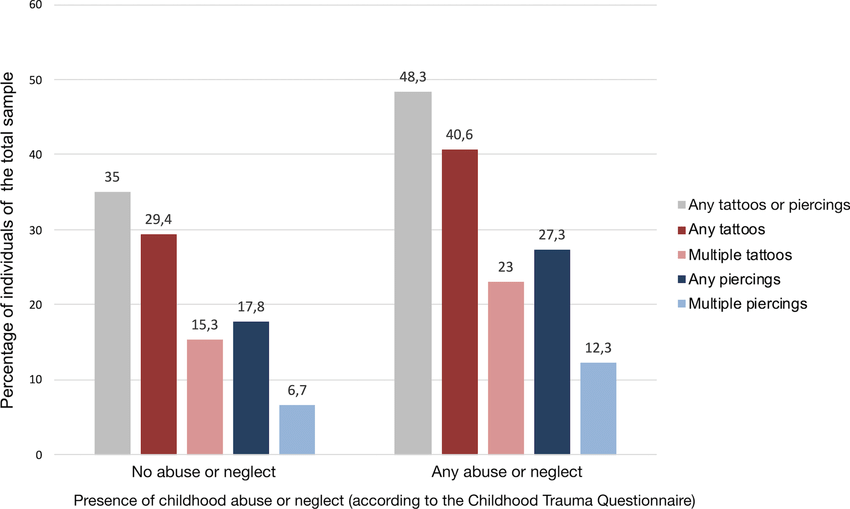
A graph showing evidence from a representative community survey
(PDF) The Association of Childhood Abuse and neglect with tattoos and piercings in the population: Evidence from a representative community survey. Available at: https://www.researchgate.net/publication/360125564_The_association_of_childhood_abuse_and_neglect_with_tattoos_and_piercings_in_the_population_evidence_from_a_representative_community_survey (Accessed: 26 April 2024).
 write
write