Part 1: Casual Loop Diagram
Part 2: Discussion
Variable Selection, Stakeholders and Time Horizon
The selection of variables and applying a long-term time frame in the quantum computing system is tactical and seeks to express both immediate and future perspectives of quantum tech. The three variables “Quantum Computing Power,” “Scientific Discovery Rate,” and “Funding for Quantum Research” will significantly influence the core activities that are the engine of this field (Bertels et al., 2021). These selections underline that these technical developments are similar to financial support and scientific progress, which are the fundamental causes of systemic quantum computer development (Gill et al., 2022). The selection of “Global Competitiveness” and “National Security Threats” as variables emphasizes the broader socio-economic and geopolitical effects of quantum computing, which acknowledge the revolutionary potential of the technology in reshaping the power relations on planet Earth (Saurabh & Rustagi, 2022).
The main stakeholders in this system are researchers, entrepreneurs, policy regulators, and the international community, all of whom are expected to extract profit from the advent of quantum computing. Since each stakeholder has unique interests, the system might have a conflict of interest. For instance, the government may focus on the long-term impact of quantum computing, such as addressing national security threats. At the same time, private entrepreneurs may be more interested in the short-term commercial benefits of quantum computing (Suhaib,2019).
The long-term time horizon is essential since this technology is nascent, and significant breakthroughs require a long time, along with workforce development and widespread adoption, which are the two major elements (Childs, 2017). This horizon promotes holistic comprehension of the development path and strategic planning that will handle the complex landscape of quantum computing to examine ethical and sustainable outcomes (Saurabh & Rustagi, 2022).
Important Feedback Loops
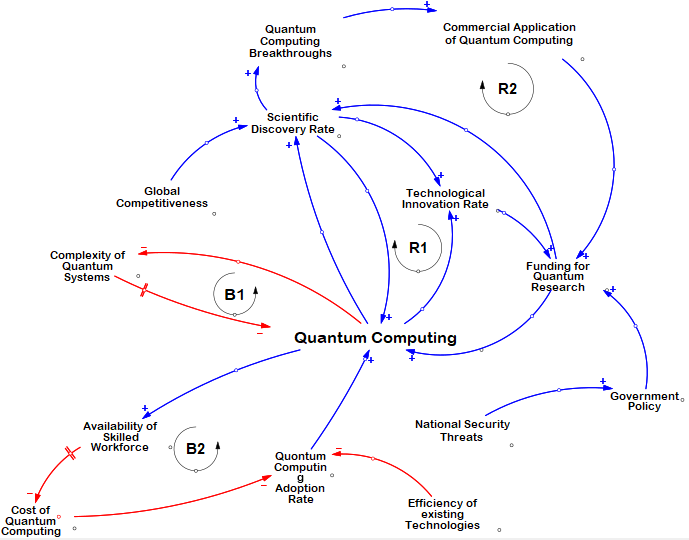
The system has two significant feedback loops: R1 and R2. R1 underlines the recurrent pattern that scientific information transfers into innovation, funding and computing power. Scientific advances (such as the development of quantum bits’ materials) have resulted in technological breakthroughs in hardware and software (Childress & Hanson, 2013; Bertels et al., 2021). These advances are the source of more and more funds for research, thus leading to the creation of quantum computers of the highest calibre (Gill et al., 2022). The cycle is reinforced since it boosts the speed of the scientific discovery process as researchers can now utilize more advanced tools. R2, on the other hand, reveals the relationship between scientific breakthroughs, commercial application, and research funding. Scientific discoveries bring more quantum computing breakthroughs, such as error correction techniques fostering the potential for real-world applications such as drug discovery (Saurabh & Rustagi, 2022). Such prospects attract more funding, thus feeding back to more scientific discoveries.
Key Delays
The system reveals two main delays associated with the complexity of the quantum systems and the availability of a skilled workforce. The first delay is related to the complexity of quantum systems. The increased quantum computing power leads to the development of more complex quantum computing systems. The ripple practical and undesirable implication is that building and maintaining such intricate systems hinders computing power advancement. Hence, it is essential for the interventions that address problems of scalability and fault tolerance in the quantum hardware (Childs, 2017). By allocating resources to address these addresses, professionals can speed up the development of quantum computers of higher capabilities.
The second delay is associated with a limited skilled workforce. An increase in quantum computing power increases the demand for a skilled workforce. The increased demand subsequently leads to limited availability of qualified personnel. Consequently, the cost of adopting quantum computing increases, thus lowering the rate of adoption (Childs, 2017). Ultimately, this reduces the power of quantum computing. To speed up this delay, governments and corporations can increase research funding and educational programs to create a larger pool of talented workers. Additionally, this funding will decrease the cost of adopting quantum computing.
Potential Archetypical behaviour
The system embodies the archetype of “limits to growth”, where the loops of scientific breakthroughs and business applications are hindered by the highly complex nature of quantum systems and the shortage of qualified labour force (Childs, 2017). This suggests that by taking the fundamentals, the growth triggered by the positive feedback mechanism may continue in the same exponential mode.
Leverage Point
The “Funding for Quantum Research” is instead an essential leverage point in the system. By adequately enhancing the funding, the stakeholders will be able to intensify the power of quantum computing and its adoption. Such measures can ignite the R1-R2 loops and help deal with problems of system complexities and shortage of workers. This will address the ethical issue of unequal access to quantum computing developments. Furthermore, focusing efforts on educational programs to grow the skilled workforce (one of the main constraints of the development of quantum computing) will help achieve both ethical outcomes and sustainability in quantum computing (Saurabh & Rustagi, 2022).
Part 3: Application of Virtue Ethics
The virtue ethics paradigm provides a comprehensive tool for assessing and acting upon the impact of quantum computing on all stakeholders. The model also helps ensure that society’s well-being is not at stake. Aristotle’s idea of ethical virtue (Eudaimonia) focuses on achieving a well-lived life through cultivating virtues, which are good character traits that enable people to act rationally (Baril, 2014). In the case of quantum computing, the people concerned are not just engineers and scientists but also the general public, industrial leaders, national governments, and the whole of humanity, who are all affected by the developments and applications of this technology.
Impact On Stakeholders’ Eudaimonia
Quantum computing can have an outstanding impact on the eudaimonia of different stakeholders. For scientists and engineers, it provides a unique chance to step forward and make discoveries or developments that correspond to their professional goals and personal intellectual values. It offers new opportunities for factories and economies, allowing them to become more productive and create new capabilities (Saurabh & Rustagi, 2022). This can lead to new industries and employment creation in the long run. The knowledge divide may develop, and the issues related to the ethical use of technology and the state’s security may be a problem that could affect the well-being of society and the world. Such advantages and disadvantages should be weighed to confirm whether the technology can enhance prospects (enhancestakeholdersforGill et al., 2022).
Relevant Virtue: Phronesis
One of Aristotle’s most important concepts was Phronesis, or practical wisdom, which is required for ethical decision-making in practical situations. Concerning the virtues of quantum computing, the virtue of Phronesis (practical wisdom) holds immense significance. Phronesis is the art of choosing the good and the useful for oneself and the whole community, leading to proper morals and actions (Costello, 2019). This virtue is the foundation for engineers and computer scientists who work in quantum computing, providing them with the proper knowledge to deal with the complexity and ethics of quantum computing development. This is the only option to solve the technical difficulties, social effects and ethical questions in the decision-making. Phronesis is a virtue that comprehends the appraisal of technology and the moral and practical aspects that should be considered in innovation (Childs, 2017).
Virtuous Course of Action
Leveraging on the virtue of Phronesis and the insights gained from the causal loop diagram, the virtuous course of action will incorporate a balanced and holistic approach to quantum computing advancements. This will encompass directly engaging the system’s delays and feedback loops through initiatives such as investing in education and training to mitigate employment shortages and guaranteeing the ethical application of technology to avoid national security challenges. Additionally, increasing quantum research funding is another virtuous course that will speed up quantum computing advancements and support ethical outcomes such as accessibility, equity, and beneficial applications (Costello, 2019). Decision-makers should incorporate Phronesis by ensuring quantum computing advancements are for the common good. This will involve promoting a broad-based approach to quantum technology development that ensures its benefits are available to all stakeholders. Additionally, phronesis-based decisions will minimize the adverse effects of these advancements by providing ethical guidelines, thoughtful regulation, and public engagement. Practically, such proactive approaches mean making research agendas transparent, joining efforts across sectors, and developing international initiatives to use quantum computing for the public good, such as healthcare and environmental protection.
References
Baril, A. (2014). Eudaimonia in contemporary virtue ethics. In The Handbook of Virtue Ethics (pp. 17–26). Routledge. https://api.taylorfrancis.com/content/chapters/edit/download?identifierName=doi&identifierValue=10.4324/9781315729053-3&type=chapterpdf
Bertels, K., Sarkar, A., & Ashraf, I. (2021). Quantum Computing-From NISQ to PISQ. IEEE MICRO, 41(5), 2432. https://ttu-primo.hosted.exlibrisgroup.com/permalink/f/1j33bpi/TN_cdi_openaire_primary_doi_51f 2fa3c45a151d1b90042902f77c979
Childress, L., & Hanson, R. (2013). Diamond NV centres for quantum computing and quantum networks. MRS Bulletin, 38(2), 134138. https://ttu-primo.hosted.exlibrisgroup.com/permalink/f/1j33bpi/TN_cdi_proquest_miscellaneous_1 671417930
Childs, A. M. (2017). Quantum computing: Quantum advantage deferred. Nature https://ttu-primo.hosted.exlibrisgroup.com/permalink/f/1j33bpi/TN_cdi_proquest_journals_197227 5538
Costello, G. J. (2019). The philosophy of innovation in management education: A study utilizing Aristotle’s concept of Phronesis. Philosophy of Management, 18(3), 215-230. https://link.springer.com/article/10.1007/s40926-018-00104-7
Gill, S. S., Kumar, A., Singh, H., Singh, M., Kaur, K., Usman, M., & Buyya, R. (2022). Quantum computing: A taxonomy, systematic review and future directions. Software: Practice and Experience, 52(1), 66–114. https://onlinelibrary.wiley.com/doi/abs/10.1002/spe.3039
Saurabh, K., & Rustagi, V. (2022). Ethical and sustainable quantum computing: Conceptual model and implications. The journal of contemporary issues in business and government, 28(1), 225-239. https://cibgp.com/au/index.php/1323- 6903/article/view/2294
Suhaib, M. (2019). Conflicts identification among stakeholders in goal-oriented requirements engineering process. International Journal of Innovative Technology and Exploring Engineering (IJITEE). https://papers.ssrn.com/sol3/papers.cfm?abstract_id=3471916
 write
write