1.0 Introduction
As technology development speeds up, the subsequent e-waste accumulation is a growing danger to environmental sustainability. In this sense, BornGood is a ray of hope, creating the first national reconditioned technology market that extends the lives of electronics and encourages environmental accountability (BornGood, 2023). This assignment reviews the operational change initiatives of BornGood and applies different analytical frameworks using SWOT and PEST Analysis to determine the need for change in the organization. The various techniques for ensuring change preparedness and overcoming resistance are scrutinized, considering the unique scenario of BornGood. A comprehensive change plan and interventions are developed and supported by an action plan focusing on ethical behaviour and practical implementation actions. The research proposes powerful recommendations that can help BornGood in management. It will also ensure that the company moves forward with its efforts to transform the IT sector into more sustainable and eco-friendly.
2.0 Operational Change Initiative
2.1 Diversification of Services and Community Engagement
The “Laptops for Kids” and “Donate Digital”- BornGood projects- are measured and proactive approaches to solving the problems caused by the pandemic and the unstable economy (Otter Voice Meeting Notes, 2023). To seek the urgent need for digital access for distance learning, BornGood demonstrates its commitment to addressing social issues, especially those affecting impoverished children. Through sharing resources and raising awareness, this project will impact more people with the help of Reach PLC and the Northern Powerhouse (Otter Voice Meeting Notes, 2023). Projects like “Laptops for Kids” benefit the community and establish BornGood as a socially responsible corporation. A broader commitment to social responsibility and inclusivity is shown through BornGood’s sponsorship of different organizations, such as those that help asylum seekers. The resilience and adaptability of BornGood are demonstrated by this episode, marking a significant operational shift towards community participation and donations (Holbeche, 2019). Considering all aspects, the multiple programs and social services provided by BornGood are a holistic approach to dealing with the issues while promoting sustainable growth and positive change. It also shows the importance of strategic partnerships and steadfast commitment to make a social impact.
2.2 Transition to Remote Working and Process Adaptation
One of BornGood’s reactions to COVID-19 was implementing the Work from the Home scheme and process adaptation, as travel and office work were no longer allowed. This change led to a disruption in the logistics of equipment pick-up, data rendering, sanitization and resale but also called for a fundamental restructuring of the operating procedures (Otter Voice Meeting Notes, 2023). BornGood, as part of the transformation to the remote-working format, had to develop new methods for dealing with equipment, ensuring data protection, and supervising processes without physical presence. Hence, they could have invested in solid IT infrastructure so staff members could access systems and data remotely while building secure telecommunication tools to encourage team collaboration (Attaran and Woods, 2019). On top of that, the company instructed staff members and ensured they could operate remotely and deal with their difficulties. Nevertheless, despite the initial challenges, BornGood can benefit from this shift by optimizing procedures, improving adaptability, and expanding the remote workers’ pool by possibly accepting remote labour. Additionally, the rise of the pandemic-triggered article, which focused on the role of organizational agility and resilience in adapting to unpredictability, reveals BornGood’s ability to overcome challenging situations (Holbeche, 2019).
3.0 SWOT and PEST Analysis
3.1 SWOT Analysis
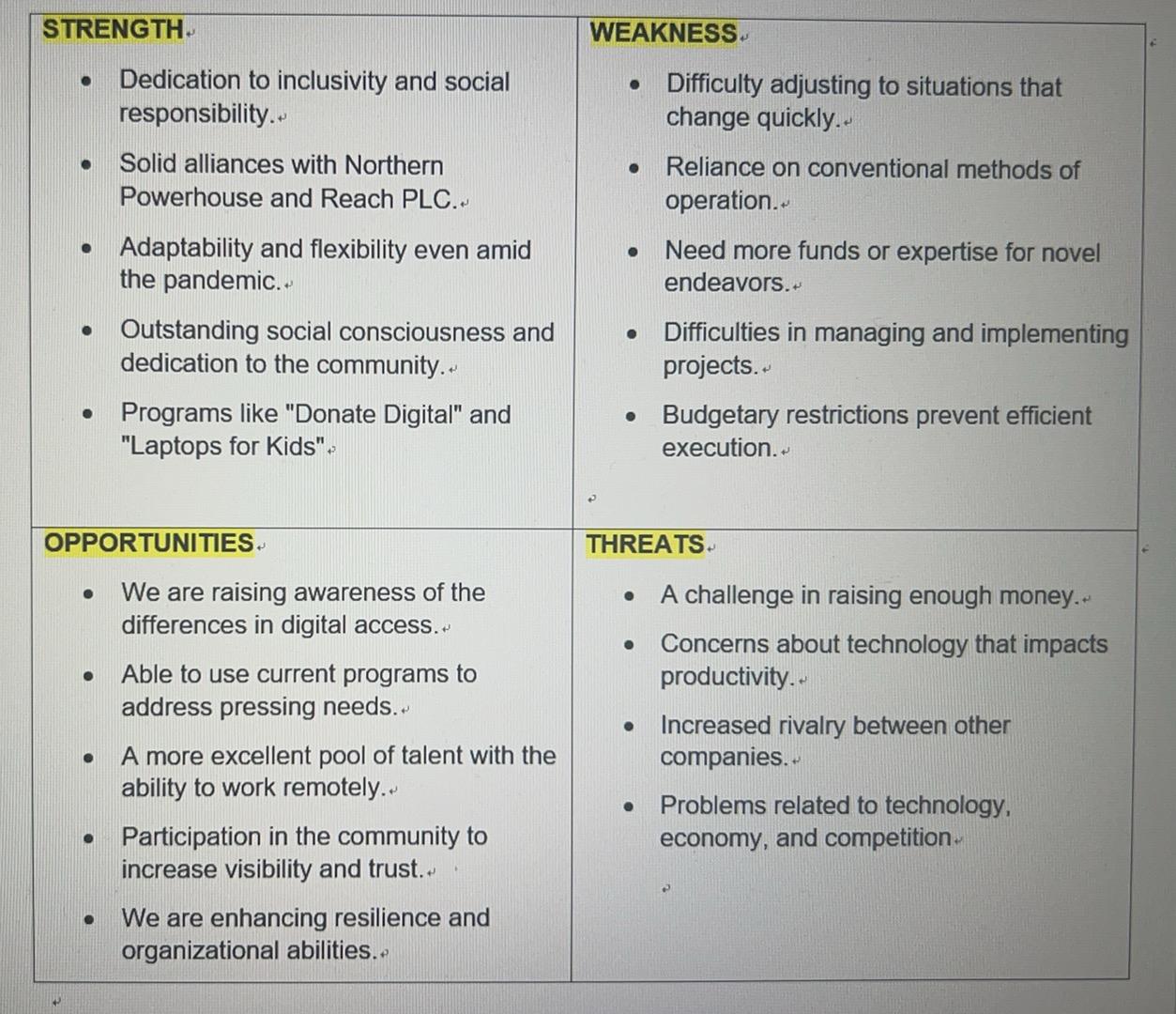
Strength: With the support of partnerships with institutions such as Reach PLC and the Northern Powerhouse, BornGood’s social responsibility and inclusivity are exemplified through programs like “Laptops for Kids” and “Donate Digital” (Otter Voice Meeting Notes,2023). The fact that they prioritize worker safety even when operating remotely during the pandemic shows that they are flexible enough to meet social needs.
Weakness: BornGood’s adherence to conventional operating procedures made the company slow to adapt to the new challenges posed by the pandemic. The absence of responsiveness made it difficult to adopt initiatives like ‘Laptops for Kids’, which identified the scarcity and deficiency of knowledge and resources (Leach et al., 2020). The organization should fill in the blanks of its knowledge and resource deficiencies, requiring it to apply innovative approaches.
Opportunities: With “Laptops for Kids” and “Donate Digital,” BornGood will acknowledge the growing digital divide and become a synonym for a socially responsible company. One of the other advantages of these work alternatives is the chance to innovate and get a larger talent pool. Working with the community can increase the organization’s popularity and effectiveness (Banerjee, Bhattacharyya, and Bose, 2017).
Threats: The lack of money needed for activities like “Laptops for Kids” is an obstacle that makes it difficult for BornGood to address the worsened social ills. Technology problems associated with remote Work also affect staff productivity, for instance, inadequate IT infrastructure and cybersecurity flaws (Singh et al., 2023). More competition makes the task very hard. Therefore, BornGood must be highly competent in marketing, strategic partnerships, and innovation to remain relevant.
3.1.1 Benefits of SWOT
As the SWOT approach is comprehensive, it is precisely what makes it ideal for evaluating BornGood’s position. It provides a holistic view by considering internal aspects, such as strengths and weaknesses, and external aspects, including possibilities and threats. SWOT analysis is a tool that helps to break complex information into four dimensions and to facilitate communication. Efficient resource distribution and delineation of the critical issues allow BornGood to set the strategic focus. Moreover, SWOT analysis is a versatile tool, adjustable to multiple situations and addressable specifically to BornGood’s needs. Though Porter’s Five Forces will likely overlook the ripple effects in society, techniques like PESTLE analysis may overlook the internal factors. The SWOT method identifies opportunities, weaknesses, strengths, and threats, making it more straightforward for BornGood to decide its managerial strategy in a dynamic context.
3.2 PEST Analysis
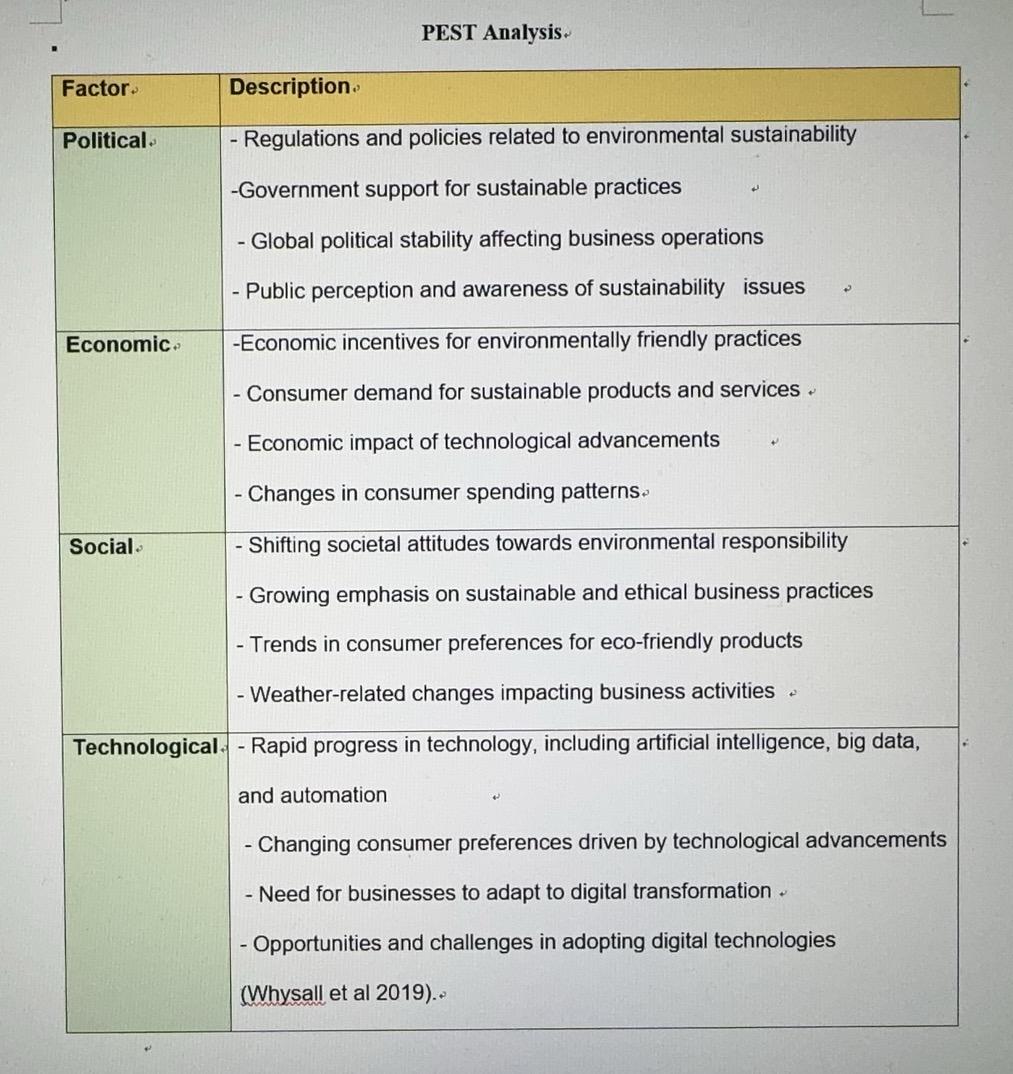
Political: Government regulation and rules about COVID-19 lockdowns and safety measures for workplaces affected BornGood’s transition to remote Work. Political stability and support for such government initiatives are the factors that will affect the business as it creates and maintains remote working arrangements.
Economic: The pandemic economic effects, such as the changes in consumer behaviour and decrease in market demand, can also affect BornGood’s decision to shift to remote working. Additionally, the company’s ability to adapt is, after all, influenced by economic factors like the financial possibilities of investing in IT infrastructure and remote work tools, as well as budget limitations.
Societal: Born Good entirely synchronizes with the current accelerating trends in modern society, like the technology-based emergence of teamwork and communication and a radical change in the perception of flexible work schedules. Social factors, which are work-life balance and employees’ preferences for remote Work, affect how the organization builds its remote Work policy.
Technical: BornGood’s use of sophisticated IT systems, cybersecurity solutions, communication channels, and other technological equipment is a crucial condition for adopting remote Work. Technological advancements and remote Work offer prospects for enhancing organizational productivity and organization.
3.2 Benefits of SWOT and its Shortcomings.
A thorough analysis of the external elements influencing BornGood’s shift to remote working and process adaption is made possible using the PEutilizingical, Economic, Social, and Technological) model. The PEST model is helpful because it sheds light on the more significant environmental framework in which BornGood functions, which includes sociological trends, economic situations, political developments, and technical breakthroughs. However, the PEST model only considers external elements; in contrast, the SWOT model considers internal characteristics like strengths and weaknesses. Although the PEST model provides a valuable viewpoint on external factors, it might not provide the inside knowledge required for a comprehensive strategic analysis. Therefore, combining the PEST and SWOT models could yield a more comprehensive view of BornGood’s strategic position, even though the PEST model helps comprehend the company’s external environment.
4.0 Achievement to Change Readiness
The change readiness service at BornGood is a strategic plan that takes a multidimensional approach toward the steps of the organizational organization and the human perspective of change management. An organization reorganization is equipped with an innovative and flexible culture. One way to pursue this is through communicating transparency, allowing the employees to be part of decision-making, and appreciating or rewarding innovation (Knezović and Drkić, 2020).
BornGood will boost overall adaptability to change by creating possession of change among its workers by inviting them to participate in the change process and consult on their suggestions. To accomplish this, BornGood will also need to devote part of the funds to developing integrated change management strategies that would concentrate on the participation and communication of stakeholders (Holifield and Williams, 2019). This comprises ensuring that the advantages are explained clearly, overcoming employee fears and opposition, and offering a convincing reason for the proposed changes. Staff members are kept in the loop during the change period. Therefore, they face lesser resistance and have higher buy-in when informed regularly, and their feedback is considered. BornGood should take other methods on the human side of change, and the ADKAR model (Awareness, Desire, Knowledge, Ability, Reinforcement) is one of them (Paramitha and Suroso, 2020).
As this model explains, the most crucial point is increasing people’s awareness of the need for change, activating their desire to participate, and equipping them with relevant information and skills. It allows the successful implementation of the change and reinforces it with encouragement and recognition. Change can be managed well by BornGood by implementing the ADKAR model’s principles of behaviour and psychology; thus, employees’ preparedness will increase, and resistance will be reduced. Furthermore, developing strong links with employees, stakeholders, and external partners is also essential for the success of change management (Watson et al., 2017). BornGood can build a culture that welcomes change by promoting transparency, trust and teamwork. Training and support can also facilitate staff adaptation to new methods and technologies.
5.0 The Approach To Change Justification
BornGood’s change management technique is hybrid; it utilizes aspects of an emergent approach (developmental, organization devorganizationD) and an economical approach (rational planned). To tackle the exacerbated societal critical challenges brought about by the pandemic, BornGood implemented programs such as “Laptops for Kids” and “Donate Digital” as planned improvements in response to challenges of economic instability and technological challenges. The programs were deliberately planned in such a way as to support the objectives and mission of BornGood, which has the twin goals of sustainability and maximizing social development. Organization and strategic adaptation are needed to ensure business continuity and the well-being of the employees during the transition to remote (Malinen et al., 2018). Work and process adaptation in light of the COVID-19 pandemic required careful planning and organization.
NeorganizationBornGood can also be considered a case of emergent change whose characteristics are flexibility and fast response to unexpected opportunities and threats. Collaborating with Northern Powerhouse and Reach PLC and successfully transitioning to remote Work. Work indicates the organization’s attitude toward change management. BornGood presented adaptability and creativity as the critical characteristics of uncertainty through how it handled its operations and strategy by modifying them in response to the dynamic environment.
6.0 Change Plan and Interventions
BornGood’s change management approach integrates aspects of emergent (developmental, OD) and economic approaches (rational, planned), acknowledging that organized planniorganizedaptability is needed to face rapidly changing conditions. The first step in addressing the areas for improvement and any barriers to change in BornGood is a thorough examination and study of their current operations and organizational internal environment (Felipe, Roldán and Leal-Rodríguez, 2017). Stakeholder engagement is crucial for the success of the BornGood transformation plan; partners, customers, employees, and the community are all at different stages of the process. BornGood actively garners support and buy-in by requesting feedback, addressing questions, and generating a sense of ownership among stakeholders. Creating open and transparent communication channels for stakeholders regarding the purpose of the change, its progression, and its effects on the staff and operations would minimize and build trust.
The workforce is empowered with professional skills training and acquiring relevant knowledge to adapt to new working styles, technologies, procedures, and incredibly remote Work. This involves workshops on change management, soft skill development, and technical training to facilitate willingness to change (Bagga, Gera and Haque, 2022). Emphasis is put on continuous improvement and implementing systems for monitoring and evaluating the progress of change projects, obtaining feedback from stakeholders, and making adjustments when necessary. The propelling factor, the iterative process, allows BornGood to remain adaptive to the changing needs and obstacles while maintaining its focus on organizational organization and social responsibility. BornGood is a hybrid strategy incorporating the most appropriate aspects of contingent and directive strategies to adapt to uncertainty and generate desired outcomes. The born good brand can adapt to changing conditions and maintain its vital objective of gaining a substantial grip on the community in which it operates due to its risk-based strategy.
7.0 Action Plan
An action plan allows for an organized implementation process; thus, it helps put the previously suggested change plan and interventions into practice. It entails all details of the tasks, targets, roles, and materials required for each phase of the change management process. The change management team will assess the operations process and organizational environment with relevant departments before relentlessly gaining insights. After that, they will conduct surveys and interviews and use data analysis software tools (Braun et al., 2020). The team will work with resources such as strategic planning workshops and consultancy from experts, which they will also collect from senior leadership. This will help to develop a strategic change plan with specific goals and objectives in this review (Grunnan and Fridheim, 2017). Simultaneously, stakeholder activities will be launched, guaranteeing the buy-in and support for the duration of the process. These will be jointly done by the change management team in cooperation with HR and the corporate communications department, using workshops and feedback systems.
In support of the change management team, the corporate communications department will initiate stakeholder engagement and establish consistent communication lines. The department will utilize different guidelines, such as newsletters and town hall meetings. Strategy planning will be paired with training and development initiatives. The HR Division will run these initiatives, collaborating with the department managers and subject matter experts to offer a mix of on-site training and e-learning courses. Finally, the change management team will use the data from key performance indicators and feedback surveys to establish the mechanisms for continuous improvement (Kerzner, 2022). For example, formal assessment cycles and continual monitoring, the outputs of which will be reviewed by the department heads and stakeholders. BornGood can fulfil its goals most efficiently by implementing this action plan and executing activities and synchronization processes.
7.1 Challenges in Implementing the Action Plan
When implementing the action plan mentioned above, some challenges and obstacles may need to be overcome. Firstly, some employees or stakeholders may be sceptical about the change and require effective communication and explanation to gain their support. Next, the plan might be limited by the availability of resources, requiring resource planning and management. Moreover, the organizational structure should be more facilitative of change implementation; thus, some adjustments and modifications are necessary. Additionally, cross-departmental collaborations and cooperation can experience communication barriers and conflicting interests, thus requiring the creation of efficient communication channels and coordination mechanisms. Eventually, some technologies and systems may not correspond to the change, leading to improvements or updates. The participation of the leadership team and all the employees is required to overcome these problems and challenges that need planning, strategy and execution.
8.0 Key Performance Indicators (KPIs)
The extent of success of change management at BornGood depends on the stakeholders’ satisfaction and participation. BornGood’s KPIs are the participation rate and the feedback score to measure stakeholder involvement and links with corporate goals. The means of surveys, feedback sessions, and communication channels measure these traits. Keeping track of employees’ adoption of remote working tools is also necessary. KPIs such as tool usage and policy adherence also inform what needs improvement and what has already been achieved. Practical training and development programs should be in place (Kerzner, 2022). To ensure their impact on preparedness for Work, KPIs should be set, including completion rates and skill competency. Though the retention rates and satisfaction scores are the significant indicators of the concept of employee engagement and morale, the agility of BornGood is measured by the key performance indicators (KPIs), such as the response time to the changes in the market. Moreover, KPIs such as beneficiary reach and community feedback are used to assess how change initiatives influence social responsibility programs. Continuous improvement is made possible by tracking developments and modifying plans in response to input; KPIs like the efficiency of the review cycle serve as a guide for this process.
9.0 Approaches to Managing Change Resistance
BornGood can employ a complex tactic based on ethical and sustainable behaviour to cope with the resistance to change and improve the experience. Establishing effective and open means of communication is the priority in the first place. As for BornGood, the company will likely effectively resolve doubts and uncertainties among its employees through an open and honest discussion environment (Salvato and Vassolo, 2017). Through this, workers feel free to express their concerns and ideas about possible changes. This approach earns trust and confidence among the staff. The process of transformation is also crucial in involving the staff. BornGood might lead to a member’s sense of belongingness and commitment by asking for their ideas, opinions, and advice. Over time, this will lower the resistance, and buy-in will go up. Providing enough training and support for the change management processes is also essential.
Employees can be well equipped to master the shift in processes, technology, and work styles through training sessions on change management, soft skills, and technical training (Bagga, Gera and Haque, 2022). Because of that, the transition will be smooth. Above all, stakeholder inviting should be done at all stages of the change process, including customers, partners, and community members. The making of the agreement and the necessary support for the proposed changes are determined by getting their feedback, dealing with their worries, and finding common ground. Ethics must be the priority of change projects to maintain ethical values and standards. The BornGood will demonstrate a deep involvement in social responsibility, inclusion, and community participation
by prioritizing theprioritizingoreover, the holistic perspective of corporate social responsibility and sustainability by BornGood Company aligns with integrating sustainable practices into the change projects, for example, reducing environmental impact and focusing on sustainable development goals. Ultimately, a reward and recognition program should be designed and executed, and the awards should be assigned to those employees who influenced the change management (Mansaray, 2019). The techniques above will ensure that BornGood will be ethical and sustainable, adapt to change, deliver valuable services that customers find satisfying, and implement organizational
10.0 Recommendations
- To supervise change projects, form a change management team with members from multiple departments. Ensure that people who are aggressive, knowledgeable, and aligned with strategic goals should be on this team (Braun et al., 2020).
- Adopt a methodical strategy to update change reviews quickly. This is by conducting focus groups, surveys, and performance testing of change project KPIs.By putting resource efficiency first and adhering to sustainable development objectives, sustainability is incorporated into every step of the change implementation process.
- The organization should adopt a continuous improvement culture. This is done by encouraging a flexible environment where employees are continuously trained and developed to improve trade architecture, instruction, and creativity (vom Brocke et al., 2018).
- Enhance worker participation during transitions and include communication channels in the action plan. Use newsletters and town hall meetings as communication tools to enlighten and involve staff members.
- To foster collaboration and teamwork among many departments, dismantle departmental barriers and cultivate workforce partnerships.
- A long-term strategic plan should be created to improve the efficacy of change management. Implement collaborative action plans based on the previously indicated suggestions to get the intended results.
11.0 Conclusion
In conclusion, the creative design and the flexibility to change BornGood emphasize social responsibility, diversity, and sustainability. The organization’s organization and resilience during the COVID-19 pandemic are evident as they worked remotely and joined other societal outreaches like “Laptops for Kids.” The SWOT analysis reports that societal consciousness and agility are strengths, but resource access and quick change adaptation are weaknesses. Threats comprise technical challenges and economic barriers, and opportunities imply access to more skills and solving the urgent issues of society. BornGood should cultivate an atmosphere of openness, involve staff members in making decisions, and offer assistance and training for better transition preparation. A hybrid approach that emphasizes continuous improvement and stakeholder involvement is suggested for change management. Bolstering the change management tactics of BornGood will help realize social and organizational organizational These techniques include incorporating sustainability principles, fostering a culture for constant improvement, enhancing the communication channels, and promoting cross-functional collaboration.
List of References
Attaran, M. and Woods, J. (2019). Cloud computing technology: improving small business performance using the Internet. Journal of Small Business & Entrepreneurship, [online] 31(6), pp.495–519. doi https://doi.org/10.1080/08276331.2018.1466850.
Bagga, S.K., Gera, S. and Haque, S.N. (2022). The mediating role of organizational leadership and change management in virtual teams. Asia Pacific Management Review, [online] 28(2), pp.120–131. doi:https://doi.org/10.1016/j.apmrv.2022.07.003.
Banerjee, S., Bhattacharyya, S. and Bose, I. (2017). Whose online reviews to trust? Understanding reviewer trustworthiness and its impact on business. Decision Support Systems, 96, pp.17–26. doi:https://doi.org/10.1016/j.dss.2017.01.006.
BornGood (2023). BORNGOOD. [online] Beyond Single-life Tech | Home. Available at: https://borngood.uk/%20 [Accessed 22 Feb. 2024].
Braun, V., Clarke, V., Boulton, E., Davey, L. and McEvoy, C. (2020). The Online Survey as a Qualitative Research Tool. International Journal of Social Research Methodology, 24(6), pp.641–654.
Felipe, C.M., Roldán, J.L. and Leal-Rodríguez, A.L. (2017). Impact of Organisational Culture Values on Organisational Agility. Sustainability, 9(12), p.2354.
Grunnan, T. and Fridheim, H. (2017). Planning and conducting crisis management exercises for decision-making: the do’s and don’ts. EURO Journal on Decision Processes, [online] 5(1-4), pp.79–95. doi:https://doi.org/10.1007/s40070-017-0065-0.
Holbeche, L. (2019). Designing sustainably agile and resilient organizations. Organizations and Behavioral Science, [online] 36(5), pp.668–677. doi:https://doi.org/10.1002/sres.2624.
Holifield, R. and Williams, K.C. (2019). Recruiting, integrating, and sustaining stakeholder participation in environmental management: A case study from the Great Lakes Areas of Concern. Journal of Environmental Management, 230, pp.422–433. doi:https://doi.org/10.1016/j.jenvman.2018.09.081.
Kerzner, H. (2022). Project management metrics, KPIs, and dashboards : a guide to measuring and monitoring project performance. Hoboken, New Jersey: John Wiley & Sons, Inc.
Knezović, E. and Drkić, A. (2020). Innovative work behaviour in SMEs: the role of transformational leadership. Employee Relations: The International Journal, ahead-of-print(ahead-of-print). doi:https://doi.org/10.1108/er-03-2020-0124.
Leach, M., MacGregor, H., Scoones, I. and Wilkinson, A. (2020). Post-pandemic transformations: How and why COVID-19 requires us to rethink development. World Development, 138(1), p.105233. doi:https://doi.org/10.1016/j.worlddev.2020.105233.
Malinen, S., Hatton, T., Naswall, K. and Kuntz, J. (2018). Strategies to enhance employee well-being and organizational porganizationala postcrisis environment: A case study. Journal of Contingencies and Crisis Management, 27(1), pp.79–86. doi:https://doi.org/10.1111/1468-5973.12227.
Mansaray, H.E. (2019). The role of leadership style in organizational corganizationalnt: A literature review. Journal of Human Resource Management, 7(1), pp.18–31. doi:https://doi.org/10.11648/j.jhrm.20190701.13.
Otter Voice Meeting Notes. (2023). 1st Employer PODCAST Artefact – Re-Buyer (now rebranded as ‘Born Good’).m4a. [online] Available at: https://otter.ai [Accessed 19 Feb. 2024].
Paramitha, T.A. and Suroso, D.K.T. & I. (2020). ADKAR MODEL TO MANAGE ORGANIZATIONAL CORGANIZATIONALtional Journal of Research Science and Management, [online] 7(1), pp.141–149. Available at: https://ijrsm.com/index.php/journal-ijrsm/article/view/80.
Salvato, C. and Vassolo, R. (2017). The sources of dynamism in dynamic capabilities. Strategic Management Journal, 39(6), pp.1728–1752. doi:https://doi.org/10.1002/smj.2703.
Singh, T., Johnston, A.C., D’Arcy, J. and Harms, P.D. (2023). Stress in the cybersecurity profession: a systematic review of related literature and opportunities for future research. Organisational Cybersecurity Journal: Practice, Process and People. doi:https://doi.org/10.1108/ocj-06-2022-0012.
vom Brocke, J., Maaß, W., Buxmann, P., Maedche, A., Leimeister, J.M. and Pecht, G. (2018). Future Work and Enterprise Systems. Business & Information Systems Engineering, 60(4), pp.357–366. doi:https://doi.org/10.1007/s12599-018-0544-2.
Watson, R., Wilson, H.N., Smart, P. and Macdonald, E.K. (2017). Harnessing Difference: A Capability-Based Framework for Stakeholder Engagement in Environmental Innovation. Journal of Product Innovation Management, 35(2), pp.254–279. doi:https://doi.org/10.1111/jpim.12394.
Appendices
ACTION PLAN
| DESCRIPTION OF ACTION | DEPT/ PERSON RESPONSIBLE | SHORT /MEDIUM/ LONG TERM | DESIRED OUTCOME |
| Use surveys, interviews, and data analysis tools to extensively evaluate BornGood’s existing operations, organization, and organizational environment. | Change management team. | Short term | Learn about BornGood’s business processes, corporate culture, and outside influences. |
| Using the information gathered from the assessment phase, create a strategic change plan with precise goals, targets, and deadlines. | Change management team, with input from senior leadership. | Medium-term | A thorough strategic change plan with precise goals, targets, and deadlines for organizational |
| workshUtilizing stakeholder engagement activities involves important stakeholders at every stage of the transformation process to guarantee support and buy-in. | The change management team is in charge of corporate communications and HR assistance. | Short to Medium-term | Increased support and buy-in from stakeholders for the change activities. |
| Set up feedback forums, newsletters, and frequent town hall meetings to inform stakeholders effectively. | The corporate communications division is under the direction of the change management group. | Short to Medium term | Improved transparency and communication about change projects and updates on progress |
| offering employees online modules, workshops, external training providers, and possibilities for training and development aimed at helping them adjust to new technology and processes. | HR division, working with subject matter experts and department managers. | Short to Medium term | |
| Establish systems for tracking and assessing the success of change initiatives using KPIs, feedback forms, and frequent review sessions. | The change management team, including feedback from stakeholders and department managers. | Long term |
 write
write