Elucidate Key Drivers of Technological Change and Innovation
Identifying and Explaining the Main Drivers of Technological Change
That fact is confirmed by the mix of external forces (such as the need to respond to market demands and the need for overall operation efficiency) and strategic imperatives that the organization needs to achieve a given mission.
Resource configuration and competitive events have a substantial effect on the technological development of the organization. To match shifting consumer demand and market happenings, the company equally understands the need to be reactive and agile. Through innovation, the organization strives to fill the gaps of new demands from its customers, which is proof that the offerings provided will continue to be on the leading edge of the market. The forward-looking staff of the organization can make it defensively strong and grab the chances of new opportunities.
Inwardly, the organization strives to adopt new technology to ensure no operation is inefficient and that labor productivity is at its peak (Subramanian & Nilakanta, 1996). The organization harnesses technology to optimize the channels through which work is done, reduces the need for repetitive tasks, and maximizes the use of available resources. Internal optimization also helps the enterprise refresh its mechanisms, helping it to be more efficient, innovative, and continuous about the improvement in the future. Thus, the organization will eventually build a firm ground for future development and success by directly equipping employees with the necessary tools and technologies to achieve great workplace performance.
As in the case of any technology suite, technological initiatives are carefully mapped into the organization’s long-term plans. The utility of technology for realizing business growth, entering new markets, or differentiating the set of products and services solely depends on the strategy of the organization in question. (Ravichandran, 2018) Technology preserves a competitive edge by owning the latest innovations and digging deep into tests, trials, as well as applications of those latest technologies. This type of strategic alignment ensures that technological changes not only form a reaction to market pressures but also a comprehensive strategy for the organization.
Discussion of Organizational Change Management Methodologies and Project Management Tools
The organization helps in the implantation of technological changes through the use of varying organizational change management methodologies and project management tools to achieve a smooth transition of the process with successful results.
Agile methodology is right at the heart of the organization’s way of dealing with the inevitability of technology change. Many different and dynamic market conditions are required to adapt quickly to changing market requirements or changing environments that are iterative and collaborative due to the Agile methodology. Agile project management does this by segregating tasks and cooperation between the multidimensional team thus Agil;e pav,es the way for change to adaptability and ability tothe respond to change to make tech projects remain on track and in line with the organizational goals and needs of customers.
Change management frameworks, including Kotter’s 8-Step Process and Lewin’s Change Management Model, which are focused on the human dimension of change, provide structured evidence for effectively managing the effects of technological change (Ravichandran, 2018). These organizational paradigms enable the organization to tackle challenges such as apprehension of resistance to change, formulation of employee buy-in, and smoothening up the whole implementation process. Such change management frameworks, through arousing the urgency of change, relating a very appealing vision and incentivizing employees to take part in the process work as filters that enable the organization to deal with impediments and to win around stakeholders from all levels.
Management tools for a project are vitally important in implementing efficient plans, monitoring progress, and coordinating technology change campaigns. Gantt charts form the visual representation of project schedules and those of their dependencies, thus facilitating the identification of bothersome bottlenecks on the side of the organization, tracking progress and rooting out impedances at the same time (Ming-Chu & Meng-Hsiu, 2015). The team members can access partnership platforms like Trello and Asana to chat and share the file system or the task list so that collaboration and productivity will be accelerated. These PM tools enable to run tech-change projects smoothly and these projects not only benefit internal stakeholders but the entire organization as well.
Application of Relevant Theoretical Frameworks
By and large, the organization’s key drivers of technological change support the conventional theory of innovation processes, casting light on the realities of organizational evolution and the path toward adaptation.
Schumpeter’s theory of creative destruction contends that technological improvements unconsciously force the development of the economy by substituting old technologies and management patterns with new, more rationally evolved ones. The theory here emphasizes how the organization’s technological change causes disruptions that make it impossible to maintain the old systems because the new technologies open up opportunities for innovation (Hatzikian, 2015). Through the virtue of technology enhancement, the organization makes the journey of creative destruction, which gives an opportunity to break down old systems and structures to bring better solutions. By doing this, the company can go toward its strategic goals to enhance its operations in the market and competitors by using technology as a platform for change.
Another aspect of Roger’s development of the theory of the diffusion of innovation is that it helps us understand the process of developing and spreading new technologies within business sectors. The communication of innovations is a process that Rogers identifies as the diffusion of innovations. In this process, the groups or societies being introduced to new technologies primarily adopt these technologies over time (Subramanian & Nilakanta, 1996). Technological change in the organization’s implementation This theory indicates the critical role that factors determination of the adoption of new technologies play, including economic benefits, feasibility of the offered systems and users’ acceptance. This ethical theory can be applied to the technology initiatives and channeledchanneled toward the critical stakeholders’ demands and concerns. In this way, the implementation process can be made easier, and the initiatives can be driven towards successful results.
Conceptual Map Detailing Reasons for Failure
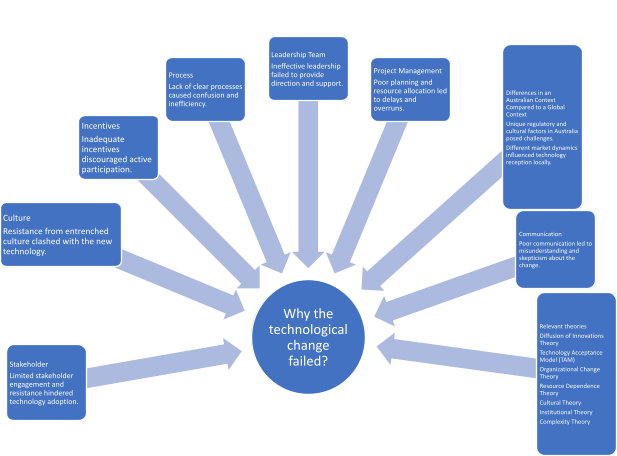
Conceptual map: Why the technological change failed
Analyse and Explain the Conceptual Map
The thinking-mthinking modelhe visualized components of the issues behind failure ofthe the technological initiatives project in the organization. The map scrutiny aids us in examining the internal processual factors and their interactions with each other in particular; team breakdowns of communication could play a negative role in the overall result.
This notion is characterized by the fact that the mode of communication in the groups, attributed to a leading factor, prevents the technological change from being successful. The drop in the communication line is depicted by detached pathways and the disjointed arrows in the maponepresent,ing the lack of the interccted collaboration among the team members. This disruption in information circulation might occur due to the following reasons: weak management, undefined tasks and objectives or intolerance to change.
From the theoretical standpoint, the failure of team communication to meet its objectives conforms with the ideas of organizational theory and communication changes. In Lewin’s change management model, the artifact that embodies this model is equally important for successful change management and overcoming change resistance in organizations, which is communication (Attaran, 2004). In the case of needing to establish communication channels and generally accepted positions, staff may appear bored and not have a purpose forwork on the project, ultimately causing resistance and project failure. On the same token, theories of organizational communication reiterate the significance of efficient open communication channels for developing collective effort, trust, and involvement within teams. When communication fails, it becomes an emerging issue that can inflict the flow of information, block decision-making processes, and ultimately impact the success of organizational initiatives.
Additionally, in the conceptual map, the different causes related to the failure of technological change projects, like organizational structure, power, values, culture, and setting environment between Australian and international contexts are also visible. These factors are interrelated and buttress each other simultaneously, leading to an aggravation of the problems attached to the implementation of the technological change process within the organizational context. For instance, power dynamics such as noncooperation by some people within the organization might negatively influence how new technologies are adopted into the system. The same is true for organizational culture, which is seen as a thing that is so painful to change, as well as the discomfort of risk. It can thus get in the way of innovation and limit progress towards technological transformation.
Linking identified factors with the theories of administrative transformations and communication will let us understand the underpinning principles leading to the collapse of the technological change initiative (Attaran, 2004). By resolving conflict amongst misunderstanding of teammates, power abuse and cultural differences, firms can reduce employees’ resistance to change and create an atmosphere of productive and successful technology transformation. For instance, mechanisms like clear-cut communication, stakeholder cooperation, and process alignment are capable of helping resolve these challenges and leading to the effective application of technological change programs. Besides, organizations must fully comprehend the institutional framework in which the change process takes place, comprising the variance between local and global stages to ensure the approach is customized to particular organization’s needs and goals, thus augmenting the chances of success.
Identify and Justify Recommendations for Successful Implementation
However, there also lies an opportunity to revise the previous initiatives into a robust strategy that takes into account the shortcomings and constraints identified. This requires taking the integrated step concerned projects and organizational change management suggestions. Let us expand on each recommendation to provide a thorough understanding of how they can be effectively implemented: Let’s expand on each recommendation to provide a thorough understanding of how they can be effectively implemented:
Establish Clear Communication Channels and Stakeholder Engagement: Important for properly incorporating the change, communication is a fundamental aspect of successful change management, especially in technological change projects of the organization where the breakdown of communication between the teams identified is a major cause of failure. However, the effective solution is to create open and transparent pathways for two-way communication and interact with the stakeholders at all levels (Laig & Abocejo, 2021). By doing regular updates, organizing town hall meetings and him/her open forums, you will be able to create and encourage employees to express their concerns and give suggestions. Furthermore, using the digitation channels such as e,liminating the distance of communication with collaboration platforms would sol,ve the problem of sharing information and member teamwork.
Justification: The two most important elements that underpin effective project implementation processes are sufficient communication channels and people involvement. The prevention is tactically addressing the failure in organizational team communication. As they are doing that, they can reduce misunderstandings that can cause resistance. They can, in turn, increase the overall success of the projects. In addition, taking stakeholders along during the implementation process instills a sense of stakeholder ownership and commitment, ensuring change success. Through creating a two-way communication channel and active engagement with employees, management can bring the necessary interpersonal connections that improve trust, teamwork, and the effectiveness of the change program.
Implement Change Management Strategies: The ways through which change management is incorporated matter most in dealing with the organizational transition and overcoming the resistance to change. To overcome resistance to adopting a technologically driven culture and develop a more accepting mood, businesses should conduct change management procedures including Kotter’s 8-Step Process or Lewin’s Change Management Model (Laig & Abocejo, 2021). They give organizations a strategic structure for campaigns on change management, resistance and acceptance of change, and build the bridge between change occurring in an organization and its employees. By specifying the reasons behind the change, taking the employees into confidence about the change, and supporting resources for implementation, the organizations can ensure a peaceful environment before the successful adoption of change.
Justification: The critical map described several factors that led to the failure of the technological reform measures, such as resistance to change and organizational culture. Change management procedures help organizations to deal with challenges in a better manner through preventing resistance and, as a result of this, make the transitional process easier. Adopting a strategy that allows employees to contribute to and support the change process can positively affect an organization’s adoption outcome and implementation.
Having patterned change management frameworks would mean that resistance is tackled systematically, clear communication is maintained, and employees are given the power for the whole through on them. With this preventive method, the stakeholders’ fears are allayed, the people learn to be trusting, and everyone develops a sense of ownership, which in return leads to better commitment and successful execution of the techno-change initiative.
Develop a Comprehensive Training and Support Program: One of the most important factors in this process is the training and support provided for employees, who will need a set of competencies and knowledge to adjust their habits. In considering the respective flaws towards labor skills mismatch and employee preparedness, they will develop a practical training and support program (Do et al., 2016). It would be proper to include lecture-based training sessions, online tutorials, and provision of technical support materials as part of the program. Moreover, organizations should also give committed support at all times, coaching and mentoring to help employees towards the ability to improve their difficulties and build trust while using the new technology.
Justification: The lessons learned map was the most important tool that highlighted and demonstrated employee readiness and skill gaps as the most important contributors to the failure of the initiative. Through the creation of a well-designed training and support program, organizations can deal with those challenges, ideally eliminating the shortage of using it as an excuse for bad performance. That way, employees develop eagerness for change, reduce the resistance, and in that way, create a more efficient tech change implementation process. This would be a good paragraph to include about the characteristics of digital leaders.
Investing in employee training and support is one of the key steps organizations should undertake to ensure the effective and efficient use of technology. Providing practical workshops, online classes and manua,ls will enable organizations to guarantee that employees possess tools and methods for learning processes of acquiriand new technologies effectively (Ming-Chu & Meng-Hsiu, 2015). Apart from constant support and mentoring throughout the process, employees will be able to deal with the rising challenges and boost their confidence in adopting a new technology, which can greatly increase their success rate.
Moreover, a package of training and support services show that showsrganization values a perspecttheve of the staff by assisting them in developing and sharing successes which is ,a key component of culture development and innovation. With the professional development of staff, companies can effectively create employee engagement, motivation, and retention, leading to the eventual success of the technology change management agenda. Accordingly, the development of training and support programs is a key component to solving skill voids, dismissing resistance, and successfully implementing new technology change.
In short, a holistic approach to project management and organizational change management is very important for the project to work well and guarantee the effectiveness of the technological change initiative. Organizations may effectively deal with any existing failures and barriers through the empathic practices of laying down communication channels and stakeholder engagement, implementing change management strategies and creating robust modus operands for training and support. Thus, this preventive measure not only mitigates resistance but also develops understanding and support for employees, resulting in changed adoption and innovations getting achieved.
Reflect on Learning and Future Practice
The course vector has brought many priceless lessons behind the organizations’ technological advancement and innovation process. I am aware that technological change implementation is not a single-step process which involves earlier adoption to the new technology but also thoughtful planning, skills to communicate well to the members of organization, and understanding the interfirm dynamics. What has changed my thinking significantly is that I replaced the view about technology changes just as a technical process with a holistic view, where in addition to the technological factors, cultural, change management, and stakeholder engagement levels must be considered.
Deepening into this learning, I willit in a corporate setting by purposing more holistically to working with technological change and innovation. Apart from being exclusively concentrated on the technological aspects, I will, however, emphasize to grasp the contextual scenario, determine the challenges against change, and develop a viable solution to these challenges. Additionally, I will underline the role of communication and stakeholder engagement, enabling a smooth [process] with all the concerned parties consulted and informed throughout this change process.
These issues I will explore in the article have also made me think differently about how I handle innovation and technological change. Now, I understand that staying on one step forward is preferable to taking two steps backward; planning for the possible problems gives me a better chance to prevent them early. Besides that, I grasp the importance of collaborative and interdisciplinary teamwork as power tools to drive innovation, wherein participants with different skills, perspectives or areas of expertise possess the capacity to enrich the process, leading to the development of creative solutions to complicated issues.
Overall, my learning odyssey has provided me with the tactical knowledge and know-how to cope with the complexity of technological development and advancement in corporate settings, but also has given me the richness of experience and the ability to deal with changes more confidently. Moreover, that will be a challenge in the future. I am deeply involved in applying this knowledge as effectively as possible, choosing a holistic approach to management, and creating a culture of innovation and constant changes within organizations.
References
Attaran, M. (2004). Exploring the relationship between information technology and business process reengineering. Information & Management, 41(5), 585–596.
Do, B. R., Yeh, P. W., & Madsen, J. (2016). Exploring the relationship among human resource flexibility, organizational innovation and adaptability culture. Chinese Management Studies, 10(4), 657-674.
Hatzikian, Y. (2015). Exploring the link between innovation and firm performance. Journal of the Knowledge Economy, 6, 749-768.
Laig, R. B. D., & Abocejo, F. T. (2021). Change management process in a mining company: Kotter’s 8-step change model. Journal of Management, Economics, and Industrial Organization, 5(3), 31-50.
Ming-Chu, Y., & Meng-Hsiu, L. (2015). Unlocking the black box: Exploring the link between perceived organizational support and resistance to change. Asia Pacific Management Review, 20(3), 177-183.
Ravichandran, T. (2018). Exploring the relationships between IT competence, innovation capacity and organizational agility. The journal of strategic information systems, 27(1), 22-42.
Subramanian, A., & Nilakanta, S. (1996). Organizational innovativeness: Exploring the relationship between organizational determinants of innovation, types of innovations, and measures of organizational performance. Omega, 24(6), 631-647.
 write
write