Abstract
Organizations worldwide are incorporating technology in their operations to enhance efficiency and improve productivity. Automation has proved to be a major factor in reducing production costs and improving product quality; thus, organizations are heavily investing in automation technology and research. Automation is more in technology organizations such as Amazon since they rely on technology to produce and distribute their products. The objective of the report is to analyze the data and determine how the data can be used to make key decisions in the organization. Besides, the report will identify the efficiency of the organization and whether technology improves the operations and production. Generally, there is a correlation between technology and production efficiency.
Introduction
Automation is critical in contemporary businesses as it makes it economical for companies to produce and distribute their products. Besides, automation ensures consistency, which creates confidence among the customers. Other major benefits of automation include customer satisfaction, cost savings, operational efficiency, and compliance. Notably, efficiency helps the organization to easily predict their production and sales due to reduced errors in determining the sales volume and raw materials. Automation allows the firm to set up a system that operates automatically by running the process and apparatus. Amazon is a retail business company based in the United States. Due to its wide market that cannot be efficiently served through manual operations, automation is used in various levels of business operations. The company is the best international seller in terms of computers and accessories, toys and games, and books, among other products. The wide market makes it necessary for the company to invest in the efficiency and convenience of serving the widespread customers. The company’s requirements include an automated system that allows easy processing of bulky orders and the location of various categories of products. There are, therefore, four main concerns of the company that can be efficiently handled through automation: order fulfillment, data inventory, customer support, and data analysis and reporting. Amazon aims to reduce task difficulty and create utility through automation.
Theoretical Framework
Diffusion of innovation theory can be used in automation through the spread of new technology to different people and populations across the world. The introduction of an automated system acts as a basis within which other global businesses operate, taking into account the leveraged benefits of seamless business operations in various parts of the world (Fujii, 2022, p. 544). Diffusion of innovation theory explains that a product or idea gains momentum and acceptability and spreads within the social system or a specific population (Fujii, 2022, p. 544). Notably, the automation of Amazon’s operations incorporates the theory as the technology spreads from the company to millions of people using Amazon’s services across the world. Since Amazon is a global business, different populations will likely adapt to automation more quickly than others. In the Diffusion of Innovation theory, people who adapt early to introduce innovation have distinguishing characteristics compared to people who adopt the same innovation at later stages.
The theory establishes five main adopter categories: innovators, early adopters, early majority, later majority, and laggards. In contemporary society, innovation has become part of populations’ daily lives; thus, there are a few laggards in this technology era (Leif, n.d, par, 4). The innovators include Amazon’s management and developers of technology automation, while early adopters include employees interacting with the automated system. Customers across the world lie under the early majority, late majority or laggards. Notably, a significant number of people are in the early majority or late majority, implying that according to the theory, although it may take time, innovation eventually succeeds. The theory can be applied in automation initiatives by communicating with customers and employees about the technology and the benefits associated with using automation to both the customers and the organization.
Innovation management theory provides critical skills to organizational management, enabling them to effectively run and guide the organization to the desired innovation trajectory. The theory explains the innovation process and how the organizational management can manage it from the initial stages to a successful implementation (Arifin, 2022, p. 905). Organizations seeking to introduce an innovation must devise an implementing strategy to ensure a positive reception of the innovation to the stakeholders. Innovation management theory uses a bibliometric flow chart to show how the organization can incorporate the knowledge of an innovation to implement its management. The theory stresses data collection and web scraping, which should lead to data reprocessing to understand the organisation’s innovation needs before conducting content analysis and bibliometric analysis.
According to the theory, the output is sufficient knowledge for innovation management theory. The theory has four perspectives that must be considered by organizational leadership, which include management of innovation, business, economics and finance, environment and geography and technology and infrastructure (Arifin, 2022, p. 905). During innovation management, the leadership must monitor the success and analyze possible risks from early stages to implementation. Amazon automation innovation requires keen consideration of the process and involvement of all stakeholders. Management will apply the theory to ensure that all factors are considered during the implementation process. Notably, Amazon’s performance will indicate success and adjustment to the innovation. Management must educate stakeholders and incorporate innovation as one of the organisation’s values.
Data Analysis
Fulfillment
Fulfilment involved the total orders processed, average order processing time, percentage of orders fulfilled by robots and average items picked per hour per robot. Total orders processed increased from 2.5M to 3.8M while the average order processing time in minutes decreased from 15 to 12 minutes. The percentage of orders fulfilled by robots has risen from 75% to 85%. On the other hand, the average number of items picked per hour grew by 25% to 250 hours (Amazon Case Study Data 2). The data indicates a significant improvement in Amazon’s efficiency in operations. The increase in orders processed shows an improvement in time usage in the organization. Notably, the excess of 800,000 orders processed can be quantified in terms of sales; thus, automation positively impacted the organization. A decrease in processing time shows that the company saved on time, which could be attributed to an increase in total orders processed. The cost implication of automation in fulfilment is reduced cost as the robots could perform much more work than human labour. Assuming that the same cost was incurred with the robots within the same duration, then the cost per item decreased as the number of processed items significantly increased (Laber et al., 2020, p. 64).
Inventory Management
Real-time inventory accuracy rose from 98% to 99%, while RFID-tagged products rose from 80% to 85%. On the other hand, the percentage reduction in stock discrepancies rose from 90% to 95% (Amazon Case Study Data 2). The data shows an improvement in the company’s data inventory. There is a clear indication that automation improved efficiency and accuracy and reduced discrepancies. Real-time inventory accuracy is nearly perfect with automation, which shows that although there was efficiency, accuracy was slightly improved by the automation processes.
Customer Support
Amazon is a global company that is expected to handle a significant number of customers’ queries every day. The number of queries handled increased to 700,000 from 500,000. The percentage of queries resolved by chatbots rose to 70% from 60%, while the average response time by chatbots in seconds reduced to 8 seconds from the previous 10-second wait time. There was a corresponding improvement in customer satisfaction rate of 3%, rising to 88% from 85% (Amazon Case Study Data 2). The automated chatbots enhanced the efficiency of customer service by improving customer-organization interaction. An increase in the number of queries indicates the possibility of unsatisfied customers’ initial existence as their queries were not handled. The customer satisfaction rate indicates that the customers well received the use of chatbots as the wait time was reduced.
Data Analysis and Reporting
The reports generated daily rose to 700 from the initial 500 reports, while there was an increase in average time saved in data analysis from 40% to 50%. The Key performance indicators (KPI) show that the performance of an organization has improved from 8 to 12 (Amazon Case Study Data 2). The automation pattern shows an improvement in Amazon’s overall performance. The report generation indicates that automation was efficient and that it would be possible for management to predict the number of reports to be generated within a specified period. Innovation management would be made more efficient with data analysis and reporting statistics as it becomes easy to predict the position of Amazon in a specified future.
Results and Discussion
The Amazon data on automation pre and post-application of automation indicate a significant improvement in the performance of the organization in different sectors. The result of the analysis indicates that the customer satisfaction improved, inventory management improved and reporting and analysis was significantly improved (Amazon Case Study Data 2). The results align with theoretical frameworks as the organizational management must understand the trends and the innovation to ensure accurate implementation. The changes show in the data from January 2023 to July 2023 is predictable thus can help management to effectively make decisions on implementing innovations in future. Amazon operates in a global environment requiring diffusion of technology and innovation from headquarters to other satellite offices. Therefore the analysis gives an opportunity for the company to determine the changes to make in offices in other countries to enable meet individual needs in countries they are located. The findings indicate that the organization has leveraged technology in its operations and that the efficiency of operations has improved. The improvement chart can be presented as shown below:
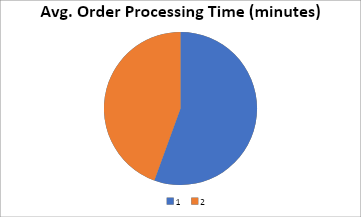
The average order processing time decreased from January to July as a result of efficiency.
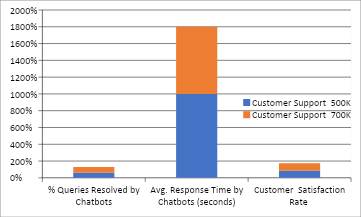
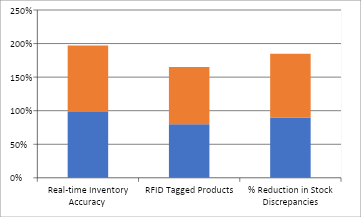
The chart indicates the changes that took place after introduction of the chatbots to deal with customer queries. From the charts, there was a significant improvement in quantity of customer and rate of satisfaction when the numbers of customers served were 500,000 compared to the rise to 500,000.
Conclusion
Automation at Amazon comes with significant improvement in terms of the customer served and efficiency of the operations. The chatbots have significantly reduced the burden of communicating with customers, with the number of customers increasing. The satisfaction rate indicates that the customers are more satisfied with the innovation implemented by the organization. Besides, the management must use the data to guide the innovation process and determine the appropriate implementation procedures within the organization. It is also important for management to determine the areas of improvement and educate the employees on leveraging the automation process. Inventory management reduces the number wastage while at the same time improving the customer experience. Automation of report generation enables the organization to reduce chances of errors while ensuring timely reports. The decision making is made easy as the reports can be generated at any given time. The large number of customers served everyday would demand employment of a large number of employees who are replaced by the robots. The cost of operation is therefore significantly reduced as the robots do more work in a more efficient manner.
Reference List
Amazon Case Study Data 2
Arifin, J., 2022. Innovation management theory: Current trends and implementation.
Fujii, M., 2022. Simulations of the Diffusion of Innovation by Trust–Distrust Model Focusing on the Network Structure. The Review of Socionetwork Strategies, 16(2), pp.527-544.
Laber, J., Thamma, R. and Kirby, E.D., 2020. The impact of warehouse automation in amazon’s success. Int. J. Innov. Sci. Eng. Technol, 7, pp.63-70.
Leif Singer. (n.d.). Diffusion of innovation theory. https://sphweb.bumc.bu.edu/otlt/mph-modules/sb/behavioralchangetheories/behavioralchangetheories4.html
 write
write