Abstract
The Stroop effect, one of the best-documented cognitive phenomena to date, has proven very instructive in understanding the attention mechanism and interference. The classic Stroop task dramatically demonstrates how the person’s ability to name a color is significantly impaired when, in reality, the word’s meaning is incongruent with the ink color. The Emotional Stroop task expands on this to look at how emotionally salient words affect cognitive processing in general and specifically in tasks requiring reporting the ink color used. This study aimed to establish how much emotional words influenced response times in a color naming task concerning neutral words.
Notably, 219 individuals participated in a within-subjects experimental design that outlined the difference: 153 bus drivers and 66 pilots. During an experiment, the participants accomplished a battery of tests comprising the conventional Stroop task and its Emotional Stroop counterpart: the name of the ink color for neutral and charged words. The hypothesis is that the response time for emotionally laden words is longer because of the heightened cognitive and emotional processing.
Results were calculated by using paired samples t-test and were compared with the average reaction times of both types of words: words arousing emotion and neutral words. This showed that the reaction time for the emotional word had significantly increased for both groups, meaning there was an apparent cognitive interference effect. The mean reaction time for words with a connection to emotional implication was significantly more compared to words expressing neutral meaning, thus nullifying the study’s null hypothesis. The results will form the basis for future investigations on cognitive processing in its interaction with the emotional response and its implication on daily tasks and decision-making processes.
Introduction
The Stroop effect represents a hallmark of cognitive paradigms and has been the subject of investigation for scientists about the complex interplay between attention and interference. Eponymous effect 1935: original work by John Ridley Stroop. It presents the eponymous effect, which shows a cognitive time lag when the task of naming the color of a word and its meaning are conflicting. This cognitive interference, therefore, acts as a critical stone in the study of selective attention and automaticity of reading, supplying a quantifiable measure for cognitive control and processing speed.
Since the first study of Stroop, many variations were developed to test different aspects of cognitive interference and executive control. Among those, the Emotional Stroop task has revealed the most. The emotional Stroop task was introduced by McKenna first in the year 1986 (Ziaratnia et al., 2023). In this task, emotionally charged words are intermixed with neutral words in a kind of cocktail to test the hypothesis according to which emotional stimuli attract attention more strongly than neutral stimuli, hence increasing cognitive load and impairing the task of color naming. This presupposes that with emotionally salient words, there comes an attentional bias, which, therefore, slows task performance due to additional emotional processing involved in such stimuli.
The present study aims to explore if and how emotional words, when used in a Stroop task, affect response time compared to neutral words. The study then moves to the other two, cognitively high-demanding yet quite distinct, professional populations, bus drivers and pilots, to assess whether the present findings will hold within populations with high cognitive demands that, however, are not related to activities of considerable cognitive control.
The theoretical framework is based on emotional salience, a critical determinant for cognitive resource allocation. In this respect, emotional words are assumed to automatically activate an attentional response, reflecting the relevance of such material to survival and personal relevance, hence an implication for an increase in cognitive interference. We tested the hypothesis that such interference would only result in longer response times to emotionally loaded words when performing the Stroop task. In this sense, it is possible to consider that more general literature in attentional processes and emotional cognition suggests affective factors can substantially modulate the performance of attention-demanding tasks.
This study is aimed to make a precise contribution to knowledge about cognitive-emotional interactions through a rigorously designed experiment and statistical analysis. More practically, the findings of the present study may be used to devise strategies to reduce the effect of emotional interference in those professional environments where the highest cognitive performance is crucial.
Method
Participants
In this study, the subjects consisted of 219 adult participants of both sexes, classified into two occupational categories based on professional needs for attention and cognitive control. The first group has 153 persons willing to apply for the bus driver vacancy; the second one includes 66 candidates for the aircraft pilot vacancy. This was, therefore, an assurance that all of the participants had normal color vision, as it was a requirement for their respective job applications and most COMSEC procedures, above all, a prerequisite to the validity of the Stroop task. Their involvement was done during the shortlist stage for the recruitment process; however, beforehand, candidates were confident that the results of cognitive tests would not impact their hiring. Thus, it maintained the ethics of transparency and avoided performance anxiety on the part of the candidate, which could be misleading.
Design and Procedure
The effect of content on the emotions that affect cognitive processing was measured using a within-subjects experimental design. The participants were to undergo two versions of the Stroop test: the standard version of the test and the Emotional Stroop variant. In the standard test, subjects named the color of a list of words. Some words were color words printed in an incongruent ink color (such as the word “red” printed in blue ink), while others matched (for instance, the word “blue” printed in blue ink). For the emotional Stroop test, the subjects read emotionally loaded and neutral words. Then, the people stated the color in which these words were printed.
All the tests have been done individually in a controlled environment free from destruction. The respondents were comfortably seated in front of a computer screen, through which words appeared in different colors; they were to answer with the word that appeared on the screen as quickly and correctly. The word presentation was randomized, and the computer software recorded the color-naming response latencies for each word presented. The sequence of word presentation was randomized to control for the order of presentation.
Materials
The research material involved in this study comprises the standardized set of words for the Stroop test and an equivalent set of emotionally laden words. The computer software ensured uniformity of the font size and color saturation of the words during trials, since they were displayed in a different random order for all participants. Five ink colors were used, ensuring they were recognizable with no resemblance to the others.
Statistical Analysis
The data collected for the study were analyzed to compare the mean response time scores between standard and emotional conditions. This statistical approach is an apt choice because it would analyze differences in response times between the means within individual subjects across the different test conditions and directly test for the postulated effect of emotional content on cognitive interference.
Results
The outcome of the experiment’s data analysis refers to response times from two defined groups of occupations in their relationship to the standard Stroop task and the Emotional Stroop task. For each set of data, the test of paired samples t-test was done to verify if there exists a difference between the average response time of color-naming both emotionally charged and neutral words.
Table 1. Mean Response Times and t-Test Results for Standard and Emotional Stroop Tasks
| Group | Condition | Mean Response Time (ms) | Standard Deviation (ms) | t-Value | df | p-Value | Cohen’s d |
|---|---|---|---|---|---|---|---|
| Bus Drivers | Neutral Words | 865 | 98 | ||||
| Emotional Words | 889 | 104 | 14.6 | 152 | < .001 | 1.51 | |
| Pilots | Neutral Words | 717 | 115 | ||||
| Emotional Words | 773 | 120 | 29.9 | 65 | < .001 | 1.27 |
T-tests further indicated that the mean reaction time when color naming emotional words (M = 889, SD = 104) was significantly long compared to the neutral words (M = 865, SD = 98), t(152) = 14.6, p < .001. The finding clearly showed cognitive interference when the participants were exposed to the emotional stimuli, as hypothesized.
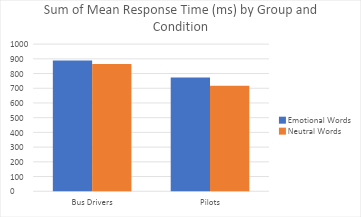
In the case of the 66 pilot applicants, a similar pattern was observed. Mean reaction time to emotional words in color naming was significantly longer (M = 773 ms, SD = 120 ms) than to neutral words (M = 717 ms, SD = 115 ms), t(65) = 29.9, p < .001. Most importantly, pilots showed quicker reaction times across the board than applicants for the bus driver position, indicating that piloting aircraft carries more cognitive demands and selection criteria. On the whole, pilots responded faster but showed an important delay in giving responses to the emotional words, as happened to applicants for the post of bus driver.
Calculated with Cohen’s d, the effect size for the difference in response times was large in each group of workers: bus drivers d = 1.51, pilots d = 1.27. The words’ emotional content gave substantial performance results. Moreover, large effect sizes enhance the practical significance of these findings and suggest that the emotional Stroop effect is really quite robust across different subgroups or population types in terms of varying cognitive control demands.
The within-group comparison further depicted that both the bus drivers and pilots had uniform evidence of interference in the case of emotional words for all ink colors used in the test. It is not dependent on color since the effect of emotional content on cognitive interference does not have any significant difference when it is exposed to different colors. The emotional content is dependent on color, and the effect of emotional content regarding cognitive interference is more of a general phenomenon affecting cognitive processing.
That said, these results serve to confirm the central hypothesis of the study: that emotional words in a Stroop task do show the high level of cognitive interference that is manifested through prolonged response times. The effect was somehow the same across extremely diversified occupational groups, but this effect reached statistical significance, meaning that the emotional stimuli have great power over general attentional processes.
Discussion
This, therefore, means that this experiment analyzed data of the Stroop test, and it shows that there is very strong evidence supporting the hypothesis put forward, which states that emotional words produce a great deal of cognitive interference, as evidenced by the relatively long response times of both bus drivers and pilots. This finding is well within the fairly large body of literature that accedes to the effects of emotionally salient stimuli on cognitive processing (Brunel et al., 2023). These results indicated that, although such professions do, in fact, place high cognitive control, emotional stimuli can still be elicited toward them in a measurable response-time delay.
This effect was observed in both groups, and seems to support that emotionally charged words attract attention more than neutral words, therefore causing an increase in cognitive load and interference. However, such cognitive distraction by emotional words, as stimuli usually takes over cognitive resources, due to their inherent relevance toward personal well-being and survival (Ogando, 2023). It seemed a likely explanation for such cognitive distraction by emotional words.
Besides, the findings of the Emotional Stroop effect are apparent and strong, in either the general or clinical population. Although pilots, in general, did show faster response times, which may reflect an indicator for high baseline levels of cognitive control likely due to the stringent selection in their profession, pilots were not immune to the disrupting effects of the emotional content. That too, well in line with the Yerkes-Dodson Law, which basically means that performance increases with physiological or mental arousal to a point, after which it falls off. Emotional words, no doubt, push beyond this fine point of optimal arousal, so they keep impairing performance even for very skilled persons. Emotional Stroop Test reaches more broadly than the traditional Stroop task and attains importance as a dominant instrument to investigate the impact of emotional factors over and above the influence of emotional factors on attentional control (Brunel et al., 2023). Therefore, more study mechanisms in the Emotional Stroop effect should focus on the difference of interindividual in emotion regulation and stress responding.
Conclusion
It can be concluded from these findings that emotional stimuli do, in fact, have an important and quantifiable influence on cognitive processing, utilizing the classic cognitive task of the Stroop effect. This especially goes a long way in highlighting the importance of the emotional components in tasks that demand high levels of cognitive control, hence paving the way for further exploration in emotion-cognition interactions.
Reference List
Brunel, J., Mathey, S., Colombani, S. and Delord, S., 2023. Modulation of attentional bias by hypnotic suggestion: experimental evidence from an emotional Stroop task. Cognition and Emotion, 37(3), pp.397-411.
Ogando, L.P., 2023. The Bilingual Mind and Emotional Brain: Evidence from the Emotional Stroop Task (Doctoral dissertation, Saint Peter’s University).
Ziaratnia, S., Sripian, P., Laohakangvalvit, T. and Sugaya, M., 2023, July. Comparison of Physiological Responses to Stroop Word Color Test and IAPS Stimulation. In International Conference on Human-Computer Interaction (pp. 211-222). Cham: Springer Nature Switzerland.
 write
write