In this aspect, delve into the core part of state repression against drug trafficking and the consequences in terms of narcoterrorism activity in Colombia. The study is based on a data trend analysis, particularly identifying patterns associated with narcoterrorism and those against those historical events. Although no specific indicators for government interventions can be black and white, the data is characteristic and meets the criteria of the observations. To accurately do this detailed and comprehensive analysis, the bi-monthly average is determined using the Global Terrorism Database (GTD). GTD (Global Terrorism Editing Database) is the best resource, covering the most essential information on over 200,000 terrorist activities. It decorates the description of such elements as the features, distribution in the geographical area, and outcomes of diverse terrorist incidents taking place worldwide; for instance, it provides detailed information about the Global Terrorism Database for the year 2022. This enormous set of data raises the credibility of the study. It permits the research to show in detail the evolution of narcoterrorism operations over the period from the beginning till now. The fact that GTD is used as the primary data source emphasizes that all efforts have been made toward reproaching the dependent variable systematically. After that, the foundation for the research is established, which is research that will be comprehensive and meaningful.
In my experience, the case study would be about Colombia to mix the unfolding of patterns between these variables. According to Johnson(2022), A rise in narcoterrorism is connected to the rise of the Medellin Cartel headed by Pablo Escobar. The cartel’s reign was described in terms of violence that was counted unprecedentedly at the moment of the bombings, assassinations, and kidnappings being focused on expanding its empire and weeding out competitors.
This was the end of the Medellin Cartel in the early 1990s, which instead facilitated the advent of other cartels, prominently the Cali Cartel, for whom the cycle of drug-related violence in Colombia would also continue. The Cartel Cali, less evidently violent, was compelling in dominating Colombian organized crime until the late 1990s when the Colombian government tore it down. The wee of Cali Cartel is a historical limelight on the decline of the narcoterrorism activity in Colombia, whereby drug trafficking exists and is perpetrated by smaller cartels.
A line graph showing analysis of Trends in Narcoterrorism Activity
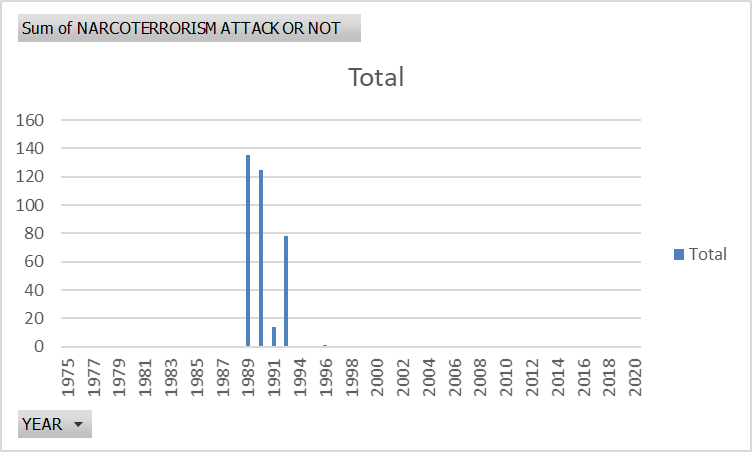
Line graph 1. Trends in Narcoterrorism Activity (Combined Score) Over Time
Line graph 1, shown here, on the attacks related to narcoterror in Colombia from 1975 to 2020, is an attempt to picture the total number of attacks during this time. The number of attacks is represented on the Y-axis, while the X-axis presents all years under review. Besides, one should remember that the graph has limitations; it excludes government interventions targeted at drug trafficking, terrorism financing, and other securing issues. However, the trend is clear when it comes to government and suppression as well. Undeniably, the spike in volunteering is concentrated toward the peak period from the late 80s to the early ’90s.
Narcoterrorism was on the rise in the 1988-1990 period in Colombia, mainly because of the Ecstasy boom and elite involvement in drug trafficking. The resurgence of the Medellin Cartel, led by Pablo Escobar, further aggravated the situation. According to a report by the United Nations Office on Drugs and Crime (UNODC), this epoch is marked out by a unique rise in the level of violence committed by drug trafficking networks, with the Medellin Cartel in the forever her position (UNODC, 2019). Pablo Escobar, who was known for a long time as “The king of coke,” was able to command and influence millions of people with the drug business that he had built and had, which spread outside the borders of Colombia. The cartel’s M.O. involving the use of force such as bombings, assassinations, and kidnapping to eliminate rivals, scare law enforcement agencies, and threaten authorities was a very usual way to conduct business in this region. The drug trafficking and narcoterrorism that ruled during Pablo Escobar’s life had and still have severe consequences in Colombian society until nowadays Hollywood movies that are quite well known nowadays are Nicolas Caro’s “Blow” and Mary Lambert’s movie about a natural person named Pablo Escobar: “Pablo Escobar.” Terror tactics of the Medellín Cartel raised rampant anxiety, eventually leading to lawlessness and a collapse of trust in the government. The long-term effect of such malevolence was not only an anarchic state of play but also a continuation of a violent cycle that acted as a sterile ground for further suffering for many years. Furthermore, its vast wealth caused it to penetrate different sectors of society, and as a result, it led to systematic corruption and immunity. Such malaise has been found eloquently in the reports from the UNODC, among others (2019). Consequently, the emergence of narcoterrorism was mainly caused and overlapped all the operations of large drug cartels such as the Medellín cartel, on the matchstick of that was the complex link between drug trafficking, violence, and politics in Colombia.
Besides the additional supporting environment factors, contextual things should be considered when looking at the graph’s result. For example, the Medellin Cartel might have developed to its fullest during this time owing to the multiple acts of violence it committed. As the example of the Colombian government going tough on the cartels in the early 1990s may show, the result may be reduced narcoterrorism activity afterward. Also, factors such as the evolution of the criminal behavior model changes in economic situations or the strategy of law enforcement may affect the patterns under observation.
Comparison with historical events
Investigations of the catastrophic events that engulfed Colombia in the 80s and 90s have shown drug cartels to have been the most dangerous faction of the nation, with the Medellín Cartel being directed by Pablo Escobar, who is undoubtedly one of the most well-known criminal leaders ever. Their operations, however, extended beyond borders, as they had already invaded the U.S. and other nations transporting Colombian cocaine while corruption and violence continued to remove polls within Colombia. The government of Colombia, in conjunction with foreign law enforcement agencies, embarked upon a comprehensive and rigorous campaign of attacks on the Medellin Cartel, which was already being seriously undermined by the mounting opposition inside and outside the country. These arrests of such type went hand in hand with the events that occurred in history by acting as the historical series of targeted operations at removing the structure of production, distribution, and influence of the cartel. Over time, the law enforcement agencies were getting close to seizing the assets and locking key rings of the cartel through coordinated operations, raids, arresting key cartel members, and seizing significant assets linked to their illicit activities. Extradition agreements with the United States have been instrumental in this since they have allowed the removal and prosecution abroad of the biggest names, like Pablo Escobar, from the drug trade. With this joint operation showcasing the government’s resolve and that of its allies in the conservation of the international community, the battle against drug cartels that had infiltrated every place in the country was propelled to a higher level. While it was difficult and frequently tantamount to bloodshed, diss was directed at the Medellín Cartel, symbolizing a significant victory in the fight against crime and the law and the cooperation among the international bodies responsible for combating crime networks.
Pablo Escobar’s arrest and death in 1993 marked a turning point in the major organized crime Columbian Medellín cartel. This event left the organization without solid leadership, leading to a disruption of its power to humbly coordinate large-scale violence and terror. Governmental actions not only intensified drug trafficking chaos in their cartel’s operations but also damaged financial networks and communication channels, setting a more complex situation for them to conduct acts of deadly violence jointly. With continued pressures coming in, the cartel committed to playing low-profile games with the goals of surviving and trying not to be seen as prominent as before through a decrease in bombings and assassinations. This trend is shown in the fact that there were significantly fewer murders carried out by drug traffickers during the period when the cartel was declining. It is tangible evidence that the confidence of the drug mafia to hold their violent actions and any illegal actions is being lost. The Colombian authorities succeeded in severing the cartel’s links, and that resulted in a decrease in the flow of drugs to the U.S. and a remarkable increase in security over there. This shows the profound influence of the Colombian government on the leadership, strategies, and personnel of the cartel.
Discussion of Government Interventions and Cartel Responses
What is more, the emphasis is placed on the interpretation of historical evidence that could be described as controversial, namely, the question of the covert actions of cartels, if they existed, and the response strategies against the governmental interventions of the oil producers. For example, when the Columbian government was dismantling the Medllín Cartel in the late 1980s and early 1990s, there was an apparent lack of both the descriptions of this and the courses of action taken (Global et al., 2022). Although the cartel is generally known to have faced severe pressure and hurdles and to have experienced certain strategic adjustments, the exact tactics remain a puzzle if followed during the period. Unlike the drug enforcement efforts which were committed by several countries and the assistance of the authorities, which included the Interpol and the Drug Enforcement Administration (DEA), the answers of the Medellín Cartel did not have an immediate effect on the historical records (McConnell, 2021). However, this indecisive evidence highlights the complex, secretive nature that often covers the workings of cartel operations, which are done in strata, whereby various sections are kept secret from each other and used to avoid law enforcement detection.
Based on this vagueness, numerous possible strategies and theories are achieved by considering the main patterns revealed through corrupt practice. Several tactics could involve progressive measures, talks, and semi-secret operations. As an instance of such reactions, cartels may retaliate by escalating violence with their rivals that are encroaching on the turfs left behind by the authorities or to assert dominance over the others. However, this pattern can be observed in escalating violence during collisions between cartels and authorities and in other activities in territory disputes (McConnell, 2021). Organized groups may even discuss and begin to negotiate with law enforcement or a rival gang to reduce the damage caused by a government impediment or to protect their colony. Among various negotiation techniques are reaching agreements, offering explanations, or entering collaboration to address hard-to-handle situations. The mafia can pass to work that will be hard to discover, like diversifying its unlawful activities, extending its original territory, or adopting clever screening methods to ensure they remain undetected.
Implications for government policies
With the “war on drugs” approximately 50 years ago, President Richard Nixon issued an “all-out offensive” against drugs, rating drugs as the most dangerous and making Colombia a major drug-producing country, it became a major drug-producing country (Marchiano, 2021). In the first place, during the mid-1970s, Colombia was the world’s leading supplier of marijuana transported through the Caribbean. Although at first, drug crime organizations concentrated on growing opium plants for heroin production, this soon changed into a cocaine case as the illicit market for this drug was one of the highest. Filling the power vacuum left by the demise of Pablo Escobar and the Medellin cartel, Colombian drug cartels, like the infamous Clan de Golfo, began to rise to power, making massive fortunes and gaining control over political space in the country.
According to Grover (2020), The Colombian government has implemented various strategies to combat drug trafficking, including the Aerial Spraying of Glyphosate by the Venezuelan government, which caused controversy because of the effect on the environment and the health of the population (and finally, in 2015, it was banned). Forced Eradication: Handbook removal exercises designed to remove cocaine plants from growers. Crop Substitution Programs: Facilitate the crop change process for the farmers. This is a means of substituting coca with legal crops.
Despite persistent efforts, these policies have not tackled the cultivation of the substance or traffic conduction in Colombia. According to Zuleta (2022), the nation not only remains the largest on the planet in terms of the amount of cocaine produced but also accounts for approximately 95% of the world’s supply, provided that it is the fifth country globally in terms of the number of consumed drugs. An estimated 1982 tons of cocaine had been transported the year the trafficking peaked in 2020.
Global Seizures and Colombia’s Role: Global confiscated cocaine markedly reached an epic level of 2,900 tons in 2020, and Colombia was in the vortex. Colombia ranked first with a 41% record of seizures of the drugs worldwide, the U.S. followed with an 11% record, and Ecuador considered half of it with 6.5% (Zuleta, 2022). Despite suppression, however, the retaliation against the cartel remains a persistent problem, marking a trend of ongoing violence and executions. On the other hand, cartel leaders’ capture seldom gives answers to the problems in the community. In some cases, that would trigger “armed strikes” from paramilitary groups, causing disorder and destruction for daily activities. Corruption in law enforcement, whether police or even else, affects drug enforcement strategy’s reverse impact since it leads to a state of impunity and undermines the performance of the authorities who are supposed to keep the peace.
Rethinking Approaches: Public officials should acknowledge the shortcomings of purist strategies of eradication and focus attention on the root causes of drug production/trafficking, such as social, economic, and community factors that keep the drug problem infiltrating our societies (Björnehed, 2004). Intelligence-Led Operations: Investment in intelligence collection and analysis is of high priority, primarily intended for targeting specific players or disorganizing the networks of criminals. Operational planning involving accurate information on hotspot allocation and reducing crime damage are essential requirements. International Cooperation: Since drug trafficking is a transnational phenomenon, cooperation with neighboring states is crucial for conducting coordinated actions and exchanging intelligence (Björnehed, 2004). Measuring Success: Furthermore, those functions that define the efficacy of the strike should be as the main criteria, namely the disruption of cartel operations, reduction in violence, and enhancement of community safety, should be prioritized. Adaptive Policies: Besides the apparent implementation of versatile policies, which would be re-evaluated directly after successful outcomes, policymakers should consider what had failed over the past interventions.
Limitations of The Study and Conclusion
Ensure that the study has overcome restrictions that may have affected its scope and outcomes; its limitations should acknowledge such constraints. Data demands present a critical issue, and data availability and quality substantially impact every stage of data analysis processes, from depth to data accuracy. Similarly, sample size and quality may have restricted the investigation of the context in an aspect that could have covered the scope of the problem discussed in the paper. Furthermore, the focus of the analysis must be well determined, or narrowing it down too much or too wide can affect the study’s potential to draw conclusions and its generalizability level. Here, it will be essential to discuss how the scarcity or the lack of time sometimes limits the researcher’s scope. Because of this, the significance of some variables or contexts related to the topic may have been missed.
One of the main tasks is to cover the integration of unscheduled results while elaborating the overall research, as it can lead to discovering ominous tendencies or specific variations you are not expecting during data processing. These most peculiar off-target findings supply crucial information that could either put to the test the current beliefs and theories or, on the contrary, trigger further questions and refinements of those. By integrating these unforeseen details into the analysis and discussion, researchers could go beyond the existing understanding of the phenomenon under study and be at the forefront of this area of knowledge advancement.
In conclusion, the study has come up with significant findings of how government attacks on bloody drug traffic and drug dealers affect the activity of narco-terrorists in Colombia. The qualitative investigation of these varied issues’ historical trends and other contextual factors has presented a complex issue dynamic with solid messages. Significant findings regarding the role of the drug cartels, such as the Medellin and Cali Cartels, in the spread of narcoterrorism, as well as the drawbacks of ambushes conducted by governments in stemming the driving factors of drug violence, will be dissected. Going forward, it is necessary to outline data limitations and choose carefully the range of examination so that the study process will be comprehensive and complete to arrive at proper conclusions. In addition, current research should keep looking for unforeseen discoveries and all kinds of other new things, which will aid in extending and deepening understanding of this timely subject matter and providing evidence-based policies to deal with this issue.
Bibliography
Björnehed, Emma. 2004. “Narco-Terrorism: The Merger of the War on Drugs and the War on Terror.” Global Crime 6 (3–4): 305–24. https://doi.org/10.1080/17440570500273440
Johnson, P. L. (2022). Narcommunication: The messaging, marketing, and murder of organized crime (Doctoral dissertation, City University of New York). Retrieved from https://search.proquest.com/openview/6c4be96e2f7cbe4a58353a0eb7ae712d/1?pq-origsite=gscholar&cbl=18750&diss=y
Global Terrorism Database. (2022). Global Terrorism Database. University of Maryland.
https://www.start.umd.edu/gtd/
Grover, J. A. (2020). COLOMBIA: US COUNTERNARCOTICS ASSISTANCE ACHIEVED SOME POSITIVE RESULTS, BUT THE STATE NEEDS TO REVIEW THE OVERALL US APPROACH. Current Politics and Economics of South and Central America, 13(4), 415-506. Retrieved from https://search.proquest.com/openview/5e0d6781d2d60b3da68fa2d06e863ab8/1?pq-origsite=gscholar&cbl=2034882
Marchiano, D. (2021). Fabulous Disaster: How Nixon’s War on Drugs Increased Drug Use and Expanded the Racial Divide (Doctoral dissertation, Adams State University). Retrieved from https://search.proquest.com/openview/42787462179e8e1e0014fa86722dc07b/1?pq-origsite=gscholar&cbl=18750&diss=y
McConnell, A. (2021). Operational Collaboration Between Drug Cartels and Terrorists and the Implications for Present and Future US Security (Doctoral dissertation, National American University).
United Nations Office on Drugs and Crime. (2019). United Nations office on drugs and crime.
Unodc.org. https://www.unodc.org/
Zuleta, D. L. (2022, October 4). The war on drugs: 50 years of death and failure. EL PAÍS English. https://english.elpais.com/international/2022-10-04/the-war-on-drugs-50-years-of-death-and-
 write
write