A demand management strategy is a process businesses use to predict and schedule how to fulfill customer service demand. It seeks a demand and supply curve in balance. A demand plan enhances customer service, assists with logistic planning, reduces extra storage costs, and increases production efficiency (Brau et al., 2023). We at Wild Dog Coffee are a small coffee shop with one operational office looking to build a new location to grow our boundaries. Our espresso patrons are catered to for breakfast, lunch, and supper. Our goal in expanding is to perform and evaluate lucrative analysis while being open to taking risks. Our study aims to present an analytical overview of implementing functional demand management to achieve profitable business development. Using sound techniques supported by the executed project, comments from the demand management plan will help with precise forecasting, inventory management, schedule analysis, and satisfying customer requests.
Impact of advertising on beverage demand
Raising knowledge of our beverages’ existence and the services we provide among prospective clients would probably increase demand. Furthermore, our monthly chart shows that our sales increase with monthly expenditure. For example, 987 and 1412 pounds of espresso beans were credited $1050 and $1500 during the first and second advertisement months, respectively. There was a $450 difference in dollars between the two months, and 425 beans were consumed. As a result, we spent more money at Wild Dog Coffee Company to market the coffee beans and drinks. Seven thousand two hundred eighty beans were processed for a total cost of $7800 during the six-month advertising period under consideration.
Nevertheless, in the third month of advertising, despite a $500 increase, the number of beans utilized fell by 412, resulting in a total drop of 30.1$ in beverages produced, defying the notion that raising money immediately increases the number of beverages produced. In addition, there was a notable 11.7% rise in bean consumption in the third month compared to the second, and there was no financial growth in the fifth and sixth advertising months. The amount of beans utilized increased by 5.8% to 1322 and 1399, respectively, despite the stagnation of advertising dollars.
Forecast using a linear regression model
Scalar response and explanatory variables are modeled using the linear regression technique. The amount of espresso beans used in our company’s seventh month of advertising may be predicted using linear regression, which makes predictions about one variable based on the value of another. Assuming that the desired dependency is linear, linear regression is based on the line that best matches the explanatory variable value ($1350) provided on the plot to determine the missing input value (Maulud & Abdulazeez, 2020). Because the quantity of beans used depends on the cost of advertising in a generally linear fashion, it is simpler to forecast the quantity of espresso coffee beans consumed in the seventh month by looking at the money spent, as indicated in the graph below and Appendix 1.
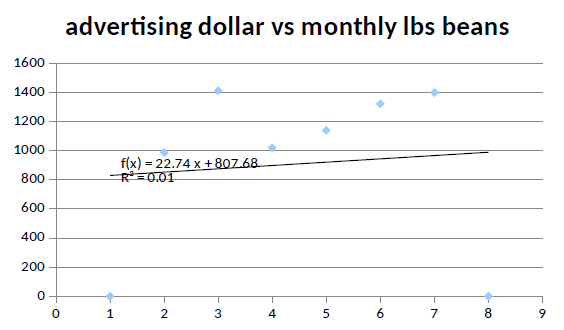
The response variable is the quantity of espresso beans, while the explanatory variable is the amount spent on advertising. We have an R-squared of 0.5231. The quantity of espresso beans may be calculated by multiplying the plot value by the $1350 advertising cost + 383.57. The transaction is anticipated to result in 1089.76 pounds of coffee beans. The monthly fluctuation in the number of espresso beans consumed is indicated by the R-squared value of 0.5231. By evaluating the advertising dollar spent, the quantitative demand for coffee is estimated using past data on dependent variables.
Interpretation of the results
This information indicates that one cup of Wild Dog Coffee Company coffee is made with 15 ounces of espresso beans. For the seventh month, the firm will make 1162 cups of coffee (17436.16/1.5 ounces), in line with the anticipated 17436.16 ounces. The business is open from 6 a.m. to 8 p.m., or 14 hours daily, on Saturday and Sunday. This indicates that Wild Dogs Coffee Company employees must make 39 cups daily (or 1162 cups per month/working days) during the seventh month. This equals 3 cups per hour (or 39 cups per day/working 14 hours per day). Since one cup of coffee takes 1.5 ounces of beans, the firm would need 585 ounces if the staff prepared 39 cups of coffee per day. This is comparable to 36.56 pounds of espresso daily, as 16 ounces equals one pound of beans.
However, the amount of beans used and the amount spent on advertising in the fifth and sixth months show otherwise, as changes in sales are only sometimes closely correlated with changes in advertising expenditures. On the other hand, if more espresso beans are used in the second month than in the first, it is feasible to identify a rise in coffee sold. Advertising expenses directly impact the business’s success (Skelly, 2021). It is not, however, the only element contributing to the increase in sales. For this reason, when it comes to the strategy and execution of starting a new business, a linear regression should not take center stage.
Inventory Management Analysis
The right amount of goods to have on hand in order to meet demand is ascertained with the use of an inventory analysis. It is crucial to managing Wild Dog Coffee Company’s entire present asset base. Inventory reduces storage and maintenance costs and helps to provide a seamless beverage preparation process (Mishra et al., 2021). The goal of implementing an inventory management analysis is to increase the profit margin while maintaining the stability of the beverage business. But Wild Dog Coffee Company is a little business with constrained storage and manufacturing capabilities. Coffee granules must thus be stored and maintained correctly because shipments are only produced once a week, seven days after an order is placed, and out-of-stock situations result in business closure. Furthermore, the company’s expansion and prosperity rely on the profitable sales of coffee prepared from espresso beans.
Characteristics of Continuous Inventory System
A perpetual system, often called a continuous inventory system, functions in real-time for the business based on the point of sale (POS) recorded by monitoring completed orders and inventory. This method examines and counts inventory, daily or weekly, after which the assets are changed and updated. A continuous inventory system makes inventory checking easier while preventing disruptions to the regular operations of beverage production. Since physical inventory can be compared with data recorded for accuracy using this approach, losses related to faults may be readily identified and corrected. However, because software implements the system, a malfunctioning piece of software creates the failure. Failures in the program’s operation might have a significant impact on the expansion of the business. It is also costly since it needs ongoing resources for planning, carrying out, or modifying. The system’s inefficiency may also result from overestimations or underestimates.
Characteristics of Periodic Inventory System
For accounting and reporting reasons, a periodic inventory system calculates the cost of products sold; the physical assessment is conducted at specific intervals. It is distinguished by calculating the inventory at the beginning of the term. The most significant benefit of a periodic inventory system is that it enables the business to document the current stock status. It makes it easier for the business to produce goods smoothly since daily stock movement records are unnecessary. Nevertheless, the procedure has its limits. For example, the corporation is not required to record and check inventories daily, which results in inadequate information control. Assume, secondly, that the Wild Dog Coffee Company wants a weekly stock record system with periodic inventory. When that happens, the store’s beans will all have been sold, and it will have to close while it waits for a fresh supply to arrive.
Scheduling Management
A business’s operations depend critically on creating and implementing the best personnel strategy. Before developing a workforce strategy, management must assess the workforce and determine the employees’ preferred days and hours. Employees will probably be less productive if scheduled without first receiving therapy. This might be a recipe for disaster. Following discussions about work plans with each employee, managers will have a far better grasp of their workforce and be able to start creating unique staffing options. The finished plan should be posted by management one month in advance to give reps time to set up their calendars properly and show up prepared for every action. The Wild Dog Coffee Company must know the two types of staff planning before creating a workforce strategy. The term “fixed schedule” refers to the central arrangement, which indicates that employees will put in the same days and hours of labor every week. The second plan involves having employees go through a set of workdays or hours on a rotating timetable. Put another way, each week, the employees switch out their shifts. There are advantages and disadvantages to fixed and rotating schedules, two types of plans that may be used to construct a successful staff plan. The final workforce plan is in Appendix 2 and 3.
Fixed Schedule
Advantages:
- Most reps find that the set shifts are ideal since they will always be aware of when they are working and when they are not.
- Easier to arrange
- Increased productivity
- A regular work schedule with few overtime hours will prevent management from having to pay excessive compensation, which can reduce operating expenses.
Disadvantages:
- Burnout among employees may result from working the same days and hours every week.
- Reduced teamwork among employees as a whole since everyone works the same shift and is surrounded by the same people
- It becomes more challenging to hire new employees because there is no flexibility in the schedule
Flexible Schedule
Advantages:
- Weekly shift rotation allows employees to avoid burnout
- Team members receive equal exposure to all aspects of the day, with abilities adjusted for each shift
- Full-time and part-time employees receive a unique weekly assignment that fosters collaboration
- A more flexible plan prevents representatives from becoming complacent.
Disadvantages:
- Employees may find it difficult to adjust to a pivoting move if this is the first time they have done so.
- This type of planning may require more work to organize and carry out.
- Most employees prefer fixed shifts, so a rotating shift might be too much for them to handle.
Recommendations
Our main goal at Wild Dog Coffee Company is to provide customers with the best espresso drinks possible. Our foundation’s primary goals are to create a warm and inviting atmosphere in our coffee shops, provide the best espresso, and deliver the best possible customer service. There is always room for improvement, and we can keep our business from lagging by steadfastly looking for new methods to satisfy our clients. Because managing inventory requires a well-structured framework, I recommend Wild Dog Coffee Company use the nonstop review (Q) framework. This kind of application is quite sophisticated and provides real-time stock-level information, making ordering modern items from suppliers easier. The Q framework will need an expensive program, but it will pay out in the long run since it maintains superior inventory control and routine record overhauls. In the unlikely event that the management group and employees must manually track inventory, there is a greater likelihood of errors negatively impacting the operation. Because the continual evaluation procedure is digitized, inclination principles are consolidated.
Lean thinking will increase productivity and eliminate waste, ultimately providing the client with more excellent value. There are two different scheduling approaches to take into account; however, using a fixed workforce plan is what I usually recommend. We already employ seven people, but to ensure efficiency, I recommend hiring a second part-time worker who is not a barista. This will cost an additional $500. Hiring an additional employee ensures that everyone works the maximum number of hours each week and prevents Wild Dog from having to pay excessive overtime because of the extra time worked. While the rotating schedule will have weekly personnel expenses of $2,480.00, the fixed plan will have weekly staffing costs of $2,433.50. Though there is little difference between the two situations, every penny matters when running a business. A further criticism of this approach is that more workers prefer set shifts and are less demanding of planning. Employees who know how many hours they work and have a weekly schedule will feel more in control of their mental health. Allowing workers to work the hours they choose will ensure they give their all every day, increasing productivity. Every approach will have advantages and disadvantages, but it is the management’s responsibility to choose the models to support daily operations.
Appendix



References
Brau, R., Aloysius, J. A., & Siemsen, E. (2023). Demand planning for the digital supply chain: Integrating human judgment and predictive analytics. Journal of Operations Management. https://doi.org/10.1002/joom.1257
Maulud, D., & Abdulazeez, A. M. (2020). A Review on Linear Regression Comprehensive in Machine Learning. Journal of Applied Science and Technology Trends, 1(4), 140–147. https://doi.org/10.38094/jastt1457
Mishra, U., Wu, J.-Z., & Sarkar, B. (2021). Optimum sustainable inventory management with backorder and deterioration under controllable carbon emissions. Journal of Cleaner Production, 279, 123699. https://doi.org/10.1016/j.jclepro.2020.123699
Skelly, R. R. S. & L. (2021, June 22). The Retail Profitability Paradox. MIT Sloan Management Review. https://sloanreview.mit.edu/article/the-retail-profitability-paradox/
Tiana Adelia, N. P. D., Saputra, M. D., & Nurhayanti, K. (2022). Budget Analysis as a Food and Beverage Cost Control Tool at The Westin Resort Nusa Dua Bali. Repositori Politeknik Negeri Bali. http://repository.pnb.ac.id/id/eprint/2561
 write
write