Introduction
Experts still argue that in entrepreneurship, females or males are usually more successful in founding new ventures, which is a critical point in the evolution of the entrepreneurial world that happens through time. The fact that gender plays a vital role in the career choices of businesses now competing in the changing market conditions has long been overlooked. Leadership styles can have plus and minus points for businesses irrespective of the sector, whether a software company or non-profit. This study considers innovation, penetration to the market and culture in the organization to comprehend the complex interconnections of the success of ventures and gender relations. This idea aims to identify valuable findings that may contribute to developing an optimistic organizational leadership diversity model via analyzing the influences of the leadership style of women and men on the business model considering the market condition. The overwhelming aim of this proposal is to give an insight into the highly complex and sensitive issues surrounding the role of gender in the success or failure of entrepreneurship. To that end, it shall focus on the leadership roles played by women and men in driving young companies’ success.
Problem Statement
Gender has been a critical component in leadership effectiveness and success of entrepreneurial ventures in recent times; as such, the debate on gender in leadership is alive and will still be significant in applied entrepreneurship. To this day, there are leadership gaps among businesses in specific sectors, even though there is immense gender equality. Even though researchers such as Kiefe et al. (2022) reveal that females run more profitable companies than males, obviously in unique circumstances, the overall and more complex reasons for such differences have yet to be determined. Besides, there has been very little research on the role of gender in the success of a business, considering the perspective of industries, business models and growth stages.
Understanding the link between gender diversity and entrepreneurship is problematic because studies take snapshots from a particular sector or lack real-world experiences. Innovation, market fit, financial performance, team relationships, and organizational culture are few; however, they are the other contributing factors to the success of a venture. To ensure that businesses emerge as a consequence of balanced and long-term enterprise growth, it is vital to understand how gender interweaves itself with these factors in creating new ventures. Furthermore, the issues related to gender inequality, such as perceptions of leadership effectiveness as well as the gender imbalance in entrepreneur chances to a large extent, are rooted in social norms, cultural stereotypes, and gender biases in institutions (Aparicio, 2020). Although there is more fluctuation than ever in the practical aspects of providing a platform for realising gender equality in venture leadership, diversity and inclusion in entrepreneurship cannot be overemphasized.
A detailed examination of the attributes of different genders, as well as leadership roles in diverse settings, is required for the elimination of the knowledge gaps. There may be methods to ensure the culture of a business is gender diversified, as well as to create an environment that supports all entrepreneurs, regardless of gender, which can be discovered by conducting research on the relation of organizational results, decision-making and leadership with gender. Therefore, this study examines the complex relationship between venture performance and gender to guide practices and policies that support fair chances and strengthen the sustainability of entrepreneurial ecosystems.
Literature Review
Gender Dynamics in Venture Performance and Investment Decision-Making
The theme of capital has not yet been covered in detail, but few scholars have made some attempts at the gender dynamics in venture performance and investment decision-making. As outlined in the research article by Hohl et al. (2021), gender inequality in venture capital and its impact on performance and investment decision-making processes is still present, and these gender inequalities in venture capital undoubtedly play a significant role in determining the growth and innovation of foresting. The scholars Gompers et al. (2022) raise the gender disparity in venture capital performances, identify the reasons for the disparity as the strong gender stereotype, and ponder the causes of the stereotype. The influence of investors tainted by biases and prejudices against female founders’ stories, as illustrated in the work of Kanze et al.(2020), is that these investors are penalizing female founders for a perceived lack of proper fit with their industry. The movie Colombo (2021) also shows the use of signals in new-venture financing, thus helping illustrate the investment decision-making process more deeply. The findings of Snellman and Solal (2023) hinge upon the gender of investors, how female startup owners perform with a higher likelihood of gender homophily, and the stigma surrounding competence for the startup’s financial sector.
Women investors reduce any bias and improve the level of finance towards female-led ventures, thus creating superiority and inclusiveness in male or female-led- businesses. Likewise, the stresses of entrepreneurial hustle and rapid decision-making are stressed by her et al. (2020), which are crucial in situating an entrepreneur in an uncertain environment and making the required players of the enterprise. However, these attitudes run on the gender framework, so it might be learned that challenging leadership or losing temerity are good examples of successful leadership behaviour. The work of Zhao et al. (2021) adds new insights. They relate old age and the success of entrepreneurial careers, which is a new and subtle detail in the existing understanding of venture performance. Certainly, Hebert (2023) sees the same pattern in the question of gender stereotypes’ impacts on funding for entrepreneurs, adding to the issue of the difficulty that these business owners encounter while trying to get funds and financing. According to Wells (2021), leaders matter, and women in business need to understand and utilize appropriate leadership strategies that transport them toward accomplishments and help their businesses succeed. Gender dynamics to the longstanding ventures and investments of decisions can be characterized through a holistic way that can promote more diversity and inclusiveness. Eventually, the entrepreneurial platform will be gender-independent.
Gender Dynamics in Entrepreneurial Funding and Support Networks
Despite the deficiency of in-depth information on the problem, the researchers are accessible on gender dynamics in startup finance and networks. It cannot be ignored, but despite their gender, every entrepreneur who wants to grow his/her business often experiences societal norms and prejudices, which can impact the way they see opportunities and resources (Gafni et al., 2021; Basit et al., 2020). Annually (in role congruity theory developed by Anglin et al., 2022, societal viewpoints about gender roles determine the whole crowdfunding dynamic of social projects. The probability of success for both male and female-initiated crowdfunding projects is likely to diminish because of the small effect of backers’ opinions that are developed based on gender stereotypes and society’s views of the roles that both men and women are meant to play. Avnimelech and Rechter (2023) underline the status of accelerators in holding females in the entrepreneurship track. Hoffman et al. (2021) suggest those accelerators are the sources, peer and mentor networks that determine venta one’s development existence.
However, those advancements still need to overcome the barriers transcended by Basit et al. (2020), who opined about Malaysian women entrepreneurs’ difficulties in resource availability and gender-related impediments. Shepherd et al. (2021) aid the research by debating how to create startups, personal support networks, and strategies for entrepreneurship. Gafni and colleagues (2021) have contributed to elucidating the gender dynamics by investing in wrong evaluations of creative entrepreneurs based on their gender. Rocha (2020) and Van Praag (2020) further explained the gender problems connected to the choice of entrepreneurial careers, particularly social influence, thus suggesting a solution for this gender gap in entrepreneurship. In their work, Ruiz-Molina and Colla (2023) are the ones to add some new insights to the discussion of gender variations in entrepreneurial orientation and achievement of franchisees from France, thus emphasizing that this social process is highly many-sided and complicated.
Research Gaps and Justification for the Study
The current literature on gender components in venture results, investment decision-making, and entrepreneurial funding and support systems provide some helpful guidance by illustrating the challenges and possibilities in the field for both genders. While the study shows significant progress, nonetheless, some noticeable areas remain to be studied more deeply beneath the extensive research in this field. Another blank spot refers to the subtly different presentation of masculinity and femininity in the themes of creating and managing new enterprises and their related success measures. However, scholars like Hohl et al. (2021) and Gompers et al. (2022) have mainly addressed large-scale trends and in-built prejudices just in this field of gender disparities in venture capital and the impact of diverse decision-making models in venture investments. However, research by Snellman & Solal (2023) and Zhao et al. (2021) hone in on the impact of gender roles on business performance; nevertheless, they lack explicit detail on the significant hindrances of men and women entrepreneurs in the execution of leadership and scaling of their ventures.
Furthermore, Barastudies of t et al. (2020) and Gorjani et al . (2021) studied women entrepreneurs’ accessibility problems and gender-related riders. Nonetheless, this study needs to systematically compare leadership styles, strategy approaches, and success trials of both men and women in the entrepreneurship field. Lastly, Rocha & Van Praag (2020) and Ruiz-Molina & Colla (2023), though they acknowledge the influence of gender on career choice in entrepreneurship and performance capabilities, primarily deal with the overall patterns and neglect the research into intricate processes through which gender modulates dynamics of leadership and creates outcomes of the business. Accordingly, this initiative seeks to fill the underlying information swaps on male vs female leadership competency to the success and sustainability of new ventures, supporting the birth of novel ideas in entrepreneurship.
Theoretical Framework
In this research, the relationship between gender and leadership effectiveness is explained as a venture and success in an entrepreneurship context. We shall use the critical theories that explain this relationship. The study is based on the Role Congruity Theory (RCT). It proposes that assumptions of society regarding what gender should do influence their judgments on the effectiveness of leaders in their positions and the appropriateness of individuals for leadership. Besides, the study invokes features of Social Identity Theory where the self-concept and identity of individuals are derived from their belonging to the groups with which they recognize themselves, like gender. Simultaneously, it exploits RCT. Unlocking the door, the researcher is about to start its theoretical investigation to capture the link between gender predispositions and career constraints and their effect on leadership capability and entrepreneurial success.
Role Congruity Theory was used in previous studies to provide insight into the phenomenon of gender in leadership, as well as the (dis)advantages perceived by leaders according to their gender. Taking Anglin et al. (2022) RCT studies as an example, gender stereotypes affect gendered perceptions of leadership competency by imposing expectations on the character in social venture crowdfunding. Additionally, on the subject of gender stereotypes impacting the timing of the financing decisions of entrepreneurs’ attractiveness, he demonstrates how cultural norms impact the availability of finance to both men and women entrepreneurs. This research studies the complex relations when gender and the results of venture and leadership are considered via running the ‘who-is-the-control group’ experiments.
Because of the several aspects accorded consideration, Social Identity Theory and Role Congruity Theory were chosen as the theories for my research work. To begin with, these theories constitute a very comprehensive framework for ambiguous relationships to exist among others. Whereas in gender and leadership, there was the previous study, little is known about how these factors affect working in different jobs and businesses. The study fills the gap between theories of gender and the entrepreneurial process by synthesizing various theories to see how gender controls business success and leadership effectiveness.
Proposed Conceptual Framework
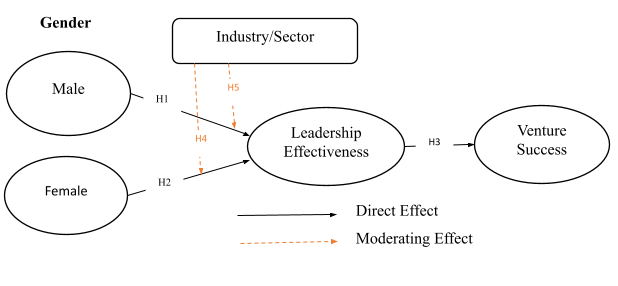
Considering the role of gender in ventures leading to success and effective leadership in entrepreneurship shows a linked web of interrelations that are far more complex than they might initially seem. As a moderating variable in the equation, a venture leader’s gender cannot be affected by leadership performance. If the leader is either a man or a woman, they have separate points of view, or they resolve their problems using different approaches. How those leaders direct projects and what kinds of groups they can inspire might be the type of leadership they may use. Characteristics considered the most evident indicators of good leadership, like taking risks, being empathetic, and remaining outspoken, are frequently affected by this gendered perspective.
Gender impacts ventures by effectively forming an intermediary mediation dependent on leadership, which is somehow a conductor of gender and venture success. Innovation, a good business valley, and wagering on the right decisions that are progressing activities rely significantly on leadership capability. While male and female leadership characteristics define how different organizations run, they also help most teams achieve their objectives, making the organization adaptable when the market condition changes. Besides, the leader’s degree of using their knowledge and expertise to motivate the followers and the desire to bring out the best in others greatly influence how the venture will fulfil the dream and sustain itself. Therefore, investigating gender-related traits of effective leadership provides an essential insight into how these gender attributes channel a firm’s performance with some implications on venture achievement.
References
Anglin, A. H., Courtney, C., & Allison, T. H. (2022). Venturing for others, subject to role expectations? A role congruity theory approach to social venture crowdfunding. Entrepreneurship Theory and Practice, 46(2), 421–448.
Aparicio, S., Turro, A., & Noguera, M. (2020). Entrepreneurship and intrapreneurship in social, sustainable, and economic development: Opportunities and challenges for future research. Sustainability, 12(21), 8958.
Avnimelech, G., & Rechter, E. (2023). How and why accelerators enhance female entrepreneurship. Research Policy, 52(2), 104669.
Basit, A., Hassan, Z., & Sethumadhavan, S. (2020). Entrepreneurial success: Key challenges Malaysian women entrepreneurs face in the 21st century. International Journal of Business and Management, 15(9), 122–138.
Colombo, O. (2021). The use of signals in new-venture financing: A review and research agenda. Journal of Management, 47(1), 237–259.
Fisher, G., Stevenson, R., Neubert, E., Burnell, D., & Kuratko, D. F. (2020). Entrepreneurial hustle: Navigating uncertainty and enrolling venture stakeholders through urgent and unorthodox action. Journal of Management Studies, 57(5), 1002-1036.
Gafni, H., Marom, D., Robb, A., & Sade, O. (2021). Gender dynamics in crowdfunding (Kickstarter): Evidence on entrepreneurs, backers, and taste-based discrimination. Review of Finance, 25(2), 235-274.
Gompers, P. A., Mukharlyamov, V., Weisburst, E., & Xuan, Y. (2022). Gender gaps in venture capital performance. Journal of Financial and Quantitative Analysis, 57(2), 485–513.
Hebert, C. (2023, July). Gender stereotypes and entrepreneur financing. In 10th Miami behavioral finance conference.
Hohl, L., Bican, P. M., Guderian, C. C., & Riar, F. J. (2021). Gender diversity affects investment decisions. The Journal of Entrepreneurship, 30(1), 134-152.
Kanze, D., Conley, M. A., Okimoto, T. G., Phillips, D. J., & Merluzzi, J. (2020). Evidence that investors penalize female founders for lack of industry fit. Science Advances, 6(48), eabd7664.
Kiefer, K., Heileman, M., & Pett, T. L. (2022). Does gender still matter? An examination of small business performance. Small Business Economics, 58(1), 141-167.
Rocha, V., & Van Praag, M. (2020). Mind the gap: The role of gender in entrepreneurial career choice and social influence by founders. Strategic Management Journal, 41(5), 841-866.
Ruiz-Molina, M. E., & Colla, E. (2023). Are There Gender Differences in Entrepreneurial Orientation and Performance? Evidence from French Franchisees. In Networks in International Business: Managing Cooperatives, Franchises and Alliances (pp. 201-220). Cham: Springer International Publishing.
Shepherd, D. A., Souitaris, V., & Gruber, M. (2021). Creating new ventures: A review and research agenda. Journal of Management, 47(1), 11–42.
Snellman, K., & Solal, I. (2023). Does investor gender matter for the success of female entrepreneurs? Gender homophily and the stigma of incompetence in entrepreneurial finance. Organization Science, 34(2), 680-699.
Wells, S. J. (2021). Women entrepreneurs: Developing leadership for success. Routledge.
Zhao, H., O’Connor, G., Wu, J., & Lumpkin, G. T. (2021). Age and entrepreneurial career success: A review and a meta-analysis. Journal of Business Venturing, 36(1), 106007.
 write
write