1.0 Introduction
1.1 Background
The influence of the instantaneous growth of the logistics sector in India has been profound. According to Malhotra and Mishra (2019), online shopping is acquiring acceleration due to which the logistics companies encounter or confront vigorous obstructions in conveyance, supply chain management, last-mile delivery, and so on. The e-commerce market of India has glimpsed phenomenal growth, which has been compelled by the changing consumer fondness and behaviours, ascending internet penetration, expanded usage of smartphones, and so on. Based on the perspective of Cano, Londoño-Pineda, and Rodas (2022), during the global COVID-19 pandemic, Indian retailers acclimated by consolidating the online retail channels, which has led the Indian retailers to a ripple in e-commerce adoption. Many e-commerce organisations like Amazon, Myntra, Snapdeal, Nykaa, Flipkart, and many others are adequately serving, operating, and growing in the active e-commerce terrain.
Nevertheless, Akther (2023) advocated that the wave in e-commerce sales is directly impacting logistic companies. Consumers are anticipating fast deliveries along with seamless return guidelines and procedures. On the other hand, Majumdar, Sarma, and Majumdar (2020) stated that the fast-evolving marketplace of the Indian logistic sector in e-commerce distribution encounters infrastructure constraints, metropolitan congestion, and disputes in distribution pipelines. Satisfying the anticipations of the customers for fast delivery services stays precedence for the logistic providers. The speedy rise or evolution of the Indian e-commerce business demands creative logistic solutions and explanations for fulfilling the needs and demands of the consumers and enriching the resilience, solidity, and efficiency of the supply chain operation.
1.2 Research Problem
The research problem circles evaluating the influence of the rapid development of e-commerce businesses in the Indian logistics sector. The Indian logistic businesses are confronting evolving obstructions and hindrances in the management of supply chain, last-mile delivery, transportation, and so on. The present research desires to probe the changes in the practices and conventions of the Indian logistic industry of e-commerce distribution, the current evolution rate of the e-commerce businesses, strategies or procedures to optimise the e-commerce distribution networks, along the barriers in the logistic sector. By handling all these aspects, the research strives to furnish adequate suggestions and practical insights for enriching operational stability and efficiency in the vibrant Indian e-commerce landscape.
1.3 Research Scope
1.3.1 Research Aim
This research aims to comprehend and examine the influence of the quick evolution of e-commerce businesses on the logistics sector in India. The research strives to investigate the directions, possibilities, and challenges for furnishing valuable insights for businesses to enrich the logistic operations in the evolving e-commerce terrain.
1.3.2 Research Questions and Objectives
| Research Questions | Research Objectives | Focus |
| What are the growth rates and the evolution tendencies of the e-commerce businesses in India? | To analyse the growth and evolution tendencies of the Indian e-commerce business along with the market share and trade volume of the e-commerce parties | Chapter-2 |
| How does the Indian logistic sector deal with the transformational shifts, adoption of new technologies, and supply chain optimisation? | To examine the transformational shifts, supply chain optimisation, and adoption of technology in the Indian logistic industry. | Chapter-2 |
| Who are the key stakeholders in the Indian logistic sector, and explain the procedures for route optimisation, inventory management, and consumer satisfaction? | To determine the key stakeholders in the logistic sector and procedures for route optimisation, inventory management, and consumer satisfaction. | Chapter-4 |
| What are the barriers in the Indian e-commerce businesses, and how can operational resilience in the logistics sector be optimised? | To identify the obstacles Indian e-commerce businesses face in logistic establishments and explore solutions for optimising operational resilience in the logistics sector. | Chapter-4 |
1.3.3 Deliverables
This research intends to furnish a thorough analysis of the market dimensions as well as growth inclinations of the Indian e-commerce sector. The research delves into the way that the logistic sector in the Indian e-commerce distribution is embracing transformational evolutions, technological adoption, and optimisation of the supply chain operations. Moreover, the research plans to furnish valuable insights by emphasising the obstacles and barriers confronted by logistic companies and delivering some actionable solutions for enriching operational stability and efficiency.
1.4 Outline of the Methodology
The present research is pursuing the positivist research philosophy, which underscores the practical observation of the subject matter. This research philosophy aids in assembling measurable data on market size, evolution rates, and logistic transformations. On the other hand, through the deductive research approach, the extant theories of the impact of e-commerce businesses in the Indian logistic sectors are analysed to validate the stakeholder plans and the Indian e-commerce development rate. The descriptive research design supports and underlines the present state of logistic conventions and delivers an acquaintance of logistic practices and tendencies in the e-commerce distribution networks (Gupta and Singh, 2021). Moreover, a qualitative research method permits probing the subjective understandings by evaluating the stakeholders’ challenges, philosophies, and systems. This research has concentrated on the primary data collection where an interview session was conducted among 10 participants who comprehend the Indian logistic sector and growth of the e-commerce businesses in India to assemble qualitative data. Through primary data collection, insights concerning operational complicatedness, logistic transformation, and stakeholder dynamics can be obtained. Thematic data analysis helps to extract compositions and patterns from the qualitative data compiled through the primary data collection procedure (Upadhyay et al., 2020). The blend of all these research methodologies confirms a holistic insight into the effect of e-commerce on the Indian logistic sector.
1.5 Research Rationale
1.5.1 Theoretical Rationale
The present research concentrates on the growth and development of e-commerce businesses in India and its influence on the Indian logistics sector. Many research studies have been performed and published concerning the idea of e-commerce businesses in India. However, this research is exceptional as it highlights the transformation shift of the Indian logistic sector. As Indian e-commerce businesses face multiple obstructions regarding transportation, supply chain disruption, changes in customer choices, and so on, this present research can be useful as it delivers solutions for optimising resilience and stability in the Indian logistic sector (Das, Kumar, and Rajak, 2020).
1.5.2 Practical Rationale
The present research is about analysing the growth and development of e-commerce businesses in India and their influence on the Indian logistics sector. The research has presented the growth rate and unprecedented obstructions of the Indian logistic sector in satisfying the delivery expectations of the customers, optimising supply chain operations, and handling inventory management (Sudan and Taggar, 2021). Through adequate analysis, this research delivers some recommendations that are practical for the Indian e-commerce business.
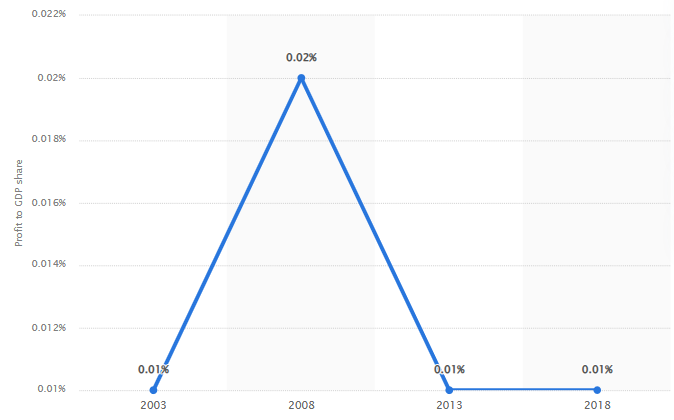
Figure 1: Profits from the logistic sector to the GDP of India
Source: (statista, 2023)
Based on the details in the above figure, in the year 2018, the logistics sector contributed to the Indian GDP by 0.01% (statista, 2023). By boosting the retail, manufacturing, and consumer goods sector, the Indian logistic sector is anticipated to accentuate its growth. This research is practical for the stakeholders as the context is vital for e-commerce businesses, logistic specialists, policymakers, and other stakeholders.
1.6 Research Significance
The present research on the impact or the influence of e-commerce growth and development on India’s logistics sector bears tremendous significance or importance in both practical and theoretical domains. At its core, the current research manages and addresses essential queries that reverberate with the stakeholders, who are mainly the policymakers, e-commerce businesses, industry professionals, customers, and so on. By solving the complex and convoluted relationship or association between e-commerce and logistics, the present research has contributed to informed and knowledgeable decision-making processes of the logistic sector of the Indian e-commerce business network and sustainable and endurable logistic industry conventions and practices (Mangla et al., 2019). Theoretical essences lie in bridging voids in existing research and literature, contextualising hypotheses such as Transaction Cost Economics and resource-based Hypothesis, and delivering practical proof specific to India. Practically, this research has offered actionable discernment for logistics establishments, allowing them to optimise diffusion networks, enrich functional efficiency, and satisfy growing consumer directions and demands. Moreover, comprehending stakeholder plans and obstructions and barriers facilitates partnership and invention within the Indian logistics ecosystem (Narayana Pati, and Padhi, 2019). Eventually, this research exceeds sheer scholarly exploration as it shapes the hereafter of logistics, economic evolution, and customer ventures in the active and vibrant e-commerce terrain.
1.7 Structure of the Dissertation
This research possesses multiple chapters to demonstrate the context, methodologies, and results of this research. The introduction chapter focuses on the research background aim, objectives, and research questions. This chapter delivers the significance of this research along with the research rationale. The literature review chapter consists of themes that are related to the present subject matter. The perspectives of other authors and researchers have been demonstrated in this chapter to understand their viewpoints. The methodology chapter possesses the methods and approaches that have been utilised to execute this research. This chapter possesses research philosophy, research approach, research design, research method, data collection, data analysis, and ethical consideration (Kubota et al., 2021). Moreover, the findings chapter focused on the outcomes of this research. It mainly concentrates on the data assembled through the primary data collection procedure. Furthermore, the conclusion chapter concludes this research by delivering a summary of the findings along with adequate recommendations.
1.8 Ethics in Business Research
Ethics in business research plays a key role in the evolution of e-commerce in India’s logistics sector. In this research, declared consent has been prioritised, which guarantees that the interview participants will voluntarily contribute their understanding and insights. Confidentiality and anonymity safeguard interviewees’ individualism and discreet details. Decreasing hazards and preventing harm is paramount, specifically when concerning functional obstructions encountered by logistics establishments (De Bakker, Rasche and Ponte, 2019). Moreover, transparency regarding associations and funding sources constructs belief. Additionally, sticking to ethical regulations confirms that the research advantages society declares decision-making and appreciates the liberation of stakeholders.
Reference
Akther, F., (2023). E-commerce in India: Trends, Hurdles, and Growth Opportunities. Formosa Journal of Science and Technology, 2(10), pp.2871-2880.Available at: https://doi.org/10.55927/fjst.v2i10.6152 (Accessed: 16 March 2024).
Cano, J.A., Londoño-Pineda, A. and Rodas, C., (2022). Sustainable logistics for e-commerce: A literature review and bibliometric analysis. Sustainability, 14(19), p.12247. Available at: https://doi.org/10.3390/su141912247 (Accessed: 16 March 2024).
Das, D., Kumar, R. and Rajak, M., (2020). Designing a reverse logistics network for an e-commerce firm: A case study. Operations and Supply Chain Management: An International Journal, 13(1), pp.48-63. Available at: http://doi.org/10.31387/oscm0400252 (Accessed: 17 March 2024).
De Bakker, F.G., Rasche, A. and Ponte, S., (2019). Multi-stakeholder initiatives on sustainability: A cross-disciplinary review and research agenda for business ethics. Business Ethics Quarterly, 29(3), pp.343-383. Available at: https://doi.org/10.1017/beq.2019.10 (Accessed: 18 March 2024).
Gupta, A. and Singh, R.K., (2021). Applications of emerging technologies in logistics sector for achieving circular economy goals during COVID-19 pandemic: analysis of critical success factors. International Journal of Logistics Research and Applications, pp.1-22.Available at: https://doi.org/10.1080/13675567.2021.1985095 (Accessed: 17 March 2024).
Kubota, F.I., Cauchick-Miguel, P.A., Tortorella, G. and Amorim, M., (2021). based thesis and dissertations: analysis of fundamental characteristics for achieving a robust structure. Production, 31, p.e20200100. Available at: https://doi.org/10.1590/0103-6513.20200100 (Accessed: 18 March 2024).
Majumdar, S.K., Sarma, A.P. and Majumdar, S., (2020). E-commerce and digital connectivity: unleashing the potential for greater India–ASEAN integration. Journal of Asian Economic Integration, 2(1), pp.62-81. Available at: https://doi.org/10.1177/2631684620910524 (Accessed: 16 March 2024).
Malhotra, G. and Mishra, S., (2019). Effect of economic growth on the logistics sector in India. Theoretical Economics Letters, 9(1), pp.210-222. Available at: https://doi.org/10.4236/tel.2019.91016 (Accessed: 16 March 2024).
Mangla, S.K., Sharma, Y.K., Patil, P.P., Yadav, G. and Xu, J., (2019). Logistics and distribution challenges to managing operations for corporate sustainability: study on leading Indian diary organisations. Journal of Cleaner Production, 238, p.117620. Available at: https://doi.org/10.1016/j.jclepro.2019.117620 (Accessed: 18 March 2024).
Narayana, S.A., Pati, R.K. and Padhi, S.S., (2019). Market dynamics and reverse logistics for sustainability in the Indian Pharmaceuticals industry. Journal of cleaner production, 208, pp.968-987. Available at: https://doi.org/10.1016/j.jclepro.2018.10.171 (Accessed: 18 March 2024).
statista (2023) India – logistics sector profits to GDP ratio 2018, Statista. Available at: https://www.statista.com/statistics/1051125/india-logistics-sector-profits-to-gdp-ratio/ (Accessed: 18 March 2024).
Sudan, T. and Taggar, R., (2021). Recovering supply chain disruptions in post-COVID-19 pandemic through transport intelligence and logistics systems: India’s experiences and policy options. Frontiers in future transportation, 2, p.660116.Available at: https://doi.org/10.3389/ffutr.2021.660116 (Accessed: 17 March 2024).
Upadhyay, C.K., Vasantha, G.A., Tiwari, V., Tiwari, V. and Pandiya, B., (2020). Strategic upturn of reverse logistics with Crowdshipping: Transportation explication for India. Transportation Research Procedia, 48, pp.247-259. Available at:https://doi.org/10.1016/j.trpro.2020.08.019 (Accessed: 17 March 2024).
 write
write