Abstract:
This paper utilizes economic principles to delve into the potential ramifications of recent developments on the demand, supply, and equilibrium price of substitute goods, particularly chicken and beef. Through a comprehensive examination of recent news articles such as “U.S. Chicken Prices to Fall at Last Thanks to Green Fuel Boom” and “U.S. Cattle Herd Shrinks to 73-Year-Low in Blow for Beef Lovers,” this analysis elucidates the impact of external factors on market dynamics and consumer behavior. By dissecting these events, we aim to gain insights into how changes in supply and demand for these products may alter pricing structures and consumer preferences, thereby providing a deeper understanding of the interplay between market forces and the availability of substitute goods.
Introduction:
Chicken and beef provide the most significant protein sources for human intake while also serving as dietary alternatives for all people around the globe. Since they are crucial in this regard, understanding what drives markets in terms of demand, supply, and equilibrium price is of great importance not only for producers and consumers but also for people creating policies (Freitas Jr, 2024). This paper will dive deep into the recent events within the chicken and beef markets in an attempt to understand the possible effects. Through analyzing shifts in supply and demand, as well as pricing structure movement, these analytical findings are expected to add precious knowledge to the shifting picture of these markets. In the end, the awareness of all those dependencies is the prerequisite for the stakeholders to make the right decisions and cope with the intricacy inherent to a poultry and beef industries.
Demand and Supply Analysis:
The recent news (articles), “Relief for cheap chicken in U.S. is finally here as green fuel drives down prices” and “U.S. vs. beef consumers – the bad news as reliable herds shrink to a 73-year-low,” highlight the indications of the substantial advancements in the poultry and beef markets. Using the economic concepts based on course materials we can decode theses issues to comprehend how they impact demand, supply, and equilibrium price.
First of all, in the case of beef, the decreasing number of cattle rolled into a reduction of potential output of beef. This fall in supply may be viewed as a result of such factors as droughts, feed cost hikes, and the alterations in ranching by changing essentially the five market determinants of supply (Freitas Jr et al., 2024). In accordance with the law of supply, demand for the same commodity falls, and equilibrium prices rise as well as the equilibrium quantities decrease. As supply curve shifts to the left it shows less quantity supplied at any particular price, thus leading to increased beef prices. Therefore, people substitute other items for the high priced products and then the quantity of items time consumed declines which is a price elasticity of demand.
However, this has broad implications in the soybeans processing industry for those that deal with poultry. Soybean meal being the major constituent of the chicken feed, the chicken farmers get the advantage of the lower costs of production due to the increase in its supply. This fall in production costs serves as a positive supply shock and leads to an increase in the amount of poultry supplied to the market (Mankiw & Taylor, 2023). The term of supply law indicates that an upward shift in supply pushes down the equilibrium price and increases the equilibrium quantity. So the supply curves whose right curves, the equilibrium price of poultry decreases and thus consumers get more affordable. The reduction in the price may in fact attract more consumer demand for poultry because the consumers respond to changes in prices. The concept of price elasticity of demand is illustrated.
In addition, a lowering of equilibrium quantity and price can also be done for more efficiency of the mentioned market. In an economically balanced market all prices are adjusted in order to keep the supply and demand equal, which creates economic equilibrium. However, external factors including government regulations and technological innovation will occasionally have an effect on the interference of market equilibrium (Ramsey et al., 2021). The weakening of cattle herd and its repercussions on beef supply are a good illustration of how changes in one market may have an impact on the equilibrium in another market and so the interconnectedness of markets within the larger economy.
Additionally, it is clear that market dynamics’ comprehension is essential for policymakers in implementing effective interventions. Government initiatives including subsidies and trade agreements are capable of changing the supply and demand dynamics in the poultry and beef markets. Policies such as providing support to sustainable farming practices or humanizing the impact that the climate change may have on them may assist the policymakers to stabilize the prices and continue the food availability for consumers.
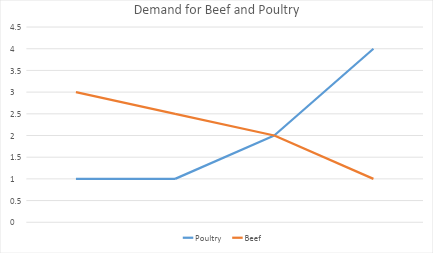
In conclusion, analysis of recent trends in poultry and beef commodities is about the complexity of supply, demand and equilibrium pricing dynamism. Livestock shrinking and green fuel boom’s effect on soybean brewing implicate not only soybean but also fuel sector. Knowing these flows and intricacies of the market is of great importance for key players as they make their way through the maze of the market. These players include producers, consumers and policymakers. The application of economic tools like supply and demand analysis, price elasticity, and market efficiency would help us to understand the causes of any shifts in the market equilibrium conditions. Moving ahead, the authorities shall evaluate these insights to come up with strategies for balancing the market and meet consumers’ demand for chicken and beef. In general, the study reinforces the need of a detailed perception of market dynamics when tackling the challenges and the opportunities of the poultry and beef business.
References
Freitas Jr, G. (2024). U.S. Cattle Herd Shrinks to 73-Year-Low in Blow for Beef Lovers. Bloomberg. https://www.bloomberg.com/news/articles/2024-01-31/us-beef-to-remain-expensive-as-herd-shrinks-to-73-year-low
Freitas Jr, G., Veloso, T., & Almeida, I. (2024). U.S. Chicken Prices to Fall at Last Thanks to Green Fuel Boom. Bloomberg. https://www.bloomberg.com/news/articles/2024-01-28/why-us-chicken-pork-prices-will-fall-when-soy-based-renewable-diesel-ramps-up
Mankiw, N. G., & Taylor, M. P. (2023). Economics (6th ed.). Andover Cengage Learning.
Ramsey, A. F., Goodwin, B. K., Hahn, W. F., & Holt, M. T. (2021). Impacts of COVID‐19 and Price Transmission in U.S. Meat Markets. Agricultural Economics. https://doi.org/10.1111/agec.12628
 write
write