Introduction
The Sustainable Development Goals (SDGs) that the United Nations adopted in 2015 set out an ambitiously interconnected global agenda with the main objective of securing a sustainable future for all. Goal 6 (see Figure 1), which is the target of “ensure availability and sustainable management of water and sanitation for all,” promulgates by 2030. Goal 6.1 commits to the realization of universal access to safe and affordable drinking water, while Goal 6.2 sets the objective of ensuring sustainable sanitation and hygiene services for all. This report appraises the current world status and progress towards these hugely relevant aims.
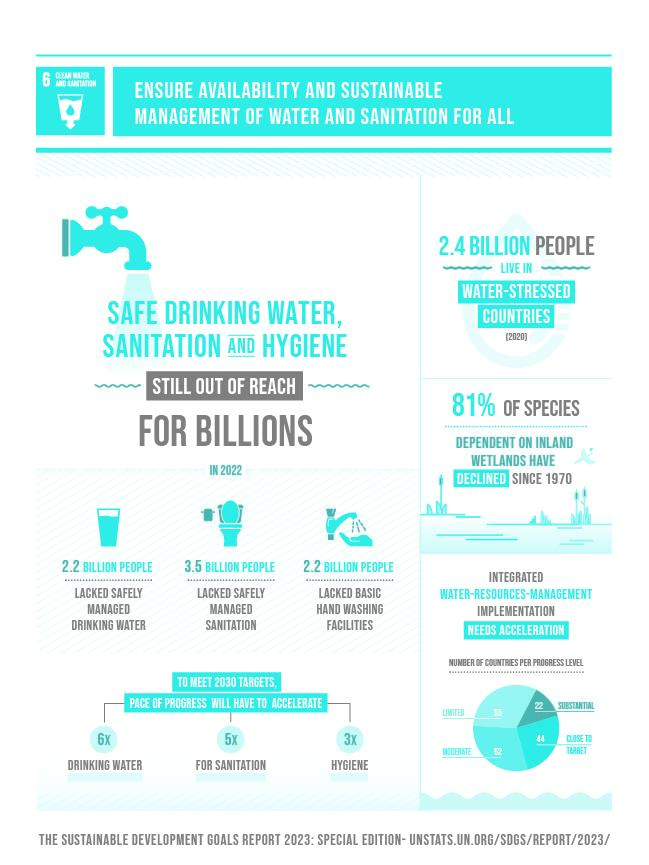
Figure 1: SDG 6 Overview
Background
Access to safe and clean sources of drinkable water and sanitation facilities are among the major indicators of public health. Lack of medical personnel, especially in less developed regions, is one of the elements causing infectious diseases spread, the high mortality rate among children, and lower life expectancy. The MDGs came before the SDGs, with the 2015 target of cutting down by half of the proportion without access to sustainable water sources and basic sanitation. Although the goal of supplying safe drinking water was met ahead of schedule, “improving” here did not mean that the water was being handled according to quality standards or easily manageable. Progress in the sanitation field could have been more active.
Progress Overview
SDG 6.1 (Drinking Water): The WHO/UNICEF Joint Monitoring Programme claims that only 74% of the global population, according to 2020, used ‘safely managed’ drinking water services, which means that the drinking water service is located on-site, accessible when needed, and without fecal and priority chemical contamination (Cronk et al., 2024). The difference between the regions with respect to access is huge, reaching 94-98% in Europe and North America against a mere 58% in sub-Saharan Africa. At a national level, coverage of safe drinking water according to the national standards is still below 40% in some African countries like Somalia and Ethiopia, according to the Afrobarometer surveys. The number of people without reliable access to clean and safe drinking water has risen over the years, reaching more than 2 billion people with the latest statistics as of 2023.
SDG 6.2 (Sanitation): Greater gaps exist for goal 6.2 as it was seen that only around 66% of the global population used safely managed sanitation services in 2020 (World Health Organization, 2021). This involves a household toilet that is not shared with others, in which human waste is safely removed either in situ or taken offsite to a treatment facility, along with a handwashing area with soap and water available. The progress has been the slowest in Sub-Saharan Africa, where an estimated 25% have access to safely managed sanitation, and over a quarter (26%) still practice open defecation (World Health Organization, 2021). Worldwide, recent figures indicate that 3.6 billion people do not have safely managed sanitation, creating endless cycles of diseases and malnutrition.
The debilitating consequences of unsanitary water, lack of proper sanitation, and poor hygiene are well brought out by several cholera pandemic situations in regions with poor water infrastructure. According to a 2016-2020 cholera epidemic in war-torn Yemen, there were over 1.2 million cases (Ng et al., 2020). Haiti had a separate outbreak in 2010 after the hurricane, where some cases were recorded among UN Peacekeepers, and over half a million people were suspected of cholera after the destruction of sanitation systems.
Whilst technologically innovations such as “smart hand pumps” that remotely monitor the rural water points provide potential for the expansion of access, sustainable finance to provide for the operations, maintenance and infrastructure still remains the primary bottleneck. This is indeed apparent even in village handpump non-functionality rates that are prone to be doubled when the payment systems are chaotic. Comprehensive new policies and WASH investments are called for, and water is one of the issues particularly highlighted by the latest Afrobarometer public surveys that took place in most of the nations on the continent.
Conclusion
Advancements from the past decade notwithstanding, the recent statistics show us that we are a long way from reaching the SDG 6 target of universal access to safely managed water and sanitation services by 2030. Currently, almost 25% of the world’s population needs the safest, cleanest drinking water of high quality and available when needed. The next larger group – nearly half of the world’s population – requires access to safe and decent sanitation and handwashing facilities that follow the basic standards. The situation is, however, the worst in developing countries of sub-Saharan Africa.
As such, the aforementioned continued prioritizing of policies, investments and development of modern technologies aimed at increasing access to WASH is not only a fundamental step towards the fulfillment of basic rights, but also towards tackling preventable infectious diseases, reducing malnutrition levels, ensuring longer lives and improving sustainable development across multiple interconnected dimensions including health, education, gender equality, poverty elimination, among others. There is an urgent need to regain the momentum and finally accomplish the SDG 6 transforming goal within the next few years of this critical decade.
References
Cronk, R., Tracy, J. W., & Bartram, J. (2024). The influence of seasonality and multiple water source use on household water service levels. Cleaner Water, 100012.
Ng, Q. X., De Deyn, M. L. Z. Q., Loke, W., & Yeo, W. S. (2020). Yemen’s cholera epidemic is a one health issue. Journal of Preventive Medicine and Public Health, 53(4), 289.
World Health Organization. (2021). Progress on household drinking water, sanitation, and hygiene 2000-2020: five years into the SDGs.
 write
write