Executive Summary:
The presentation exhibits Woolworths, a leading retail and supermarket company, from the point of view of the United Nations Sustainable Development Goals (UN SDGs). It has been designed to assess Woolworths as an SDG player, highlighting vital areas and figuring out what needs to be reformed (Berning, 2014). Employing a combination of both qualitative and quantitative methodologies, including primary research through surveys and interviews and secondary research through the examination of sustainability reports and financial statements, the study thus provides in-depth insights into the efforts of Woolworths towards sustainability.
The analysis results shall evaluate Woolworths’ accordance with the UN SDGs, showcasing the areas of success and those bringing improvement. The report plans to analyze Woolworths’ operations in both retail and supermarket by studying target areas and coming up with practical recommendations to support its green initiatives (Berning, 2014). From a broader perspective, the discussion section explains the implications of the findings, offering insights into the underlying reasons behind Woolworth’s performance, which can be used to develop strategies for improvement. This part compares and contrasts industry benchmarks and prior studies contextualizing Woolworth’s sustainability efforts into a broader corporate sustainability landscape, stimulating further discussions on sustainable business practices within the Retail and supermarket segments (Berning, 2014).
The report is an unequivocal analysis of Woolworths’ sustainability standing vis-a-vis the UN SDGs. While highlighting Woolworth’s accomplishments and the areas needing improvement, it intends to stir up positive windmills within the brand and make other industry players appreciate the importance of sustainability in their operations (Berning, 2014). Ultimately, the intention is to facilitate the all-round struggle for UN SDGs and build a more sustainable world for all stakeholders.
Introduction:
The retail sector, which is outstandingly represented by Woolworths, is continuously growing and innovating, and in this context, sustainability issues and corporate responsibility are making their way to the forefront. Woolworths adopts inspirational ways; thus, it stands out from the competitive business market as a recognized brand whose products and services are of a high standard while displaying concern for the environment and the community. Here, I review Woolworths’ performance across the retail sector, focusing on its objectives to be environmentally friendly, contribute to society, and work towards achieving the Sustainable Development Goals (SDGs).
Results & Findings:
Methodology
The data collection for this survey is all-encompassing and involves both primary and secondary research approaches. Primary data was passed through surveys and interviews with the Woolworths company, conducted directly with stakeholders such as employees, customers, and suppliers.
Further than conducting the primary research, the secondary research covered reading through different sources of existing data. The process included considerations of both Woolworths’ sustainability reports that uncover the self-reported sustainability performance, initiatives, and their impacts on the company’s operation. Moreover, an analysis of Woolworths’ fiscal performance indicates the financial elements of the company’s sustainability efforts, such as the investment in sustainability activities and the effect on its earnings. Besides, industry presses were surveyed to provide a more comprehensive view of retail and the eco-friendly retail sector. Tertiary research provided a background to contextualize the sustainability practices of Woolworths in this industry framework. As to which way it will change, it identified trends, best practices, and new trends.
This study utilized both primary and secondary research approaches as its central methodology to, through the results, ensure complete coverage of Woolworth’s sustainability level and its compatibility with the United Nations Sustainable Development Goals (UN SDGs). The multiple-pronged strategy used to gather information from different sources, including observation and data triangulation, strengthened the validity and dependability of the information and the analysis presented later in the report.
Performance of Woolworths in the Retail Sector
At its core, Woolworths’s goal in the supply chain is to decrease soil pollution and use eco-friendly agriculture. R856 million of excess food was given to charities, while the company also invested time, resources and technology into the system of Black farming via the Living Soils Community Learning Farm. Woolworths also continued the emphasis by working with schools and giving back to the community.
Woolworths Group has advanced by a significant margin regarding net-zero emission with a 16% reduction in Scope 1 and 2 of our current emissions compared to the 2019 baseline. Plans to source all our electricity from renewable sources by Woolworths continue to be at the centre stage. We were able to finance our first solar PV installation, and the electricity requirements will be catered for up to 40%. In electric vehicles (EVs), South Africans retailed first, and Woolworths commissioned 42 EVs that were enabled for online deliveries. While these will save approximately 400,000 tonnes of tailpipe carbon, every new passenger contacts us and shares their experience. In one of the noteworthy achievements, Woolworths notes an essential milestone in removing single-use plastic shopping bags. All Woolworths food market stores are plastic-shopping-bag-free, and all Woolworths Fashion, Beauty and Home stores will be moving away from plastic shopping bags in 2024.
Comparative Analysis of Woolworths’ Retail Sector Contribution to SDGs
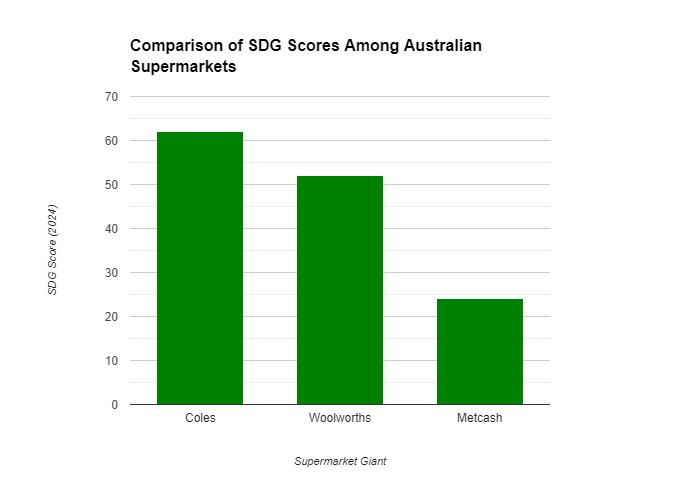
The comparison of sustainability in Australian supermarket chains Coles, Woolworths, and Metcash shows trends in their sustainability performance. Coles managed to be the leading supermarket chain in terms of contributing to the Sustainable Development Goals (SDG), achieving a score of 62, higher than the score of 55 that they had in 2020. On the other hand, Woolworths’ performance declined to a score of 52 from 56 last year (Home- Productivity Commission, n.d.). MetCash, with a score of 24, significantly jumped from its five the previous year. In addition, both Coles and Woolworths are the leading players contributing to SDG 1 (No Poverty) and SDG 2 (Zero Hunger) through the supply of food essentials.
Nevertheless, all three businesses have to deal with the industry controversy due to its exposure to alcohol sales. Woolworths has gambling exposure, and the Endeavour Group Ltd demerger has helped reduce this issue (Home- Productivity Commission, n.d.). The assessment shows how the sustainability practices are reshaping within the Australian supermarket sector and which areas can be improved further.
Discussion:
The discussion section will present an interpretation of the data, mentioning the areas in which Woolworths performed best and areas of improvement. It will then compare the results with the industry benchmarks and the previous studies, spotlighting the areas of improvement and demonstrating tactics through which Woolworths can boost its contribution towards the UN Sustainable Development Goals.
Performance of Woolworths in the Retail Sector
Goal 2 of the United Nations Sustainable Development Goals (SDGs), Zero Hunger, is a key focus area for Woolworths. The company is committed to addressing food insecurity and promoting sustainable agriculture practices within its supply chain. Woolworths endeavours to reduce food waste by implementing initiatives such as the Odd Bunch program, which offers imperfect fruits and vegetables at discounted prices to minimize waste. Additionally, Woolworths works closely with its suppliers to ensure responsible sourcing practices and support sustainable agricultural methods. By prioritizing efforts to reduce food waste and promote sustainable agriculture, Woolworths contributes to the global goal of eliminating hunger and ensuring food security. Through these initiatives, Woolworths demonstrates its commitment to sustainability and social responsibility while striving to impact communities and the environment positively.
As a retail business, Woolworths has demonstrated its aspiration to environmental consciousness about corporate sustainability in its retail operations. Woolworths, the top player in the retail sphere, has implemented several strategies that, among them, are reduced to mitigating environmental impact, heightening social obligation, and contributing to economic growth (Rezaei, 2019).
Woolworths has been involved in environment-saving activities relating to lowering emissions, producing less waste and environmentally friendly sourcing methods, among other green issues. One clear-cut example is that the company has invested in energy-efficient technologies, launched a recycling initiative and preferred sustainable products over others (Rezaei, 2019). Goal 7 of the United Nations Sustainable Development Goals (SDGs), Affordable Clean Energy, is a priority for Woolworths as the company continues to make significant strides towards its net zero carbon emissions goal. Woolworths has demonstrated commendable progress, with a decrease of 16% in Scope 1 and 2 carbon emissions against a 2019 baseline. Moreover, Woolworths is investing in renewable energy solutions, exemplified by its financing of solar PV installations at store locations. These installations are expected to contribute significantly to the company’s renewable energy goals, with one store set to generate up to 40% of its energy requirements through solar power.
Furthermore, Woolworths has introduced electric vehicles for online deliveries in South Africa, marking a significant milestone in sustainable transportation efforts and expected to yield substantial reductions in tailpipe carbon emissions. Woolworths underscores its commitment to promoting affordable, clean energy and reducing its carbon footprint through these initiatives. By providing alternative transportation options, employees can still get to work on time, minimise the congestion caused by tailbacks, and enhance the retail chain’s sense of socially responsible business conduct.
The retail operation of Woolworths has embraced social responsibility by creating a diverse, multicultural business environment, providing employees with fair wages, monitoring human rights violations, and giving back to the community (Rezaei, 2019). This enterprise has put in place various policies to ensure that diversity is well depicted in the workforce and supply chain, where everyone has the same chance of leadership. Besides, Woolworths organizes a wide range of community activities, including charitable giving, volunteering programs, non-profit initiatives, and partnerships that work for social impact and the well-being of society.
In economic terms, Woolworths’s economic standing is documented by the drag of financial stability and growth line. Besides portraying a clear commitment to the environment in which it operates, by incorporating sustainability into its business management, Woolworths has also brought about tremendous improvement in its brand reputation and customer loyalty, enhancing operational efficiency and profitability (Rezaei, 2019). In addition, Woolworths has gotten a head start in the retailing business by investing in sustainable procedures, which means they are innovators like everyone else and have set a precedent for other retailing companies’ environmental metrics.
In general, Woolworth’s performance in the retail industry presents the firm’s sustainability promotion as the main factor, along with creating value for the shareholders. To that effect, the firm articulates its sustainable development strategy through proactive and strategic measures geared towards integrating sustainability in retail operations (Rezaei, 2019). As such, Woolworths contributes to the achievement of the United Nations Sustainable Development Goals (UN SDGs) to foster a sustainable future for all.
Comparative Analysis of Woolworths’ Retail Sector Contribution to SDGs
The comparative analysis of Woolworths’s retail sector contribution towards the UN SDGs involves evaluating the company’s performance against a well-framed set of the other targets outlined in the SDGs. In its drive to act sustainably and responsibly, Woolworths sets a course for overcoming crucial global problems of poverty elimination, sustainable consumption and production, and climate change (Dwivedi et al., 2012).
- Poverty Alleviation and Decent Work: Woolworth’s effort to propound fair labour practices across its supply chain manifests the importance of SDG 1 (No Poverty) and SDG 8 (Decent Work and Economic Growth) (Dwivedi et al., 2012). Through fair pay, a safe working environment, and enhanced career advancement possibilities, Woolworths supports workers’ economic empowerment, which aims to eradicate poverty and inequality.
- Responsible Consumption and Production: The engagement of Woolworths about renewable sourcing, waste reduction and resource effectiveness commensurate with SDG 12, which is Responsible Consumption and Production (Dwivedi et al., 2012). By implementing projects such as sustainable farming, waste minimization, and innovative packaging, Woolworths aims to ensure that environmentally friendly conduct is practised and that sustainable consumption is promoted among consumers.
- Climate Action: Woolworths’s efforts towards the reduction of greenhouse gas emissions, as well as the use of renewable energy resources, serve the UN Sustainable Development Goal target 13 (Climate Action) (Dwivedi et al., 2012). Through its investments in energy-efficient technology, wind farms and optical power, and ambitious emission reduction targets, Woolworths is definitively staking a claim on the issue of climate change and the minimization of its impact.
- Community Engagement and Partnerships: The Community Engagement initiatives that Woolworths is undertaking and its partnerships with nonprofit organizations align directly with SDG 17 (Partnerships for the Goals). Via partnerships with NGOs, local communities and government agencies, particularly in dire social issues such as food insecurities, health and education, Woolworths develops social sustainability at the grassroots level (Dwivedi et al., 2012).
Combined Performance of Woolworths Across Industry Sectors
UN SDGs may have an impact on Woolworth’s performance in several broad areas, notwithstanding obstacles brought on by gaps in publicly available data and the difficulty of quantifying such impacts:
- Aligning with the UN Sustainable Development Goals (SDGs) can boost Woolworth’s brand reputation and draw customers who value sustainability highly in today’s increasingly socially and environmentally conscious consumer sector (Dwivedi et al., 2012). Woolworths can set itself apart and attract more customers by showcasing its commitment to SDGs like climate action (SDG 13) and responsible consumption and production (SDG 12).
- Woolworths can achieve long-term cost savings and efficiency by adopting sustainable practices supporting social and environmental objectives. Efforts such as cutting down on energy use, streamlining transportation routes, and implementing effective waste management systems can eventually lead to significant operational savings. (Dwivedi et al., 2012) Woolworths can boost profitability and achieve SDG 8—economic growth and resource efficiency—by investing in sustainable technologies and practices.
- Compliance and Risk Management: A few UN SDGs may become laws or industry standards, especially those concerning transparent supply chains and responsible sourcing. By upholding these standards, Woolworths can reduce non-compliance risk and guarantee moral business conduct (Rezaei, 2019). Woolworths can proactively manage environmental, social, and governance (ESG) risks and uphold stakeholder confidence by incorporating the Sustainable Development Goals (SDGs) into its risk management framework.
Despite these possible advantages, Woolworths needs help accurately assessing and disclosing its contributions to UN SDGs across all industry sectors. A thorough evaluation of the company’s performance needs to be improved by the need for SDG-specific data, making it challenging to quantify the organisation’s impact on specific goals (Rezaei, 2019). Moreover, tracking and attributing SDG-related outcomes is more difficult because supply chains and corporate operations are intricate and interwoven. Woolworths can take several proactive measures to address these issues and improve its performance following the UN SDGs.
- Better Data Gathering and Reporting: Woolworths should prioritize gathering and disclosing SDG-specific data in all industry sectors where it conducts business. To give stakeholders thorough insights into the company’s sustainability performance, standardized metrics and indicators may be created to track progress toward each goal and improve disclosure and transparency procedures (Rezaei, 2019).
- Collaboration and Stakeholder Engagement: Woolworths should interact with them to understand stakeholders’ expectations and priorities regarding sustainability and the SDGs. These stakeholders include suppliers, customers, regulators, and civil society organizations (Rezaei, 2019). By promoting cooperation and joint ventures, Woolworths can use the pooled knowledge and assets to tackle intricate sustainability issues and effect significant transformations throughout its supply chain.
- Integration of SDGs into Business Strategy: Woolworths should incorporate the Sustainable Development Goals (SDGs) into all aspects of its business strategy and decision-making procedures (Rezaei, 2019). Setting precise goals and objectives in line with pertinent SDGs, adding sustainability considerations to investment and procurement choices, and integrating SDGs into performance management and corporate governance frameworks are a few examples of how to do this.
- Woolworths should constantly work to enhance its sustainability performance and develop fresh ideas to take advantage of new opportunities and challenges. This might entail making R&D investments, implementing new technology, and investigating alternate business models that promote SDGs and foster resilience and growth in companies (Rezaei, 2019). As a result, even though evaluating Woolworth’s overall performance across all industry sectors concerning the UN Sustainable Development Goals presents difficulties, the business has the chance to strengthen its sustainability initiatives and favourably impact global objectives.
Woolworths can establish itself as a frontrunner in sustainable business practices and generate significant effects within and outside its operations by prioritizing data collection and reporting stakeholder engagement, strategic integration of SDGs, and continuous improvement (Dwivedi et al., 2012).
Recommendations
The recommendations below are put forth to improve sustainability efforts even further, taking into account the goals and progress that Woolworths Group has set for itself through 2025:
Improve Career Development Opportunities Constantly: Woolworths has made significant investments in its employee’s upskilling and capability planning, but more work is still required to establish fulfilling careers in retail (Home- Productivity Commission, n.d.). To do this, Woolworths should keep funding career development initiatives and employee training programs, making sure that every team member has the tools and resources needed to succeed in the retail industry.
- Put Team Wellbeing First: Woolworths should expand on its successes in fostering the overall well-being of its employees (Home- Productivity Commission, n.d.). This entails lowering the overall rate of recordable injuries, improving mental health care, and promoting a culture of well-being and safety. Employees physical and emotional well-being can be further supported by putting in place comprehensive health and wellness programs.
- Enhance Inclusivity and Diversity: Woolworths should continue to encourage equity and diversity at all organizational levels to maintain its status as a genuinely inclusive workplace. This entails maintaining equal opportunities for all workers and continuing programs to assist underrepresented groups such as refugees and Indigenous communities (Home- Productivity Commission, n.d.). Establishing employee resource groups and regular diversity and inclusion training can help promote an inclusive workplace culture.
- Accelerate Transition to Green Electricity: Woolworths needs to move as quickly as possible to switch all its operations to renewable energy sources to meet the 2025 goal of 100% green electricity (Home- Productivity Commission, n.d.). This can entail investing more in solar power installations, pursuing cutting-edge technology to lower carbon emissions, and funding more renewable energy initiatives.
- Encourage Sustainable Product Choices: Woolworths should keep giving customers access to healthier and sustainable product options as a top priority. This entails making more nutritious food options available, reducing packaging waste, and encouraging sustainable sourcing (Home-Productivity Commission, n.d.). Positive change can be further accelerated by working with suppliers to raise sustainability standards and launching consumer education programs.
- Woolworths should step up its efforts to ensure that by 2025, no food waste ends up in landfills. This will strengthen the management of food waste. To do this, robust food waste reduction plans must be implemented, along with partnerships for food rescue and investments in organic waste solutions (Home- Productivity Commission, n.d.). Reporting and tracking systems can be enhanced to track development and pinpoint improvement areas.
- Achieve Net Positive Carbon Emissions by 2050: Woolworths should increase efforts to reach carbon neutrality goals. To do this, thorough emission reduction plans must be implemented, as well as communication with suppliers to address emissions in the supply chain and investments in carbon offset initiatives (Home- -Productivity Commission, n.d.). Long-term sustainability objectives can be advanced with regular reporting and monitoring of carbon emissions.
- Encourage Good Impact on Consumers and Communities: Woolworths should stay true to its goal of positively influencing consumers and communities. This entails continuing assistance for philanthropic endeavours, relief efforts after natural disasters, and community coordination (Home- Productivity Commission, n.d.). Building trust and goodwill includes strengthening community engagement and being open about social impact initiatives. By prioritising these recommendations, Woolworths can solidify its leadership in sustainability within the retail industry and effect significant change in promoting a more sustainable future.
Conclusion
As evidenced by its performance in achieving several Sustainable Development Goals (SDGs), Woolworths, in summary, demonstrates a noteworthy commitment to sustainable development (Rezaei, 2019). Though tremendous progress has been made, there is still an opportunity for improvement in some areas. Improved transparency, increased stakeholder involvement, and innovation in sustainable practices are among the leading suggestions made to Woolworths. These steps strengthen Woolworths’s standing as a pioneer in sustainability and promote improvement throughout the company. Further research may also examine how Woolworth’s sustainability initiatives are perceived by customers and evaluate their long-term effects (Rezaei, 2019). Woolworths can improve its strategies to satisfy better changing sustainability expectations and preferences by learning more about the attitudes and behaviours of its customers. Ultimately, Woolworths can continue to significantly impact sustainable development and long-lasting positive effects in the communities it serves by actively interacting with stakeholders and constantly aiming for improvement.
References
Berning, A. (2014). Sustainable supply chain engagement in a retail environment: the case of Woolworths food suppliers (Doctoral dissertation, Stellenbosch: Stellenbosch University).
Dwivedi, A., Merrilees, B., Miller, D., & Herington, C. (2012). Brand, value and relationship equities and loyalty-intentions in the Australian supermarket industry. Journal of Retailing and Consumer Services, 19(5), 526-536.
Naidoo, M., & Gasparatos, A. (2023). Consumer worldviews and perspectives on environmental sustainability initiatives in the South African supermarket sector. Journal of Cleaner Production, 413, 137496.
Rezaei Vandchali, H. (2019). Managing relationships to improve sustainability in the supply chain network for Australian food retailers (Doctoral dissertation, University Of Tasmania).
(n.d.). Home. https://www.woolworthsgroup.com.au/content/dam/wwg/investors/reports/2022/full-year/Woolworths%20Group%20Sustainability%20Report%202022.pdf
(n.d.). Home – Productivity Commission. https://www.pc.gov.au/inquiries/completed/retail-industry/submissions/sub110-attachment.pdfThe 17 goals. (n.d.). Sustainable Development. https://sdgs.un.org/goals
(n.d.). Woolworths Holdings Limited. https://www.woolworthsholdings.co.za/wp-content/uploads/2023/09/2023-Good-Business-Journey-Report.pdf
Appendices
 write
write