Executive Summary
Communication behaviours in different businesses depend on the culture of the people. Cross-cultural communication plays a significant role in business operations. In India, body language, fashion, and food create an identity for the people, and this is reflected in the corporate world.
The business report provides distinctive features of Indian culture, identifying its central point and uniqueness. Through cross-cultural communication and distinctive Indian traditions such as fashion, body language, and food, the motives of this report are to show that culture is important in business communication.
Introduction
The present report investigates cross-cultural communication in global business operations through Indian culture. The primary aim of the report is to demonstrate how Indian culture manifests in the corporate world. Fashion in India is not only about dressing but also a reflection of societal norms and cultural identity. In business settings, dressing conservatively and modestly is seen as a sign of respect, and it highlights the benefits of understanding and following cultural norms. Additionally, Indian cuisines are important in business meetings and other networking events related to Indian culture. By looking at these traditions in Indian culture, the report will contribute a critical understanding that highlights cross-cultural factors in business communication. More importantly, the report intends to answer the following questions:
- How does fashion in India create a reflection of corporate cultural identity?
- How does Indian cuisine enhance corporate cultural identity?
- How does body language serve as an important form of communication in business?
Background
Culture is acquired through values and beliefs in a particular group. Communication is an important aspect of culture, as it applies to all facets of life. Business communication is important as it creates an understanding between parties. On the other hand, cross-cultural communication is important as it provides an understanding of how employees from different cultures speak, perceive the world, and communicate.
Their shared values and religious beliefs strongly guide Indians. Kalogiannidis (2020) argues that India is a relatively conservative society where respect for elders and hierarchy is important. Such values are seen in the corporate world and in business practices. Even though the younger generation is not as conservative as the older generation, traditions and conventions that govern communication and interactions are still adhered to.
In global trading between Indians and other cultures, understanding and respecting cultural practices and beliefs enhances communication and productivity. When communicating, the corporate space in India mainly uses the English language. () argues that communication with Indians can be direct and context-based. During business meetings and negotiations, a hierarchy has to be followed, where decisions are made from top senior management to low-ranking employees. This affects the way communication happens as information flows through the hierarchy.
Analysis
How does fashion in India create a reflection of corporate cultural identity?
Clothing and fashion choices are important in cultural contexts as they have symbolic meaning. Fashion in India is not only about dress code and fashion but also a reflection of societal norms and cultural identity. In India, certain colours and patterns hold significance when conveying messages about status. Men in corporate Indian set-ups can wear Indian formals at work. Indian formals for men include a light-coloured Kurta just below the knee or at knee length, and it can be paired with churidar, which gives a good compliment to an outfit.
On the other hand, women in corporate Indian space have a wide range of attire, and Indian fashion can easily be incorporated into the work set-up. One of the most common attires that can be worn is a saree. It is graceful and elegant and mostly worn to business meetings. The versatility of the dress allows it to be worn for a boardroom meeting, business lunches and dinner parties; however, it might not be appropriate for day-to-day office hours. Madlock et al. (2019) argue that some rules have to be adhered to when wearing a saree in a corporate Indian set-up. It cannot be transparent, bright and flashy. It should not be tied too low or high so that it gives a professional look. Wearing a saree is a form of business communication where women are viewed with femininity and respect.
Another popular garment is the salwar kameez, which covers the body completely, creating a slim silhouette. It is a good dress choice for day-to-day office hours and must be worn with a dupatta. Another fashion style that is incorporated as corporate attire is Indo-Western. It can be worn in boardroom meetings. It should be kept simple and paired with minimum accessories.
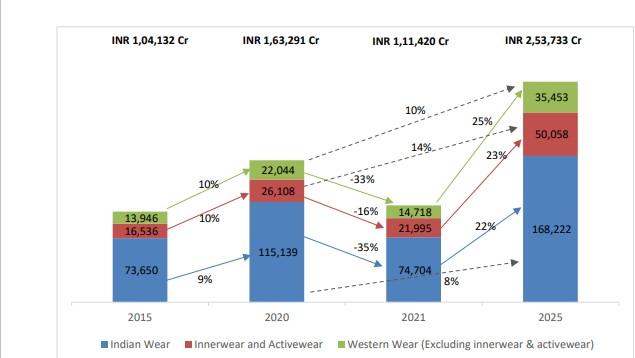
Figure 1:
Source: https://storage.sg.content-cdn.io/in-resources/6c57599f-2c43-4c82-806a-e07c3410f5d3/Images/userimages/investorinfo/IndianwearRetailIndustryReport100422VF.pdf
In Figure 1, the graph trend shows that many women are willing to wear more Indian attire compared to Western attire. By 2025, Indian attire will be the most worn attire by Indian women, showing that Indian fashion is getting more accepted even in the corporate world. Due to this, global employees who work in India might also adopt Indian fashion.
How does Indian cuisine enhance corporate cultural identity?
In India, food is an identity marker of class, religion and ethnicity. Indian cuisine is a more significant part of the country as it reflects regional and culinary heritage diversity. India has a broad range of culinary traditions, as there are different unique flavours and cooking styles. Different types of food are consumed in various set-ups. In the Indian corporate world, business lunches are mainly placed in restaurants at midday. Due to the hierarchical nature of India, the highest-ranking decision-maker will always get the best seat. During such lunches, the person who has made the invite pays the bill.
(Singh et al., 2019, the spicy nature of Indian food can make it difficult for non-Indians to enjoy meals, especially during cross-cultural global trade. If food is too spicy, (dahi), a natural form of yoghurt, can soften the spiciness. When conducting cross-cultural business meetings, spicy food is only sometimes served; a table will be provided with whole chillies served with onions and lemon. Different Indian cuisines such as crispy dosas, biryanis, chicken Tikka, tandoori and pan puri are often served at global Indian conferences.
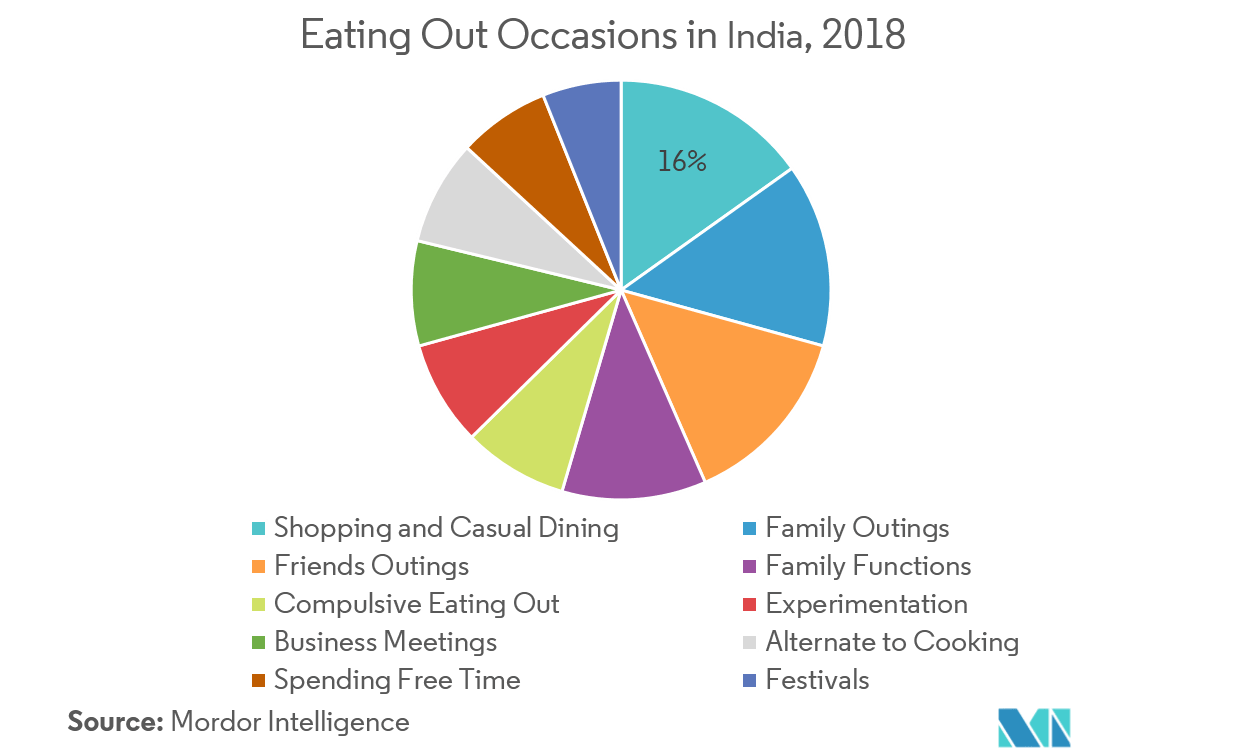
Figure 2
Source: https://www.mordorintelligence.com/industry-reports/india-foodservice-market
In Figure 2, it is evident that there are different reasons for dining out in Indian culture. The graph shows that there is a 12% likeliness of people dining out to conduct business meetings. Therefore, by embracing traditional Indian cuisine, businesses can create a conducive environment and promote connections over shared meals, hence facilitating partnership and collaboration opportunities.
How does body language serve as an important form of communication in business?
Body language is an important form of communication in India, expressing attentiveness, warmth, and respect. The communication style in Indian culture is polite and indirect. Simple gestures such as head nods carry great significance, symbolizing the acknowledgement and humility of the other person. When refuting something, direct refusals such as no are considered harsh and can lead to hostility and aggression. Words such as maybe or “I’ll do my best” are used indirectly to say no. (Naghavi & Mubarak, 2018), says that silence is also used as a form of communication. Remaining silent in a situation is a form of saying no.
Additionally, non-verbal communication is also important in corporate culture. Understanding the concept of personal space and avoiding intrusive gestures can promote positive interactions and help avoid misunderstandings. Kalogiannidis (2020) says Indians prefer less body contact and only touch when necessary. Unlike in Western culture, having less eye contact is preferred and giving direct eye contact is considered rude.
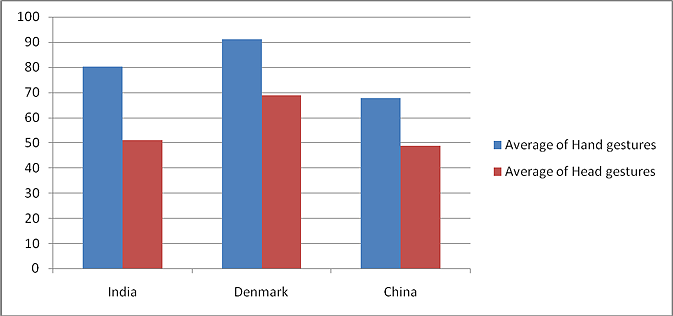
Figure 3
Source: https://www.ijdesign.org/index.php/IJDesign/article/view/313/164
As seen in Figure three, in comparison to Denmark and China, Indians use more hand gestures than head gestures. The results from this graph show that Indians are not very direct, and the use of hand gestures emphasizes communication. Also, it increases sensitivity as they prefer indirect forms of communication. Therefore, to promote trust among Indian co-workers, adopting a respectful posture and being less direct increases trust.
Conclusion and Recommendations
In conclusion, Indian culture influences corporate culture through aspects such as fashion, cuisine, and body language. In the cross-cultural corporate world, foreigners must understand how Indian culture manifests among employees. The potential limitation of the analysis section is recognizing that some cultural practices might need to be more effective in cross-cultural communication in global business communication. In particular, the type of communication in an idea might not be ideal for accomplishing tasks as it is very indirect, which is not an effective way of communication. Areas for further research to enhance the exploration of this business report topic include Indians’ acceptance of dress codes in the global business world and their form of communication. To allow cross-cultural communication in business operations, the following report recommends;
- Other cultures should embrace the complexities of Indian culture for effective business partnerships and build lasting relationships.
- I am learning about fashion, food and communication styles among Indian partners to enhance business communication.
References
Kalogiannidis, S. (2020). Impact of effective business communication on employee performance. European Journal of Business and Management Research, 5(6). https://doi.org/10.24018/ejbmr.2020.5.6.631
Madlock, P. E., & Clubbs, B. H. (2019). The influence of supervisors’ use of motivating language in organizations located in India. International Journal of Business Communication, 232948841983559. https://doi.org/10.1177/2329488419835599
Ranavaade, V. P. (2021, October 16). “DECOLONIZING FASHION IS WORK IN P r o g R e s s : INDIA STORY.”https://archives.palarch.nl/index.php/jae/article/view/10246
Singh, R. K., Luthra, S., Mangla, S. K., & Uniyal, S. (2019). Information and communication technology applications for sustainable growth of SMEs in the Indian food industry. Resources, Conservation and Recycling, 147, 10–18. https://doi.org/10.1016/j.resconrec.2019.04.014
Naghavi, N., & Mubarak, M. S. (2018). Negotiating with Managers from South Asia: India, Sri Lanka, and Bangladesh. In Springer eBooks (pp. 487–514). https://doi.org/10.1007/978-3-030-00277-0_21
 write
write