1.0 Introduction
1.1 Background and Significance of the Research
Chronic pain affects a substantial portion of the global population, causing physical limitations, emotional distress, and diminished quality of life (Yang & Chan, 2019). This topic was chosen because, despite advances in medical care, many individuals with chronic pain continue to experience little relief, highlighting the critical need for alternative and complementary therapies to address this complex issue. Mindfulness meditation has emerged as a promising approach for chronic pain management, garnering significant attention in recent years. The practice involves cultivating present-moment awareness and accepting one’s bodily and emotional experiences without judgment (Zorn et al., 2020). Numerous studies have demonstrated the effectiveness of mindfulness meditation in reducing chronic pain (Williams et al., 2022). Interventions such as mindfulness-based stress reduction (MBSR) and mindfulness-based cognitive therapy (MBCT) have shown potential in treating conditions like fibromyalgia, low back pain, and pain experienced by veterans (Pardos-Gascón et al., 2020).
The significance of studying mindfulness meditation for chronic pain lies in the potential mechanisms underlying its pain-relieving effects. These include increased parasympathetic nervous system activity, decoupling of sensory and affective aspects of pain, and improved self-regulation of nociceptive gating mechanisms (Riegner, 2022). Additionally, mindfulness meditation has been associated with reductions in pain-related anxiety, depression, stress and improvements in pain duration and severity (Cayoun et al., 2020). Given the promising quantitative evidence supporting the use of mindfulness meditation for chronic pain management, there is a growing need to understand the experiences and perspectives of individuals who have undergone mindfulness-based interventions for their chronic pain conditions. Qualitative research can provide invaluable insights into the subjective experiences, barriers, and facilitating factors encountered by individuals engaging in mindfulness practices for chronic pain relief. Such insights can inform the development and refinement of mindfulness-based interventions, ultimately improving their effectiveness and accessibility for individuals suffering from chronic pain.
1.3 Purpose of the Study and Research Questions
A qualitative study examines the lived experiences and views of chronic pain patients who have completed mindfulness-based therapies. The study explores these therapies’ perceived benefits, obstacles, facilitators, and personal and contextual factors that affect their efficacy.
Central Research Question:
How do individuals with chronic pain experience and perceive the process of participating in mindfulness-based interventions for pain management?
Sub-Questions:
- What are mindfulness-based interventions’ perceived benefits and challenges for chronic pain management?
- How do personal and contextual factors influence the experiences and outcomes of mindfulness-based interventions for chronic pain management?
- What are the facilitators and barriers to engaging with and adhering to mindfulness-based practices for chronic pain management?
2.0 Literature Review
The literature on the efficacy of mindfulness meditation in reducing chronic pain can be organized into several key themes, including mindfulness-based interventions, potential mechanisms of pain relief, and applications across various chronic pain conditions.
2.1 Mindfulness-Based Interventions for Chronic Pain
Mindfulness-based treatments (MBIs) for chronic pain management have been studied extensively. A prominent approach is the Mindfulness-Based Stress Reduction (MBSR) program developed by Jon Kabat-Zinn. This 8-week program promotes present-moment awareness and acceptance through mindfulness, psychoeducation, and group discussions (Pardos-Gascón et al., 2020). Pardos-Gascón et al. (2020) researched and evaluated randomized clinical trials to compare MBIs, including MBSR, to CBT for chronic pain problems. The review indicated that MBIs were better than standard care for fibromyalgia, low back pain, headache/migraine, and non-specific chronic pain. However, MBI-CBT comparisons were restricted.
A systematic study by Barceló-Soler et al. (2023) examined home-practice meditation adherence in chronic pain MBI patients. This review thoroughly searched and analyzed quantitative adherence and outcome studies. The authors discovered that MBSR and MBCT regimens had low home practice adherence. However, most research found strong links between home practice and good health.
2.2 Potential Mechanisms of Mindfulness-Based Pain Relief
Some experiments have discovered the nature of mindfulness-based pain relief and are elucidating the neurophysiological and psychologic processes involved.
Adler-Neal et al. (2020) carried out a (randomized controlled) trial to measure the possible role of heart rate variability, commonly regarded as an indicator of the functioning of the parasympathetic nervous system, in mindfulness-based persistent (pain relief). The research employed both psychophysical pain and HRV to get some understanding touching on the association between meditation and pain responses.
Zorn et al., (2020) used mixed-methods strategy which involved pain perception experiments and self-report measures to investigate the role of mindfulness meditation in disconnecting sensory and affective parts of pain. The study involved not only novices but also yoga experts, indicating the effect of yoga on pain experience due to their expertise.
In another study, Riegner et al., (2022) conducted cognitive studies utilizing functional magnetic resonance imaging (fMRI) and psychophysical pain testing to explore the underlying neural connectivity that drives mindfulness-based pain relief. The current study sought spatiotemporal interregional interactivity for the functional associations of painless mindfulness using whole-brain analyses and seed-to-seed connectivity analyses.
2.3 Applications in Chronic Pain Conditions
Some chronic pain problems have shown encouraging benefits with mindfulness-based therapies. Pardos-Gascón et al., (2020) observed that MBSR improved fibromyalgia symptoms better than usual care and Fibroqol. The multicenter Pardos-Gascón et al. (2021) study indicated that MBCT improved pain intensity, mental quality of life, depression, self-efficacy, and sleep disruptions in chronic pain patients, including fibromyalgia.
Lino et al. (2021) did a quasi-randomized controlled pilot trial on Mindfulness-Based Pain Therapy for persistent low back pain. Compared to the control group, the MBPT group showed significant reductions in pain intensity, quality of life, pain impairment, depression, and pain catastrophizing.
In a randomized clinical trial, Williams et al. (2022) examined hypnosis, mindfulness meditation, and active education for chronic pain in veterans. Hypnosis and mindfulness meditation reduced pain intensity, pain interference, and depressive symptoms at 3- and six months post-treatment more than the education control.
Due to the time commitment of typical MBIs, researchers have investigated the efficacy of shortened mindfulness programs for chronic pain management. Brintz et al. (2020) tested a 4-week MBSR-adapted pain management mindfulness program. The reduced program was practicable and acceptable and dramatically improved pain intensity, pain interference, depressive symptoms, positive affect, well-being, and sleep disturbance.
Shortened mindfulness practice for pain management has been studied due to the long-term disposition of traditional MBIs, which makes them inaccessible. MBSR-adapted pain management intervention by Brintz et al. (2020) was tested for four weeks. They established that the treatment modality was as good as a complete-blown program in the short treatment and was associated with a considerable improvement in the intensity of pain, interference of pain, symptoms of depression, affect, well-being, and sleep disturbance.
3.0 Methodology
3.1 Method
The primary variables of interest for this study are participants’ lived experiences and perspectives (dependent variable) regarding mindfulness-based interventions (independent variable) for chronic pain management. These variables will be explored through in-depth interviews and analyzed to identify common themes, patterns, and meanings. This phenomenological study will examine mindfulness-based chronic pain treatment interventions in participants’ lives and views. The philosophy and practice of phenology seek to understand human experiences and how people interpret their lives (Creswell & Poth, 2018).
The phenomenological technique is ideal for this study because it allows for an in-depth analysis of mindfulness-based chronic pain treatment strategies’ subjective experiences and views. This approach can reveal these interventions’ perceived benefits, challenges, facilitators, and the personal and contextual factors that affect their outcomes by engaging with participants and collecting rich, descriptive accounts of their experiences.
The following research questions will guide the study:
- How do individuals with chronic pain experience and perceive the process of participating in mindfulness-based interventions for pain management?
Sub-Questions:
- What are mindfulness-based interventions’ perceived benefits and challenges for chronic pain management?
- How do personal and contextual factors influence the experiences and outcomes of mindfulness-based interventions for chronic pain management?
- What are the facilitators and barriers to engaging with and adhering to mindfulness-based practices for chronic pain management?
3.2 Population and Sample
The participant group will be composed of adults (18 years and older) who have been diagnosed with chronic pain and who, in the last two years, have been treated that way by a mindfulness-based intervention, such as MBSR or MBCT, for pain management. Participants will be enrolled in various healthcare settings, mainly pain clinics, rehabilitation centers, and mindfulness-based therapy institutes. Participants will be recruited with permission, granting the necessary sampling techniques, such as snowball and criterion sampling, to be used (Creswell & Poth, 2018). The recruitment will be done with the GPs and therapists whose expertise is mindfulness-based therapy and whose patients meet the inclusion criteria. Furthermore, they will bring flyers and advertisements to target people who have once participated in mindfulness-related activities for pain management. Before recruiting participants, appropriate permissions and approvals will be obtained from relevant institutional review boards (IRBs) and healthcare organizations. Informed consent procedures will be followed to ensure that participants understand the study’s purpose, risks, and benefits, as well as their rights to confidentiality and voluntary participation.
3.3 Data Collection
This study’s primary data collection tool will be semi-structured, in-depth interviews (Adeoye‐Olatunde & Olenik, 2021). An interview guide will be developed to explore the research questions and gather detailed descriptions of participants’ experiences and perspectives. The interviews will be audio-recorded with the participant’s consent and transcribed verbatim for analysis.
3.4 Ethical Considerations
This research will comply with the rigorous ethical requirements set for protecting the human nature and human dignity of participants. All the participants will be informed about their rights as they are at the center of this research. Measures will be taken to ensure the safety of their data is guaranteed and to keep the student participants’ identity confidential. It is worth noting that the participants can leave the study without any negative consequences (Dankar et al., 2019). The project will follow ethical guidelines and the Belmont Report, which is included in the guidelines and principles (Nagai et al., 2022).
3.5 Data Analysis Plan
The data analysis will follow a phenomenological approach involving the following steps:
- Horizontalization: Identifying key quotes from interview transcripts to understand participants’ perspectives.
- Clustering and Thematic Analysis: Identify core themes from participants’ experiences by clustering critical statements.
- Creating textural and structural descriptions: Capturing participants’ “what” and exploring “how” and contextual elements.
- Composite Description: Combining textural and structural descriptions to capture the phenomenon’s essence.
The data analysis process will be iterative and involve constant comparison and refinement of themes as new data are collected and analyzed. Qualitative data analysis software, such as NVivo, may facilitate the organization and coding of the data.
3.6 Timeline for Completing the Study
The study will be completed in 8 months starting from March 2024. The first month will be spent getting approvals and finishing the research procedure. Participants will be recruited, and data will be collected through semi-structured interviews in April and May. June–July will be used for data transcription, processing, and interpretation. The final portion of the study, from August to September, will involve producing and publishing research reports, presentations, and publications. This Gantt chart shows the study timeline, including major tasks and milestones.
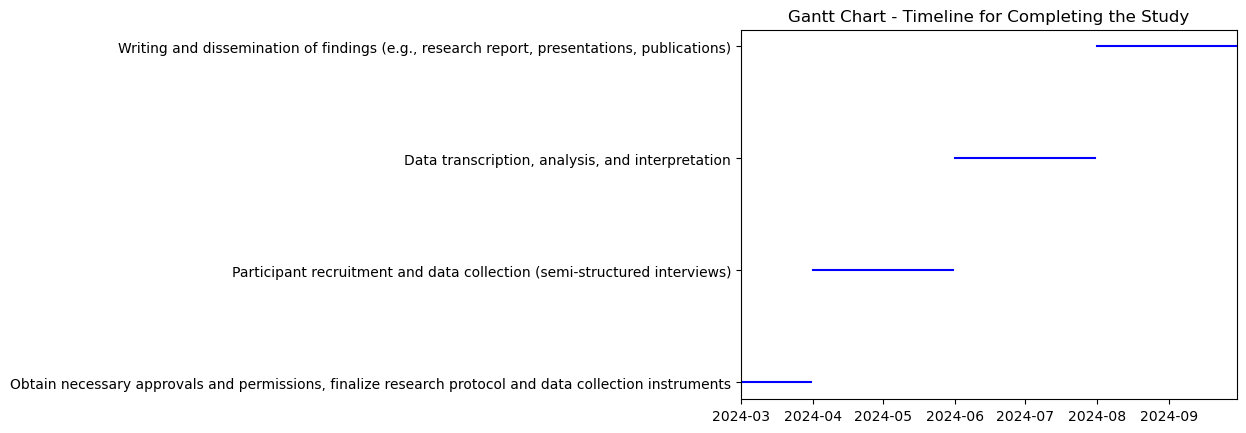
Figure 1: Gantt Chart
In conclusion, this qualitative study will employ a phenomenological approach to explore participants’ lived experiences and perspectives concerning mindfulness-based interventions for chronic pain management. It uses in-depth, semi-structured interviews to examine the perceived benefits, obstacles, and facilitators of various interventions and the personal and contextual aspects that affect their success. The study will follow strict ethical rules and use rigorous data analysis to discover emergent themes and create a composite description that encapsulates the phenomenon under examination. This project will advance mindfulness-based chronic pain care and inform the creation and execution of successful, individualized programs that meet the requirements and contexts of chronic pain populations.
References
Adeoye‐Olatunde, O. A., & Olenik, N. L. (2021). Research and scholarly methods: Semi‐structured interviews. Journal of the American college of clinical pharmacy, 4(10), 1358-1367.
Adler-Neal, A., Waugh, C., Garland, E., Shaltout, H., Diz, D., & Zeidan, F. (2020). The role of heart rate variability in mindfulness-based pain relief. The journal of pain : official journal of the American Pain Society. https://doi.org/10.1016/j.jpain.2019.07.003.
Barceló-Soler, A., Morillo-Sarto, H., Fernández-Martínez, S., Monreal-Bartolomé, A., Chambel, M., Gardiner, P., López-del-Hoyo, Y., García-Campayo, J., & Pérez-Aranda, A. (2023). A Systematic Review of the Adherence to Home-Practice Meditation Exercises in Patients with Chronic Pain. International Journal of Environmental Research and Public Health, 20. https://doi.org/10.3390/ijerph20054438.
Brintz, C., Roth, I., Faurot, K., Rao, S., & Gaylord, S. (2020). Feasibility and Acceptability of an Abbreviated, Four-Week Mindfulness Program for Chronic Pain Management.. Pain medicine. https://doi.org/10.1093/pm/pnaa208.
Cayoun, B., Simmons, A., & Shires, A. (2020). Immediate and Lasting Chronic Pain Reduction Following a Brief Self-Implemented Mindfulness-Based Interoceptive Exposure Task: a Pilot Study. Mindfulness, 11, 112-124. https://doi.org/10.1007/S12671-017-0823-X.
Dankar, F. K., Gergely, M., & Dankar, S. K. (2019). Informed consent in biomedical research. Computational and structural biotechnology journal, 17, 463-474.
Lino, C., Neuwersch-Sommeregger, S., Likar, R., & Bartolo, P. (2021). Mindfulness Meditation for the Treatment of Chronic Low Back Pain: A Preliminary Quasi-randomized Controlled Pilot Study. . https://doi.org/10.21203/rs.3.rs-1123107/v1.
Nagai, H., Nakazawa, E., & Akabayashi, A. (2022). The creation of the Belmont Report and its effect on ethical principles: a historical study. Monash bioethics review, 40(2), 157-170.
Pardos-Gascón, E., Narambuena, L., Leal-Costa, C., & Hofstadt-Román, C. (2020). Differential efficacy between cognitive-behavioral therapy and mindfulness-based therapies for chronic pain: Systematic review. International Journal of Clinical and Health Psychology : IJCHP, 21. https://doi.org/10.1016/j.ijchp.2020.08.001.
Pardos-Gascón, E., Narambuena, L., Leal-Costa, C., Ramos-Morcillo, A., Ruzafa-Martínez, M., & Román, C. (2021). Effects of Mindfulness-Based Cognitive Therapy for Chronic Pain: A Multicenter Study. International Journal of Environmental Research and Public Health, 18. https://doi.org/10.3390/ijerph18136951.
Polaski, A., Phelps, A., Smith, T., Helm, E., Morone, N., Szucs, K., Kostek, M., & Kolber, B. (2021). Integrated Meditation and Exercise Therapy: A Randomized Controlled Pilot of a Combined Nonpharmacological Intervention Focused on Reducing Disability and Pain in Patients with Chronic Low Back Pain.. Pain medicine, 22 2, 444-458 . https://doi.org/10.1093/pm/pnaa403.
Riegner, G., Posey, G., Oliva, V., Jung, Y., Mobley, W., & Zeidan, F. (2022). Disentangling self from pain: mindfulness meditation-induced pain relief is driven by thalamic-default mode network decoupling.. Pain. https://doi.org/10.1097/j.pain.0000000000002731.
Williams, R., Day, M., Ehde, D., Turner, A., Ciol, M., Gertz, K., Patterson, D., Hakimian, S., Suri, P., & Jensen, M. (2022). Effects of Hypnosis vs Mindfulness Meditation vs Education on Chronic Pain Intensity and Secondary Outcomes in Veterans: A Randomized Clinical Trial.. Pain. https://doi.org/10.1097/j.pain.0000000000002586.
Yang, S., & Chang, M. C. (2019). Chronic pain: structural and functional changes in brain structures and associated negative affective states. International journal of molecular sciences, 20(13), 3130.
Zorn, J., Abdoun, O., Bouet, R., & Lutz, A. (2020). Mindfulness meditation is related to sensory‐affective uncoupling of pain in trained novice and expert practitioners. European Journal of Pain, 24, 1301 – 1313. https://doi.org/10.1002/ejp.1576.
 write
write