In the world of digital transformation, simulation has become one of the most pervasive technologies simultaneously present in different industries and working levels, from strategic planning to tactical decisions and operational optimization. Simulation refers to imitating system operations over a particular period using a model (Sharif et al., 2023, p. 14). Simulation applications are extremely focused on industrial engineering, especially in the manufacturing sector, where its role has become more enhanced by the introduction of CPS. The creation of a common platform via a merger of simulators and CPS technologies has been accompanied by the move from classical to modern line-thinking paradigms in production design and optimization. Besides methodological applicability and its confidence as the second-most widely used in research performed in operational management, simulation remains the focal methodology in addressing complex operational challenges. Putting up virtual real-world representations and systems over time to evaluate the proposed system limits on variables in a given time frame is commonly known as simulation. This function makes the task fit for such an assessment. From a decision-making perspective, the function of this kind of software lies in its unique capability to model the complexities and dynamics inherent in manufacturing systems; this makes it a vital asset in managing risk, optimizing the allocation of resources and enhancing performance. In comparing the role of simulation in industrial engineering, the textual artefact provides a focused and ordered study of simulation’s importance, while the YouTube video artefact concentrates on visualization and experiential learning, which can cater to a diverse audience beyond just the specialists.
This research article primarily aims to investigate and clarify the significance of simulation in industrial engineering, particularly within the context of manufacturing. The secondary objectives encompass offering a detailed examination of simulation applications. They emphasize evolving trends and introduce a novel classification framework (3D-SAM) to categorize these applications (Polenghi et al., 2018, p. 497). The underlying motive is to contribute to understanding simulation’s complex role in industrial engineering. This, in effect, supports informed decision-making in the field.
Figure 1
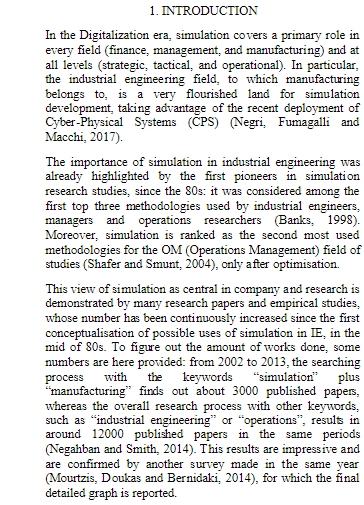
Textual analysis: https://www.researchgate.net/publication/326014373_Role_of_simulation_in_industrial_engineering_focus_on_manufacturing_systems
The audience for this content incorporates professionals and researchers in industrial engineering, manufacturing, and simulation development. The content addresses its audience by acknowledging the significance of simulation in Cyber-Physical Systems (CPS) within industrial engineering (Polenghi et al., 2018, p. 496). The information is tailored to individuals seeking insights into the historical context and growing importance of simulation in industrial engineering, emphasizing its relevance at strategic, tactical, and operational levels. The audience is engaged through references to pioneers in simulation research studies, highlighting the methodology’s longstanding recognition among industrial engineers, managers, and operations researchers. The use of empirical studies and research reinforces the credibility of the content and resonates with the target audience’s interests.
The language employed in describing simulation encompasses technical terminology, aligning with the specialized nature of industrial engineering. The tone is informative and analytical, matter-of-factly conveying the significance of simulation. Stylistically, the text employs citations and references strategically, bolstering the credibility of the information presented. Various stylistics have been used in order to improve clarity. For example, numerical data provides a quantitative dimension. Presenting a historical background and how simulation has evolved in industrial engineering helps in the understanding of its importance. The stylistic device creates the credibility of the information presented. What is more, specific references and surveys (e.g., Scopus and WoS) promote the reliability of the information (Polenghi et al., 2018, p. 497). Data-driven insights, like the percentage of simulation papers for manufacturing system design and operation, reinforce arguments with evidence.
The medium to present the role of simulation in industrial engineering is text-based. The information is conveyed through written language in order to explain key ideas, trends, and aspects associated with simulation in this field. The medium chosen is a traditional and widely utilized format for academic and research discourse. It allows for a detailed and comprehensive exploration of the subject matter. The choice of a written medium significantly influences the rhetorical strategies employed in delivering the information. Through written discourse, the author engages in a logical and structured presentation of ideas, emphasizing clarity and precision. Formal language and technical terminologies align with the scholarly nature of the content. The written medium fosters detailed explanations, the use of citations from relevant studies, and the development of solid arguments, making the use of rhetorical strategies effective in conveying the various tenets of simulation in industrial engineering.
Different sources of evidence are used to prove the importance of simulation in industrial engineering, which the artefact is arguing about. This text involves a lot of various points of view. It is the groundwork for discussing last year’s insertion of Cyber-Physical systems (CPS) in industrial engineering. The validation of the sources is decided upon by evaluating the notable names of the researchers who will conduct a field study of the simulation. Furthermore, the text argues that simulation ranks as the second most commonly known method within operations management (OM), according to Polenghi et al. (2018, p. 496). Data, for example, interval estimates, are statistical; these figures are mainly used to support the argument, and the author has provided numerical statistical evidence. Along with the text presenting the fundamental theories and definitions of the previous historical periods by using references, it also endorses the discourse’s density and validity. The practice of employing these definitions in current simulation literature, which is frequently demonstrated through newly published papers, is a factor that assures the everlasting relevance of these definitions.
The text makes reference to logos through the logical development of ideas and evidence to support the central argument regarding simulation. It logically connects the development of simulation from the digitalization era to its current importance in the field. This aspect showcases its wide use across various industries and organizations. What is more, statistics used have a logical appeal and provide quantitative evidence to support the significance of simulation. Pathos have an Emotional Appeal. While the text primarily relies on a rational appeal, it also appeals to pathos to evoke a sense of significance and urgency. Phrases such as “flourished land for simulation development” promote a positive emotional tone (Polenghi et al., 2018, p. 496). In effect, this fosters a sense of enthusiasm and importance regarding the topic. The mention of a “simulation economy” appeals to the emotions associated with the potential transformative power of simulation in making decisions (Polenghi et al., 2018, p. 500). The establishment of ethos is evident through the inclusion of reputable sources and references. These references add credibility to the information presented. Surveys and statistical data from recognized databases like Scopus and WoS add authority to the claims made.
In the YouTube video the creators strategically use rhetorical appeals of ethos, logos, and pathos to explain the significance of simulation technology within industrial engineering effectively. The Video starts with an ethos as a narrator or expert is introduced, having a broader background in either the engineering of industry or simulation technology. This man embodies the authority and confidence of a severe character, and he can claim the audience’s trust at the beginning of his speech (Department of Industrial and Systems Engineering, 2019). Besides that, testimonials or endorsements from well-known engineers or representatives from the high-tech industry will lengthen the reliability of the Video. There is no better way to enhance the source’s reliability than to endorse this information by controlling figures of the corresponding fields. For example, the creators can be a person of trust, like an academic institution or an industry association.
Figure 2
Non-textual: https://www.youtube.com/watch?v=5twpa1xmlJ0
By the entire video running time, logos dominate the conversation by logically presenting evidence, data, and case studies. These elements of proof correspond to the argument of simulation in industrial engineering (Department of Industrial and Systems Engineering, 2019). For example, the Video have particular research on empirical facts of simulation trends, showing plausible benefits, like operation efficiency and savings in cost. It is through offering specific scenarios and figures illustrating the actual effect of the implementation of simulation that authors connect to the purposefulness of using simulators in industry. Thus, the viewers’ rationality is evoked, which results in a greater understanding of the practical power of simulation.
Pathos is precisely employed by visual techniques to have a strong emotional impact on the people and themselves. A video can include heart-wrenching storylines and testimonies that people have experienced positive life changes with simulations. For example, the reassurance of workers who had safety and satisfaction improvements due to simulators in their workplaces may be a contrasting persuasion from viewers because it triggers empathy and compassion in them. They do so by focusing on the consequences of actors’ decisions, for instance, paying attention to or ignoring risks and analyzing the well-being of working people. This approach enables viewers to feel a more profound and more personal connection to the product (Department of Industrial and Systems Engineering, 2019).
The ethos, logos, and pathos combine to develop a robust and influential structure that competently delivers messages about the central role played by simulation technology in industrial engineering. The developers achieve credibility, a logical argument, and an emotional connection with the audience by employing these three techniques. Ultimately, the audience recognizes the value of simulation technology in their industrial processes and the development of new designs within the sector. Besides, the Video’s ethos is proved by the fact that it selectively uses authoritative voices and the endorsements of experts that represent the review process with respect. The (Department of Industrial and Systems Engineering, 2019) provides a platform for our industrial engineering subject matter experts to offer credible witness statements and discuss the essence of the subject, proving its reliability to the viewers.
The use of logos also partially plays into the persuasive power of the Video by presenting valid ideas and facts concerning the advantages of simulation technology for an industrial branch. The film uses figures, scenarios, and statistical reports to show the practical merits of introducing simulations, including rising efficiency, cost reduction, and better decisions. Through tangible illustrations and real-life data, the creators use viewers’ intuitive minds to look for rationale and practical computer simulation techniques in industrial settings (Department of Industrial and Systems Engineering, 2019).
The YouTube video serves the explicit purpose of giving an overview of why effective modelling and design simulation are good for business operations in industrial engineering. Using pictures, narratives, and demonstrations, the movie strives to make complex topics easier to understand and uses simulation to find the most effective way to improve industrial processes. Digital video format as the channel of the medium gives additional frames, a more emotional background, and visual and sound effects. As a result, Video becomes more interactive and easier to understand. The style of the Video is both informational and, to some extent, simple; the author uses the visual part of a presentation and simple logic when explaining the key points. Using a strategic blend of wise content, digital medium, and an exciting sense of style, the Video can ultimately achieve its goal of enlightening and informing the viewers about the function of simulation in Industrial engineering.
A comparison of the textual and non-textual formats of information dissemination reveals a crucial difference between how each medium engages its audience and conveys its message. The textual form of communication is represented by scientific papers or research papers that one can find in Polenghi et al. (2018) study on a simulation of industrial engineering, which is very much based on verbal language to display data in a logically sequential way. Such a format ensures not only measurement of the levels of comprehension but also theoretical contexts, as well as empirical evidence, so that the audience can capture the content on the academic level. On the contrary, in terms of where numerical facts are used to project the image as it is, the video format, which is the case of the YouTube video “Understanding Simulation’s Role in Industrial Engineering”, relies on visual and auditory evidence to convey concepts in a more dynamic and accessible way. Video accomplishes this by means of straightforward animations and graphics, as well as continuous narration that clearly breaks down difficult subjects for a wider audience. The textual flow, which provides an opportunity to develop in-depth and precise detail, is countered by the non-textual format that is highly engaging and accessible. Therefore, it helps other learners and people with different levels of expertise.
Simulation in industrial engineering is a very multi-role and meaningful technology. Industrial processes and decision-making are diversely demonstrated by both textual and non-textual means. Hence, the necessity for simulation in industrial settings to optimize processes, improve decision-making and motivate innovation is evident. The textual analysis has demonstrated the application of simulation theories and methodologies and provided relevant data and evidence with an expectation of relevance to academic audiences and researchers. However, the non-textual analysis served a deeper purpose by touching on the visual and auditory elements used to hook and inform the audience, which basically encompasses a wide range of people and makes the concepts easier to grasp regardless of the expertise.
References
Department of Industrial and Systems Engineering. (2019, August 27). What is Industrial Engineering? [Video]. YouTube. https://www.youtube.com/watch?v=5twpa1xmlJ0
Polenghi, A., Fumagalli, L., & Roda, I. (2018). Role of simulation in industrial engineering: focus on manufacturing systems. IFAC-PapersOnLine, 51(11), 496-501.
Sharif, S. V., Moshfegh, P. H., & Kashani, H. (2023). Simulation modeling of operation and coordination of agencies involved in post-disaster response and recovery. Reliability Engineering & System Safety, 235, 109219.
 write
write