Executive Summary
We examine the impact of back-pain tennis shoes, a significant footwear feature. Our specialist product is carefully promoted by monitoring customer opinion and competition. We analyze rivals, customer preferences, and purchasing behaviors to advise on product placement. We desire market share and long-term advantage in the growing health footwear industry. We aim to lead the market by monitoring customer wants and product benefits and disadvantages. This ad encourages brand loyalty and demand for enjoyable, healthy, and useful products.
Introduction
Knowing how consumers see your goods or services may help you sell them in the ever-changing marketing industry. Perceptual mapping helps marketers compare brands. Marketers may use surveys and other data to map the competitive landscape by charting key traits. This graphic may help companies detect market gaps, build their brand, and compare their strengths and weaknesses to rivals. A new company’s marketing director must examine data, construct a perceptual map, and advise management on positioning. Target market, competition, and trend information are needed for this approach. Perceptual mapping helps marketers reach the target market, explain the value proposition, and leave a lasting impression. Thus, the present study examines perceptual mapping by alleviating back pain by introducing tennis shoes.
Background
Customer back complaints are rising, and many wear shoes. More customers seek supportive, comfortable tennis shoes and need market-specific shoes (Liu, p. 89). “The properties of materials and intensity of activity influence interactions between the human body and activewear, which result in different subjective sensations and could alter the functional performance during exercise.” Our back pain product line is meticulously crafted since we know their needs. Research is essential for market introduction. Customer opinions of present brands must be evaluated for strengths, shortcomings, and market gaps. We choose items for our target market by examining customer preferences, issues, and buying behaviors. This data allows us to create unique features and appealing language to set our products apart from competitors and satisfy customers seeking comfort and relaxation. Our approach stresses brand and market reputation. Collaboration and creative marketing emphasize our tennis shoes’ distinct worth to build trust. Our comprehensive approach utilizing consumer data, branding, and targeted marketing will dominate this fast-growing company and enhance back pain patients’ lives.
Methodology
A thorough qualitative and quantitative method studies target market consumer behavior. Focus groups, in-depth interviews, and consumer surveys provide qualitative data. The methodologies show client preferences, issues, and brand views. Complex statistical methods are used in quantitative data analysis to acquire comfortable tennis shoes consumer opinions. This research maps competition by comfort, support, pricing, and brand reputation. Quantitative consumer behavior and market dynamics trends inform strategy. This dual-method approach analyzes markets using quantitative and qualitative methods. Both strategies provide extensive insights into customer preferences and market dynamics to inform marketing and product development.
Results
Tennis shoe purchasers value support and comfort in the ever-changing industry (Rhoades, p. 509). “Footwear and clothing are essential to protect our physical bodies from the world around us.” Buyers are learning how footwear increases performance and minimizes injury risk. Brands vary in value. Consumers evaluate manufacturers’ comfort, support, and back pain relief differently. Price sensitivity causes problems since some clients are ready to pay extra for comfort and utility. Some customers pick cheaper items, while others choose more costly ones with superior comfort and performance. Brand reputation matters. Famous companies’ dependability and skill provide them an advantage in client choices. Clients trust these consolation and support groups. They substantially impact tennis shoe sales and trends.
Discussion/Recommendations
After testing our device, sell it as a high-end back pain treatment with greater comfort, support, and effectiveness. We must attract a premium clientele that respects quality and performance with our USP—state-of-the-art ergonomic design and technology. Celebrity doctors and health advantages may legitimize our product and attract clients. Our marketing emphasizes short- and long-term health benefits, positioning our product as the best luxury and well-being option. Quality distinguishes our brand in a crowded market.
We charge more to reflect its features and our target demographic’s intelligence. This strategy boosts our premium market position and value. Discounts or unique pricing may accelerate testing and acceptance. This product may attract loyal, price-conscious consumers. We engage our target audience via distribution strategies. We reach fans who demand cutting-edge solutions via narrow sports shops. Online platforms increase viewership and facilitate shopping. Medical institution partnerships boost your reputation and provide direct access to health-conscious clientele. With pricing and distribution coordination, we dominate our target categories and market share.
We must invest in marketing, highlighting our product’s unique qualities to establish brand equity and stand out. Customer reviews and reputable sources may promote our products’ value and dependability. Celebrity, sports, and medical expert collaborations build brand trust (Xiaofei. p. 46). “With the rapid development and transformation of the sports industry, celebrity endorsements play a crucial role.” These collaborations promote our brand. A coordinated campaign that promotes our USPs and garners dependable endorsements may help us dominate the industry and develop long-term customer relationships.
Implications and Future Actions
The positioning method needs regular monitoring of customer preferences, market changes, and competition. We can spot shifting customer preferences and industry trends by being persistent and proactive. Effective performance monitoring and recent market research may show new trends and possibilities. Using this iterative method, we can precisely design our ideas and quickly adjust to changing market situations. We can detect modest customer behavior changes and explore new areas using sophisticated analytics and data. Maintaining market leadership requires industry monitoring and data-driven strategic decision-making.
Conclusion
To summarize, perceptual mapping enhances product positioning and customer perception analysis. This analytical tool helps organizations uncover gaps, opportunities, and niches by researching customer behavior. Our back-friendly tennis shoe firm uses perceptual mapping. Consumer perceptions define our target market’s favor USPs. Knowing our audience helps us tailor our message, features, and marketing. Visual mapping aids positioning. Marketing our tennis shoes may need perception. Strategic positioning boosts market share and attractiveness. Perceptual mapping may enhance our product, marketing, and strategy. Our back-pain-relieving tennis shoes may gain market share and differentiation by employing consumer perception information. Long-term success in the competitive footwear sector will ensue.
Lessons Learned
This activity taught us plenty of things, starting with customer-focused marketing. Success in every industry demands an edge and a deep understanding of customer requirements, preferences, and perceptions. They promoted strategy. Finding and exploiting market gaps and competitive differentiation is essential in saturated, competitive marketplaces. Third, it linked product, pricing, location, and promotion. Product positioning must match these requirements for a unified and appealing marketing approach. Finally, change was required. As markets evolve, plans must be revised to be competitive. These insights will help future marketing initiatives fulfill customer expectations and boost corporate success.
Recommendations for Future Participants
Future event participants should follow these tips to succeed and be productive. Research the market first. For information, study consumer sentiment and competition positioning. Researchers must use qualitative and quantitative methodologies to finish and triangulate a study. Multiple perspectives guide choices and explain complex market dynamics.
Furthermore, interdepartmental coordination is essential. Close collaboration between marketing, sales, and product development optimizes synergies and strategy. Combining resources and skills may improve group operations. Business changes; therefore, adaptability is vital. Consumer tastes and business changes need flexibility. Adaptable firms embrace developments and opportunities. These initiatives boost related regions’ competitiveness and long-term success.
Suggestions for Activity Improvement
I offer five adjustments for future attempts. Case studies and real-time market data may assist participants in comprehending and applying the market to their professions. The technique updates instruction.
Second, active brainstorming and conversation improve creativity and collaboration. Active engagement and idea sharing enable people to uncover fresh market solutions from diverse angles (Yang et al., p. 456). “The new type of innovation communities enables firms to crowdsource ideas from their users for developing new products and improving existing ones.” Participants must grasp market research and data analysis tools and procedures. Data processing, visualization, and interpretation skills allow autonomous research and informed decision-making.
For better presenting and evaluation, participants require comments. Coaching and constructive criticism improve communication and problem-solving. This method helps players adapt to market changes by encouraging learning.
In conclusion, perceptual mapping informs corporate strategy. Visualizing customer opinions about market items and brands helps assess competitive positioning and preferences. This data may help organizations market, identify growth prospects, and promote items. The method helps companies find market gaps, niches, and product repositioning to fulfill customer wants. In today’s fast-paced market, perception mapping may aid business.
The following is a simplified tennis shoe perceptual map.
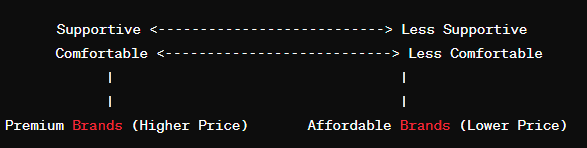
Perception maps show the following:
Tennis shoe purchasers demand comfort and support. They make high-performance sports shoes wearable. On the Cartesian plane’s horizontal axis, “Less Supportive” to “Supportive” is far left. Vertically graded “Comfortable” to “Less Comfortable.”
Each product or brand’s map location shows its customer-friendliness vs rivals. Most prestige brands are in the top-right quadrant for quality and innovation. It is more expensive yet more comfortable and supportive.
Many inexpensive brands are at the bottom-left quadrant. Cheap choices may be uncomfortable and unsupportive. The sector may provide price-performance solutions.
To navigate the complicated tennis shoe market and make educated personal preference-based judgments, one has to comprehend this support, comfort, and price positioning matrix.
Thus, this impression map compares brand comfort, cost, and support. It describes each brand’s position in this complicated industry and audience preferences for marketers. Comparing rivals’ locations may help marketers find goods. Using this tool, brand positioning tactics may stand out, satisfy consumers, or discover a niche. How their brand compares may help marketers customize offerings and engage customers.
Works Cited
Liu, Rong, Elaine Fung, and Younus Abida. “Evaluation of perceived comfort and functional performance of activewear.” Latest Material and Technological Developments for Activewear. Woodhead Publishing, 2020. 89-118.https://www.sciencedirect.com/science/article/pii/B9780128194928000053
Rhoades, Matthew A. “Smart footwear: A designer’s perspective.” Smart Clothes and Wearable Technology. Woodhead Publishing, 2023. 509-527.https://www.sciencedirect.com/science/article/abs/pii/B9780128195260000114
Wang, Xiaofei. “Sports Celebrity Endorsements: The Promotional Role of Key Opinion Leaders in the Upgrading of the Sports Industry.” Journal of Education, Humanities and Social Sciences 27 (2024): 46-52.https://drpress.org/ojs/index.php/EHSS/article/view/18055
Yang, Mu, and Chunjia Han. “Stimulating innovation: Managing peer interaction for idea generation on digital innovation platforms.” Journal of Business Research 125 (2021): 456-465.https://www.sciencedirect.com/science/article/abs/pii/S0148296319304643
 write
write