Introduction
Effective communication in the healthcare setting is undoubtedly a factor in patients’ ability to comprehend the information relayed to them by their doctors during their consultations. While the majority of people get to know what is going on, some people find it hard to understand the information, especially those with language barriers and cognitive difficulties. This is evidence of why informing patients and designing communication that suits the unique needs of patients should be prioritized. This initiative aims to empower patients and develop a healthier population by using creative art to educate people on various health issues.
Abstract
Art has had a long reputation for being a powerful tool for emotional and therapeutic expression. This community action plan aims to overcome communication barriers in health settings by integrating art, health communication, and community participation. The plan involves a collaborative workshop facilitated by public health professionals and social justice artists, where students explore the question, “What makes us healthy?” through artistic expression. Students’ perceptions are then printed on the wall located on campus, representing their understanding of different dimensions of health. Key objectives include the following: the development of the health literacy of students, the enhancement of their creativity and critical thinking, and the stimulation of the dialogue between the community and social justice issues. Ultimately, this initiative is designed to enable individuals to make a difference in health outcomes with the help of art-based interventions and public health education.
Proposal
At the heart of the community action plan is a workshop named “What Makes Us Healthy?” which is meant to involve the participants in unraveling health in all its diversity through the medium of art. This is an interactive and creative workshop that was organized by a collaboration of public health professionals and social justice artists and aims to provide students with a chance to reflect on their health questions. Through guided activities and discussions, we will discover the dynamics of the health determinants, including physical, mental, social, and environmental factors.
Working together with public health agents and social justice artists is the keystone to the workshop’s success (The American College of Obstetricians and Gynecologists, 2013). Public health professionals will collaborate on material development and delivery for the workshop, providing their expertise in health education and promotion and ensuring the content aligns with established public health principles and objectives. Social justice artists, unlike regular artists, will be taking their artistic input and creative skills to encourage active participation among students with the help of such a program.
The primary activity of the workshop will revolve around painting a mural that is a visual illustration of student’s understanding of health. The collaborative art project creates an environment where students are able to express themselves creatively and feel a part of the community’s sense of ownership and participation. (Nice, n.d). A banner will be placed on campus where everyone can see it as a symbol of the students’ joint efforts to achieve a healthy school environment.
Problem Statement
Health communication is essential in transmitting the most relevant health information and forming a cognizant relationship between healthcare providers and patients (Park et al., 2019). Nonetheless, the language barrier is one of the most difficult challenges in successful communication, which might lead to future medical errors and misunderstandings. In spite of the attempts to offer translation services, the practice of relying solely on translators often needs to be revised, as patients have to make do with only a little comprehension. This communicational gap unequally affects those people who do not speak English so well, and thus, they cannot adequately benefit from quality healthcare. Language barrier tackling needs to be introduced to guarantee communal health service delivery to empower the patient and improve their health.
Landscaping Analysis
The barrier of language in health communication is not independent of other issues but rather interacts with the broader problems of healthcare accessibility and equity (Drew et al., 2013). Organizations, such as Latino Health Access, work to improve communications between providers and patients by addressing language and cultural disparities. The staff tries to understand the needs of the historically underserved communities. Nevertheless, the task is quite daunting since it is not easy to solve it completely, especially for smaller nonprofit organizations that have little capacity. The involved and creative strategies are needed to adequately address the communication barriers and advance health communication, which will lead to better health outcomes for all.
5 Ideas + 2 Sketches
Community mural collaboration
Invite students, professionals in public health, and social justice artists into a combined mural project (Jordan et al., 2009). Students will participate in the creation of the artworks under the tutelage of public health professionals to ensure adherence to the core messages of health.
Photo stories of health narratives
Encourage the students to write their health narratives and use photographs to incorporate them into the lesson plan (Jordan et al., 2009). Such photo stories can portray a person’s journey through health and well-being, creating a sense of empathy and community bonding.
Interactive workshops on public health
Provide participatory classes where students get to acquire public health knowledge through practical activities and discussions. One of the courses is about nutrition, and the others are about physical activity, mental health, and disease prevention.
Health promotion posters
Make the students create posters for health promotion, which can be put up inside the school. These posters can be designed in a way that would attract the attention of the students in a very creative manner so as to pass the message quickly.
Student-led health campaigns
Equip students with designing and implementing their health campaigns in order to solve the issues affecting their community. This could be a target of strategies such as promoting healthy nutrition, encouraging physical activity, or heightening awareness about mental health.
Prototype
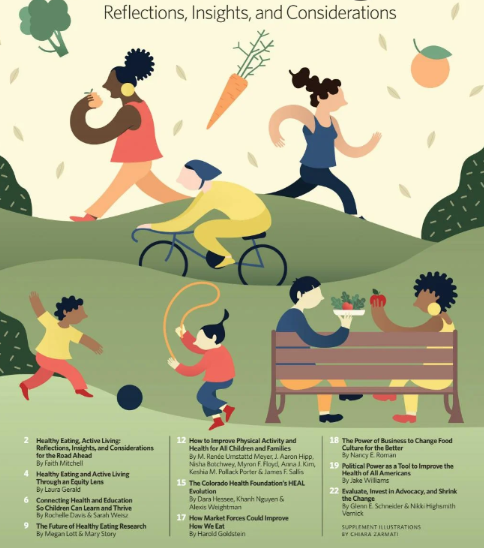
The prototype showcases a collaborative artwork created by students, public health professionals, and social justice artists. It illustrates colorful images that reflect health and well-being in different ways, like physical activity, healthy food, mental health, and interaction with the community. The mural, which depicts the students’ particular views on health, reflects collaborative work between school community members in the promotion of health and wellness.
Adoption Plan
Short-term
- Identify the main stakeholders, which are school management, teachers, parents, public health people, and social justice artists.
- Work with stakeholders to create and develop a multi-disciplinary curriculum for public health workshops, ensuring that this aligns with education standards and health objectives.
- Employ and train workshop instructors, public health experts, and social justice artists who will have the capacity to interact with students and provide the training (Cribb et al., 2022).
Medium-term
- Health education workshops will be conducted in some selected schools as part of the art activities and discussion of health topics.
- Assess the outcomes of the workshops in increasing student health literacy, creativity, and community building.
- Gather opinions from students, teachers, and workshop facilitators to identify the areas of improvement and make the necessary changes to both the curriculum and workshop format.
Long-term
- Scale up the public health workshops during the coming year to a larger group of elementary schools within the community based on the experience and lessons learned from the pilot phase (Gordon et al., 2020).
- Build a long-term community engagement by holding exhibitions of student artworks and health events and by partnering with local organizations.
- Search for funds to sustain the idea and to develop partnerships with the school districts. Also, the workshops should be integrated into the existing educational programs.
- Continuously evaluate and adapt the initiative based on feedback and evolving community needs, ensuring its long-term impact on promoting health, creativity, and social justice.
Evaluation Impact
The evaluation process of the Community Action Plan has a wide array of objectives, which are not only assessing the effectiveness of the plan but also finding out the areas that need to be improved. Firstly, it assesses how the plan is achieving its stated goals and outcomes. The evaluation, which is based on comprehensive assessments and stakeholders’ feedback, aims to establish the plan’s effectiveness in students’ understanding of public health concepts, community engagement, and continued talks on public health in the school and the community.
Measures of success are standard indicators of the initiative’s effectiveness we use to determine it. One of the indicators of success is the evaluation of the degree of mastery of the students before and after they participate in the sessions. This will be through pre- and post-assessments, surveys, and qualitative feedback with the intent of measuring changes in knowledge and understanding of public health issues. Moreover, the extent of community participation is also a very significant metric, which we can measure through variables like number of workshop participants, involvement in community activities, and input from the stakeholders. Moreover, there is also a monitoring mechanism that ensures the continuation of discussions and activities concerning public health as the initial implementation phase draws to a close (Gordon et al., 2020). The sustainability of the project is measured through regular monitoring of the degree of integration of health topics into the school curriculum, maintaining the partnerships and collaborations, and the sustained impact on the student knowledge and behavior regarding health and well-being.
Looking toward the future, the sustainability of the initiative depends on several factors, such as finding sustainable funding sources, fostering partnerships, and integrating art-based education in public health into the existing educational system. One of the key strategies is regularly assessing and updating the initiative according to the feedback and shifting needs to guarantee its efficacy and relevance as well as to form a healthy and creative community among the students and other stakeholders.
References
Amelung, D., Whitaker, K. L., Lennard, D., Ogden, M., Sheringham, J., Zhou, Y., … & Black, G. (2020). Influence of doctor-patient conversations on behaviors of patients presenting to primary care with new or persistent symptoms: a video observation study. BMJ quality & safety, 29(3), 198-208. https://qualitysafety.bmj.com/content/29/3/198
Cribb, A., Entwistle, V., & Mitchell, P. (2022). Talking it better: Conversations and normative complexity in healthcare improvement. Medical humanities, 48(1), 85–93. https://www.ncbi.nlm.nih.gov/pmc/articles/PMC8867266/
Drew, P., Chatwin, J., & Collins, S. (2001). Conversation analysis: a method for research into interactions between patients and healthcare professionals. Health Expectations, 4(1), 58–70. https://onlinelibrary.wiley.com/doi/10.1046/j.1369-6513.2001.00125.x
Gordon, H. S., Solanki, P., Bokhour, B. G., & Gopal, R. K. (2020). “I’m not feeling like I’m part of the conversation” patients’ perspectives on communicating in clinical video telehealth visits. Journal of General Internal Medicine, 35, 1751-1758. https://www.ncbi.nlm.nih.gov/pmc/articles/PMC7280396/
Halpin, S. N., Konomos, M., & Roulston, K. (2021). Using applied conversation analysis in patient education. Global Qualitative Nursing Research, 8, 23333936211012990. https://journals.sagepub.com/doi/10.1177/23333936211012990
Jordan, M. E., Lanham, H. J., Crabtree, B. F., Nutting, P. A., Miller, W. L., Stange, K. C., & McDaniel, R. R. (2009). The role of conversation in health care interventions: enabling sensemaking and learning. Implementation Science, 4, 1-13. https://implementationscience.biomedcentral.com/articles/10.1186/1748-5908-4-15
Nice. (n.d.). Five ways to improve patient interactions. https://get.nice.com/5-ways-improve-px?utm_source=google&utm_medium=cpc&utm_term=verticals&utm_content=146647&utm_campaign=NL_Q323_EN_CX1_AMER_232030_CLP_HLTH-Five-Ways-To-Improve-Patient-Interactions-eB&utm_detail=dentsu_healthcare&gad_source=1&gclid=EAIaIQobChMI8fjJ39SahQMVIXR_AB07jgD
Park, J., Kotzias, D., Kuo, P., Logan Iv, R. L., Merced, K., Singh, S., … & Smyth, P. (2019). Detecting conversation topics in primary care office visits from transcripts of patient-provider interactions. Journal of the American Medical Informatics Association, 26(12), 1493-1504. https://academic.oup.com/jamia/article/26/12/1493/5571446
The American College of Obstetricians and Gynecologists. (2013). Effective patient-physician communication. Value is what Coveo indexes and uses as the title in Search Results. –> ACOG. https://www.acog.org/clinical/clinical-guidance/committee-opinion/articles/2014/02/effective-patient-physician-communication
 write
write