The complicated dynamics of the family system necessitate a multifaceted approach that includes psychosocial patterns, intergenerational transmission, and social impacts. This paper is an intensive study of the family genogram, scrutinizing the family pattern, existing issues, and personality traits. Using family therapy theory and critical social work lenses, this article considers how structural factors like privilege, discrimination, and societal structural inequality militate against the well-being of the family system. Moreover, inviting the reader to turn their attention to the group work process, involving a partner in the development and interpretation of the genogram, plus the likelihood of application of genograms as a tool within social work practice, is also provided. This analysis results in an awareness of the overall complexity of family dynamics and the role of genograms in social work practice.
Identification of Family Patterns, Issues and Traits
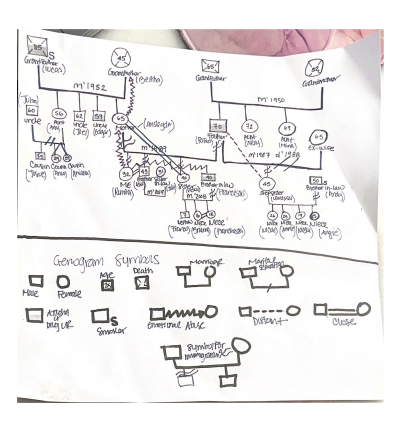
This genogram outlines a picture of the whole family and helps make sense of some underlying psychosocial problems and structures. Specific noticeable trends can be mentioned, such as the early age at which marriages occur and an increased frequency of divorces within an extended family. This is the same pattern of shifting, which can be seen while someone searches for a stable relationship due to divergent viewpoints, modes of conflict resolution, and general characters.
Moreover, the family equally encounters a rampant problem of substance abuse, with pictures implying “Smokers” as well as a range of other references that present a heavy presence of addiction or substance dependence. The family connection is strongly affected by substance abuse, which may cause lots of financial problems, damage relationships between family members, and make them go through emotional trouble. Family intervention for substance abuse must bring about an integrated approach that will involve a comprehensive examination of the root causes, such as stress, coping mechanisms, and access to support services as well.
Mental health upheaval is also significant because the tree also has decorations that used to say “MH” and strange behavior exhibited by some of the family members. Mental health issues are one of the underlying causes of conflict, individual fighting, and an individual’s reduced willpower to seek help on time. Reckoning with and handling mental health issues with families especially is essential because it helps to ensure family members’ sound mental health and their ability to cope and adapt to various challenges.
Besides, it can be observed that family members may differ regarding education, with some of them attaining higher education and others facing obstacles on the educational front. The economy constantly changes, passing through periods of stability and hard times. It influences the family’s budget in particular circumstances. Economic factors often rattle from other fields of family existence, leaving a wake of poverty and lack of access to resources and opportunities for social mobility. Therefore, the lifestyle quality of most families is compromised.
Cultural, racial, and religious dimensions also explain the family’s uniqueness, principles, and traditions. It is not one-sided; the factors act as strengths and negatives, overshadowing worldview, social connection, and discrimination or marginalization experience. This sort of study of cultural dynamics in a family can create a better understanding; it might also strengthen the family relationships and interactions through learning and appreciation of diverse points of view and approaches.
However, more than a century has passed since the Industrial Revolution began, and family patterns connected with ethnicity, culture, race, religion, economic situation, and education have unquestionably shaped the family experience. The emerging patterns can be favorable and harmful, affecting the family’s activities, communication, and inter-facial relationships with their environment. Also, there might be an impact of certain privileges, minorities, and injustices in the family, which may be transferable to future generations. Awareness of and responding to these factors will significantly improve equality, justice, and strength within families.
Theoretical Analysis of Family Patterns, Issues, and Traits
This evaluation aims to employ the main family therapy theories to support essential concepts and events in the genogram. The Bowenian model, systems theory, and social constructionist approaches provide robust perspectives of family dynamics that can help us understand the intricate workings of family systems.
Bowenian theory highlights the notion of differentiation of self by individual people. Differentiation involves the autonomous functioning of the self-in-relationship with the object. In the case of the genogram, there might be some closeness between relationships, but that was blurred boundaries and integrated emotions (Marcia Geller, 2018). This indistinction kindles problems with relationships of healthy types and resolving interpersonal disputes.
In particular, the structural kind of family therapy is concentrated on patterns of interaction and organization in the case of a family system. One of the primary things that has been marked is a method of prevention triangulation. The method is well known for diffusing the conflicts or tensions of the family through the involvement of a third party. Family conflict (triangulation or split loyalty), which does not support the child’s role and emotions, is the most noticeable erroneous tendency in the genogram. Perceiving these types of interactions will indicate the problems, the relationships between family members, and the appearance of dynamics in the system.
Social constructionist standpoints interconnect language, culture, and the social context in influencing families` interactions. Family discourses and narrations would be best applied to understand how the portrayal of family identity influences everyone’s understanding of their roles in the family and social relationships (O’Bryan, 2023). The application of linguistic patterns inside the genogram might shed light on the questions of authority, gender, and cultural aspects within the family members. When social workers recognize the effect of language and culture, they will be able to assist families in dealing with problems more efficiently, and they will be allowed to be more robust by creating resilience.
Besides the theoretical models, the underlings of privileged, discriminated, and institutionalized inequities domains should be considered when assessing family relationships. Emotional burdens and vulnerabilities such as racism, stigma, bias, and discrimination are transmitted from generation to generation. These emotions affect different aspects of family dynamics and the quality of life around the people. Blocking systemic barriers necessitates working with the community by advocating and empowering parents to guarantee tranquility and justice in families and the community.
Through partnering in thinking of the genogram’s manifestations, the activity involved interpersonal skills, listening, reflecting, discussing, and collaborating. Through the words by which we shared some of our experiences and unique perspectives, we understood better the details of their relationships and problems. It was good for us that we were talking to other families and knew their vulnerability, which was confirmed when we were both facing and looking for job opportunities (THC Editorial Team, 2022). This experience helped us acquire empathy and bring connection. Hence, our ability to help families in similar situations is enhanced.
Therefore, in the future, we should recognize that the qualities of forte, weakness, and trauma will be transferred from generation to generation. Those trends could cause symptoms in the financial generation, and the following ones are deepening vicious or beneficial circles. Utilizing social work theories involving the family and intervening when necessary with systemic barriers can facilitate this break in the cycle of harm done, and positive change can be a forgone consequence.
Work with Partner
Cooperation with a partner who was to pinpoint the trends in the genogram entailed a structured yet dynamic process, outlining the past and the future, thus shedding light on both the bright and the dark side. As a host, directing and creating a safe environment where I could listen and draw meaningful experiences from the interviewee was the key. The latter function included making my partner feel heard and acknowledged, accepting their feelings, and assuring they would feel relaxed enough to share their experiences freely.
I did not encounter any significant difficulty in being the interviewee because I could communicate the observations and conclusions of the analysis of a genogram. It is reassuring and confidence-boosting to know that my partner works with a high level of professionalism and kindness, and it is equally reassuring that he/she is there listening to what I have to say. This level of compassion made for an atmosphere filled with an honest exchange of thoughts and, as a result, allowed for a deeper analysis of the dynamic in the family when placed on the genogram.
The interactions within the collaboration informed the crucial ideas that we could then take the positive outcomes from it. We tapped into linguistic areas, traditional norms, and class indicators through this particular system, which will explain the family unit’s diversity and complexity. From these observations, the situation’s hot spots emerged to be tackled, and they enabled us to learn about our family’s strengths and weaknesses.
Unknowingly, there was a good thing for me during the interview process – it was getting the opportunity to feel vulnerable. It allowed me to share profound conversations with my mate and understand and feel for the family in the genogram. Through recognizing and emotionalizing myself, I approach the analysis intentionally, with sensitivity and understanding. The experience of vulnerability here has been fruitful for my future career as a social worker, granting me the indispensable ability to be attentive to clients’ situations and create a supportive and non-judgmental atmosphere for them to share their issues.
Overall, teamwork led to identifying patterns in the genogram, which has enlightened and enriched me. It was a window into the family dynamics and a reminder of the significance of empathizing and adequate interpersonal competence in the social worker occupation. Suffering, trusting, and using my vulnerability in self-care have made me a better social worker and will definitely shape my future social work tasks.
Use of Genograms
Social workers can get immense advantages by using qualitative instruments like genograms in practice, providing the required insights into family relations and dynamics. Genograms demonstrate the kinship connections among family members and expose the intergenerational impacts on child-rearing (Marschall, 2022). Based on the findings, social workers can conduct comprehensive assessments and design specific intervention plans.
In the paper’s study context, genograms are a perfect inception point to observe the psychosocial tendencies, problems, and traits within the family depicted in the method. Visual representations of relational tie-ups, educational achievements, courtship and marital patterns, parent-child relations, and other pertinent factors, along with their history, have been presented in genograms, providing a multi-focus overview of the family system. This alignment of visual occurrence enables the recognition of the qualities, threads, and possibilities for treatment, which are the keys to social work practice.
Additionally, genograms are a handy tool when working with diverse populations because of their ability to incorporate cultural, linguistic, and educational concerns. The genogram employing the visual representation is not dependent on any language, and more people from different environments take it as their form of communication (Marschall, 2022). Furthermore, family trees enable you to look deeply into family and cultural peculiarities, norms, values, and traditions, which will help develop a well-meaning cultural practice.
The genograms can be a valuable instrument for social workers who work with underprivileged or oppressed groups, and they will help them determine the underlying factors of the all-over picture of privilege, ethically based discrimination, and structural inequities. Inequality in society weighs down on the family system, and as social workers look into the effect of the systemic barriers they may have to create between the poor and the rich, social justice in terms of the distribution of resources and opportunities may be achieved.
There are multiple ways of implementing genograms in my practice. The first would be to use it as an engaging component to bring the clients on board for the collaborative assessment and intervention processes. Through a collaborative process whereby clients are given opportunities to represent their strengths and resources on their journey and areas they can change or grow, I can help them become more empowered individuals. They can also help people to communicate about tragedies such as trauma, substance abuse, and mental diseases, which may be challenging to bring up in ordinary dialogues, giving them a foundation on which they can talk about the issues comprehensively with no judgment.
References
Marcia Geller. (2018). How I Do Marital Therapy: A Bowenian Model. Group, 42(2), 159. https://doi.org/10.13186/group.42.2.0159O’
Bryan, A. (2023, January 31). What Is Bowenian Family and Couples Therapy? 5 Techniques. PositivePsychology.com. https://positivepsychology.com/bowenian-therapy/
THC Editorial Team. (2022, November 13). Bowenian Family Therapy: History and Effectiveness. The Human Condition. https://thehumancondition.com/bowenian-family-therapy/
Appendix
 write
write