Introduction and Summary of Study
Administrators and instructors face balancing positive student results, effective classroom management, school safety, and appropriate discipline. Many schools implement exclusionary sanctions, such as suspension or dismissal, to keep kids out of class for unacceptable behaviours (Adams, 2022). In recent years, more people have become aware of the long-term dangers of “zero tolerance.” As a result, several schools have adopted an alternate approach that emphasizes positive behaviour measures, restorative practices, and social-emotional development. Many instructors at the district level are concerned about how exclusionary disciplinary systems make schools unpleasant places to be, lead a large number of students to leave, and exhaust teachers. When discussing stringent discipline, these phrases are frequently employed.
This study was conducted to determine how middle school teachers in Dallas, Texas, and the surrounding school districts feel about exclusionary sanctions, how they are utilized, and other viable alternatives. The following were the three research questions:
RQ1: How do middle-school teachers perceive exclusionary discipline?
RQ2: How do middle-school teachers perceive the application of exclusionary discipline approaches?
RQ3: What alternatives to exclusionary discipline do middle-school teachers perceive could replace or modify existing approaches?
This study aims to shed light on the negative impacts of exclusionary discipline on students, such as their increased likelihood of dropping out, losing interest in education, and becoming engaged with the criminal justice system. Learning about these consequences can allow teachers to create regulations that benefit students and encourage good behaviour. This study will demonstrate that certain groups of kids are disciplined differently than others. These groups include pupils from low-income families, students of colour, and students with disabilities. This revelation will raise concerns about fairness, and people will begin to discuss how to address systemic biases in how people are disciplined. Instead of punishment, the study will eventually prove that better approaches to dealing with student conduct focus on preventing problems and assisting and supporting students.
We utilized a qualitative descriptive research approach to conduct this investigation. Examining a problem requires using a qualitative descriptive study design, according to Kisely and Kendall (2011), as it provides insights from the informant’s perspective. A qualitative descriptive design considers various individuals’ unique perspectives and life experiences in connection to a specific event. This research project aimed to create a comprehensive picture of how middle school instructors in school districts surrounding Dallas, Texas, perceive exclusionary discipline, how it is utilized, and what other options are available. Many school districts actively seek recommendations for middle school teachers they may need to replace or improve due to harsh penalties, high turnover rates, instructors who are too exhausted to teach, and the negative consequences these factors have on school settings. The study’s fundamental assumption is that by investigating how instructors feel about exclusionary discipline, we may learn more about how it is utilized in schools. This information can then be used to develop new or improved discipline programs.
Chapter 5 summarizes all of the research that has been done. This section discusses the study’s significance in light of the research questions that led to it. This chapter also provides a detailed overview of how the study was organized and executed. The purpose is to assist those who utilize exclusionary punishment in schools in developing better or more program designs for future discipline. Following the findings and conclusions, this section discusses the research’s theoretical, practical, and future implications. In conclusion, this paper examines the study’s merits and cons and suggests areas for future investigation.
Summary of Findings and Conclusion
Finally, this section draws inferences from the study’s data evaluation and results, drawing connections to the literature, the study’s significance, and the progress made in scientific understanding, as discussed in Chapters 1 and 2. The facts and theory directly pertinent to the research questions of this study were supported by the findings related to the research objectives mentioned in Chapters 1 and 3. Conclusions were drawn to fill the void in the literature and resolve the study’s research challenge. This part dissected the study questions individually and examined the themes and data that backed each. In Chapter 2, we compared the results to the current literature. For every study question, we will include an overview and final thoughts.
Research Question 1
The first research question of this study was, “How do middle-school teachers perceive exclusionary discipline?” The research topic focuses on how middle school instructors interpret exclusionary disciplinary measures as determined by their standing on the discipline continuum. Suspensions and expulsions, both forms of exclusionary discipline, have the potential to significantly hinder kids’ academic achievements and increase their chances of not only graduating but also becoming engaged in the juvenile criminal system (Rakowski, 2023). To improve the fairness and effectiveness of school laws, it is necessary to look into how educators respond to and manage exclusionary disciplinary measures. This study was best suited for a qualitative descriptive methodology since it allowed middle school educators to share their perspectives on exclusionary discipline, including its execution and potential alternatives.
The replies to Research Question 1 were obtained from data collected through individual semi-structured interviews and focus groups. The research revealed information on middle school educators’ perceptions of exclusionary discipline. The theoretical foundations of procedural justice, rational choice, and criminal deterrence served as the basis for the study investigations. Middle school instructors’ attitudes on exclusionary discipline, implementation, and feasible alternatives were studied using these three theories. Three theories were used to provide context for understanding the explanations supplied by middle school instructors for their preference for exclusionary discipline. It is well known that a teacher’s disciplinary position has a considerable impact on whether or not they prefer exclusionary discipline over another method.
The analysis of the two data sources revealed middle school instructors’ thoughts and judgments on exclusionary discipline in connection to the complete range of school disciplinary actions. The individual semi-structured interviews produced three themes and eighteen sub-themes, all validated and agreed upon by the two focus groups. RQ1 concerned how middle-school teachers perceive exclusionary discipline. Three themes emerged that supported the answer to RQ1: (a) concern for student accountability, (b) alternate seating as an intervention, and (c) teacher reflections on student behaviour.
RQ1 Results
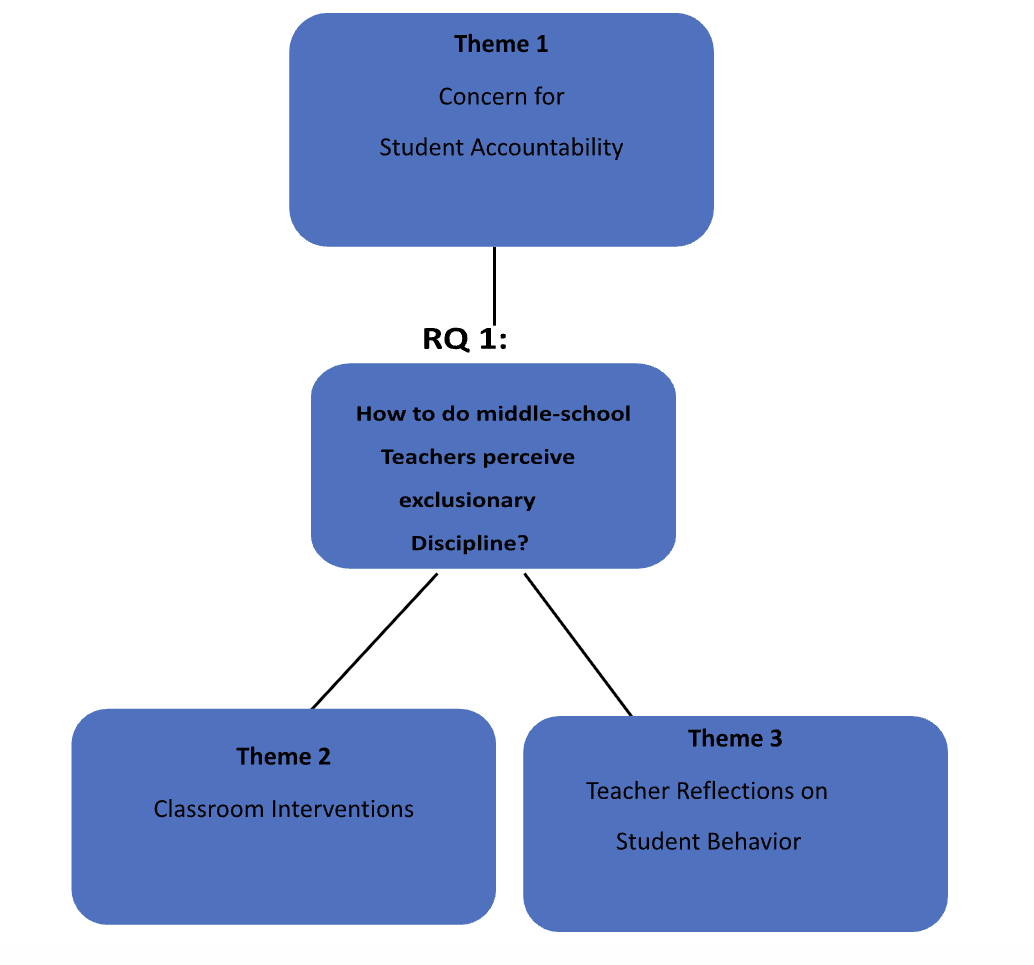
RQ1/Theme1 The first theme was a concern for student accountability. Teachers expressed that those students who experienced exclusionary discipline took ownership of their actions. For instance, one teacher (P8) noted, “They are sometimes embarrassed that you have to see them in that setting, and they want to explain what happened, why they are there, and how it will not happen again.” This state highlights teachers’ observations that some students recognized their misbehaviour and were willing to accept responsibility. Green et al. (2018) recommend that to get their needs met and be successful in the classroom, individualistic strategies such as pre-correction will focus on antecedents and other environmental factors as contributors to student behaviour. Therefore, it is evident that exclusionary disciplinary measures vary for students from different social groups, partly because of current instructional and behaviour management strategies and partly because of lower self-efficacy among students from lower socioeconomic backgrounds (Adams, 2022). Students from low socioeconomic backgrounds often lack the knowledge and understanding of specific problem behaviours, and as a result, they are at the highest risk for suspension. This lack of self-efficacy also drives such students to engage in problem behaviours despite the consequences received by peers (Adams, 2022).
RQ1/Theme2. The second theme that emerged was classroom interventions. Rather than resorting to exclusionary discipline, teachers described relocating students within the classroom, separating them from the rest of the class, or implementing strategies that maintain students’ presence in the learning environment. As one teacher (P3) described, “Just relocate the student to the other side of the room and also let them know their standards.” This statement suggests that teachers attempted to address behavioural issues in the classroom before resorting to exclusionary discipline. Positive behavioural support interventions use these links to enable teachers to appreciate other cultures better while communicating and interacting with the students professionally (Freeman et al., 2016). These alternatives recognize the need for individual intervention while appreciating the difficulty in balancing such demands given the student-staff ratio (Skiba & Losen, 2016).
RQ1/Theme 3. The third and final theme for RQ1 was teacher reflections on student behaviour. Teachers frequently reflected on students’ disruptive behaviour before resorting to exclusionary discipline. They shared instances where students persistently engaged in disruptive conduct despite warnings. For example, one teacher (P4) recalled, “There was this one time in which a student just kept talking, and even after got asked multiple times, he continued to talk as if nothing said anything to him.” These reflections highlight the deliberation that often precedes decisions regarding exclusionary discipline. According to Rahimi and Karkami (2015), teachers make the judgment call on the disciplinary course of action the student will receive. As the primary contact with the student, the teacher can identify misbehaviour, develop a link, and discipline the student.
RQ1 Conclusion. Considering problems such as student accountability, educational interventions, and instructor evaluations of student behaviour demonstrates how complex the norms for behaviour in school settings are. Some students are willing to accept responsibility for their acts, while others may struggle due to factors such as their socioeconomic status or lack of self-esteem. To address the needs of all of their students, teachers employ a variety of strategies in the classroom and emphasize the importance of creating a supportive environment. The remarks assist us in appreciating the problems that instructors encounter when dealing with disruptive behaviour and underline the need for teachers to enforce rules while still developing positive relationships with their students. According to the report, a comprehensive discipline plan that emphasizes individualized solutions and fosters a learning environment that values responsibility and assistance is advised.
Research Question 2
The second research question was, “How do middle-school teachers perceive the application of exclusionary discipline approaches? This research question was explored through interview questions 18 through 23 during the individual semi-structured interviews. This research question focused on examining middle-school teachers’ perceptions of exclusionary discipline approaches, which are essential for understanding disciplinary practices in schools, addressing the needs of students, and promoting positive school climates conducive to learning and growth. Three themes emerged that supported the answer to RQ2: (a) teacher care for students, (b) collaboration among stakeholders, and (c) communication between teachers and students and teachers and administration.
RQ2 Results
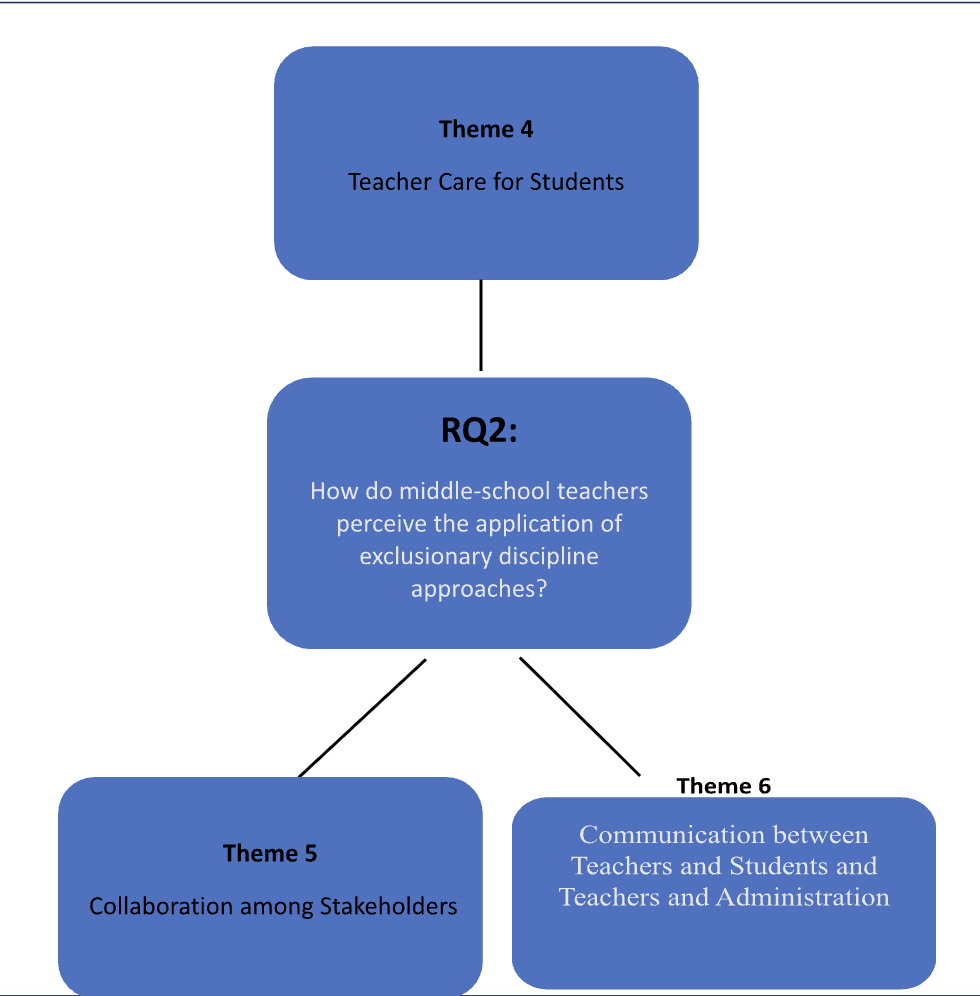
RQ2/Theme 4. Theme 4 describes how middle-school teachers expressed genuine care for their students. They believed in the importance of fostering positive relationships and communicated their affection for the children they taught. One teacher (P7) said, “That person cares about the kids. He pours into them. He loves them.” This theme underscores the emotional investment teachers have in their students’ well-being. In a study by Skiba et al. (2014), teachers identified aggression as the behaviour associated with suspensions. Noncompliance, defiance, truancy, delinquency, and disrespect were other misbehaviours the teachers reported being punished by exclusionary discipline. The researchers concluded that the disciplinary process would depend on the administrator.
RQ2/Theme 5. The fifth theme was collaboration among stakeholders and teachers, emphasizing the significance of cooperation between various stakeholders, including teachers, students, parents, and administrators, to ensure student success and maintain a positive campus culture. Collaborative efforts ranged from administrators working with parents to address student behaviour issues to teachers feeling like teammates in improving students’ behaviours. This theme highlights the interconnectedness of individuals involved in the educational process and the collective responsibility for students’ well-being. According to Cash et al. (2019), this is important in influencing behaviour change as the children can be instructed, and these adults can track progress. Exclusionary discipline alternatives also focus on having the students within proximity, thus allowing teachers to build links and initiate behaviour change.
RQ2/Theme 6. Communication was a pivotal theme that influenced teachers’ perceptions of exclusionary discipline. Teachers expressed the need for effective communication between teachers, students, and administrators. Clear communication channels were essential for understanding the rationale behind disciplinary decisions and ensuring students received the support they needed (McNeill et al., 2016). A teacher (P1) noted, “If the referral is written and the principal takes it and does something with it, whether it is unreasonable or not, I would like to know when they make a decision.” This theme underscores the importance of transparent and open lines of communication.
RQ2 Conclusion. There is a strong link between the behaviour and thoughts of teachers and other important people in the lives of middle school students and their growth and overall health. The fourth theme concerns how much middle school teachers value and care about their kids and how important it is to make strong connections with them to improve their health. In theme 5, it is emphasized how important it is for different groups, like teachers, students, parents, and administrators, to work together to create a healthy school environment and support academic success. The sixth theme stresses how important it is to talk to teachers to understand their thoughts on handling discipline. It stresses how important it is for managers, teachers, and students to talk to each other easily so that everyone is on the same page about discipline and kids get the help they need.
Research Question 3
The third research question was, “What alternatives to exclusionary discipline do middle-school teachers perceive could replace or modify existing approaches?” This research question was explored through interview questions 24 through 27 during the individual semi-structured interviews.
RQ3 Results
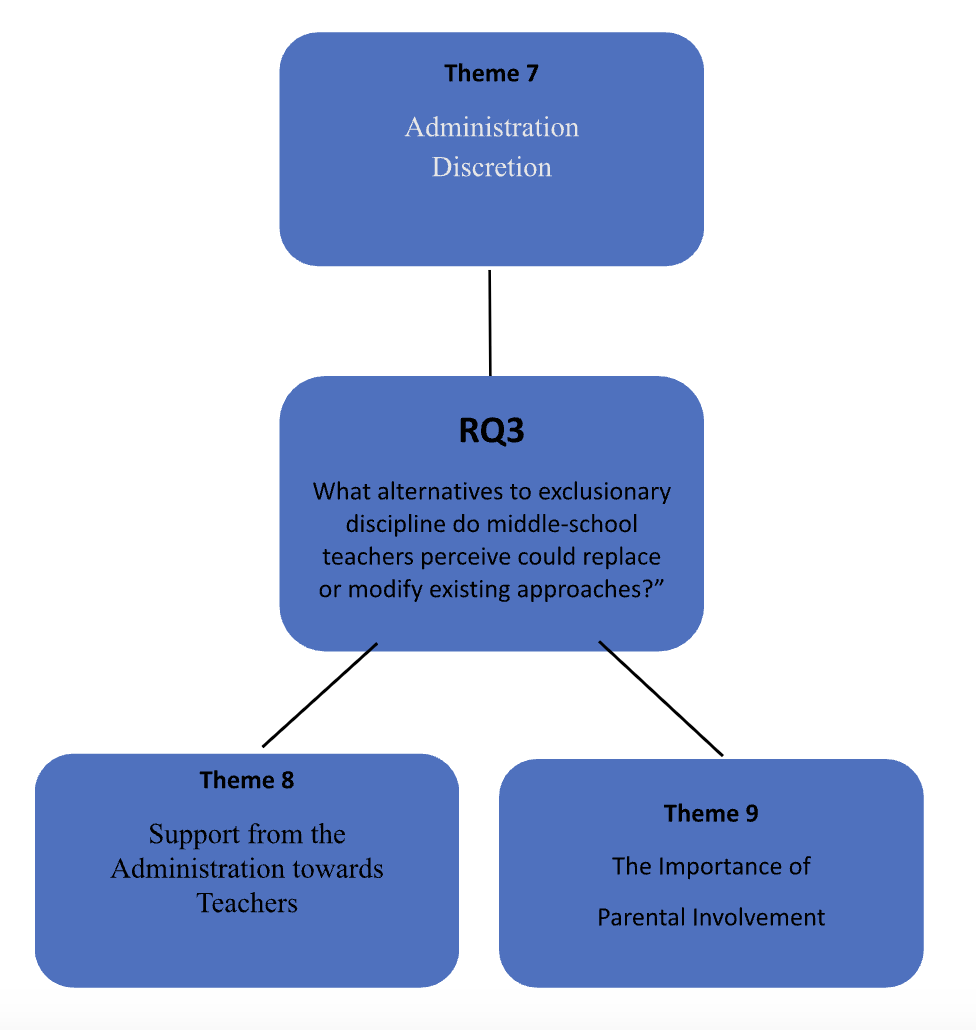
RQ3/Theme 7 The seventh theme was administration discretion, and it related to RQ3 as a description of how middle-school teachers describe their perceptions of how discipline is being addressed and handled by the administration. Additionally, the participants expressed the need for and importance of consistency among administration team members. “When it is up to the discretion of an AP to choose between sending students back to class, or sending them to ISS, or sending them home, I feel like past administrations have been much more aggressive, which I think is important. The teacher states that when students know there are consequences for their actions, they are less likely to act out or misbehave when they know there is a real consequence. this year, we do not feel there have been consequences or cherry-picked consequences.” The limited support and the workload on middle-school teachers imply that the incentive to substitute relational disciplinary alternatives for the easily administered exclusionary discipline is limited (Jones et al., 2018).
RQ3/Theme 8. The eighth theme was support from administration towards teachers. The definition for RQ3/Theme 8 was that teachers felt supported by the administration when their voices were heard. “I feel supported because my principal is a no-nonsense type of principal, and I love that about her. She is all about student achievement and success. She supports us in every way and allows us to teach, not be disciplinarians.” One of the literature reports that one of the objectives of the current legislative drive across states is to implement “professional development and training programs for middle-school teachers, school resource officers, and other school personnel” (Nese et al., 2020). This approach is essential in ensuring adequate capacity to implement alternative discipline approaches.
RQ3/Theme 9. The ninth and final theme was the importance of parental involvement. The definition for RQ3/Theme 9 is teachers describing the role of the parents and the need for their involvement. “My mom did not play. I feel like parents should be more involved because, for me to answer the question, I feel like many kids nowadays do not know the word I am looking for. They are not scared of their parents and do not respect them as they should if they make sense. I have the utmost respect for my mom, and I always wanted to make her proud of me and things of that nature.” Parents and guardians can also play an essential role in reducing exclusionary cases in schools. When the students are away from school, such as vacationing for the summer or celebrating holidays, parents can leverage the moment to talk with the child (Dufresne et al., 2010). The rapport between the student and the guardian will be great, and the student will open up about his/her issues (Korkmaz, 2007). The push to roll back laws and practices that have encouraged exclusionary discipline is motivated by the need for discipline strategies to address the racial disparities associated with zero-tolerance strategies (Skiba et al., 2014). The recommendations made by the policymakers are increasingly geared towards creating “strategies to reduce misbehaviour and maintain a safe learning environment, including conflict resolution, restorative practices, counselling, and structured systems of positive interventions.”
RQ3 Conclusion. We discovered a few common characteristics when examining what middle school instructors believed about managing discipline. Managers were free to select how to discipline children, while teachers highlighted the importance of consistency and light sanctions for bad behaviour. This freedom demonstrates a tendency to implement more brutal consequences to deter poor behaviour successfully. Furthermore, the significance of administrative support for teachers was underlined, notably when instructors were appropriately recognized and valued. A positive environment frees teachers from dealing with discipline issues, allowing them to focus on their primary responsibility: teaching. Making it a priority for lawmakers to give training and development opportunities for school personnel, especially teachers, may make alternate punishment measures more appropriate than old punishments. Finally, it was underlined that parents should be involved in punishment (Graham et al., 2022). Educators emphasized the importance of parents teaching their children respect and responsibility, as parents significantly impact their children’s behaviour. Early intervention and support networks can be established by facilitating collaboration between teachers and parents. These new measures will eventually lead to fewer exclusionary punishments.
Reflection on the Dissertation Process
The researchers aimed to collect essential data on how middle school teachers in Dallas, Texas, and the surrounding school districts feel about exclusionary sanctions, how they are utilized, and other viable alternatives. Insights from participants provided valuable information for implementing new disciplinary measures that provide a conducive learning environment for teachers and students. A lot of courage, enthusiasm, dedication, hard work, and determination were put into the planning and execution of this project. Moreover, I acquired practical experience with this process that could benefit my future research in academic methods, data analysis, interviewing, and data coding.
The initial purpose of this research was to determine teachers’ perceptions of exclusionary discipline in middle schools in Dallas, Texas. As the investigation progressed, attention shifted to an alternative exclusionary discipline that could replace the existing one to pinpoint the issue’s uncertainty. Understanding a fascinating topic was the main reason for conducting a research study. The problem space component of this dissertation focuses on the increasing demand for further research to improve current knowledge and develop a specific research study question. This research began as the dissertation progressed. Understanding and applying the suggestions from the committee chair and other members was a key lesson from this task. Finishing the job would have been difficult without their valuable criticism and helpful recommendations.
Initially, completing this paper was challenging. The idea that it could be used to bring about positive change as it unfolded replaced the previous notion that it was doubtful as time went on. This project will contribute to the existing knowledge on situated cognition and ambitious teaching approaches, making it easier for all educators to implement them. Once this dissertation is completed, further research will be conducted to benefit students, parents, and educators nationwide.
While collecting data, there were instances where asking more detailed questions instead of assuming could have resulted in more comprehensive responses. Later, we will utilize this new data to determine the timing for presenting additional questions to enhance the existing data and gain a more thorough understanding of participants’ thoughts and emotions.
Theoretical Implications
This section discusses the probable outcomes that may arise from the discoveries produced during this study investigation. This section also discusses the research’s theoretical, practical, and long-term ramifications. This qualitative descriptive study was created with theoretical principles as a guide. The study’s first question was regarding middle school instructors’ attitudes toward exclusionary punishment. We can understand how middle school children feel about exclusionary punishment by investigating this question. This study emphasizes the complexities of court actions and school-based student behaviour management. Educators play an essential role in identifying and dealing with disruptive behaviour, and they frequently choose to intervene in the classroom rather than expel children as punishment. Despite efforts to encourage kids to be responsible and participate, difficulties persist, particularly among children from low-income homes. Integrating positive behavioural supports, tailored techniques, and teacher feedback into a more comprehensive strategy could result in a more effective and welcoming school discipline system. Numerous factors influence exclusionary rules and teachers, which can be understood by examining these three key themes.
The study’s second question questioned middle school instructors’ attitudes toward utilizing exclusionary discipline. The ideas discussed above demonstrate how everyone involved in education is interdependent, and everyone has a responsibility to establish a safe and caring environment where kids can succeed academically, mentally, and socially. Middle schools understand that genuine care, effective collaboration, and clear communication are all required to deal with adverse conduct and support positive results. Graham et al. (2022) discovered that teachers associated aggressive behaviour with suspensions. Teachers identified several crimes that resulted in exclusionary punishment, including disrespect, failure to obey the rules, resistance, skipping school, and delay. The researchers concluded that managers would be in charge of the disciplinary process.
The final research question asked, “Which alternatives to exclusionary discipline do middle school educators believe could supplant or alter current approaches?” Concerns concerning discipline in middle schools must be addressed comprehensively, including active family participation, consistent administration methods, and supportive school environments. Educational institutions can foster a good, disciplined environment that helps students perform better in school and their personal lives by encouraging professionals from all professions to collaborate and use all-encompassing techniques. According to Pinkelman et al. (2015), middle school teachers must be taught to employ non-exclusionary approaches to control student conduct during their initial or ongoing professional development.
Practical Implications
The initial study inquiry’s findings will assist teachers in better understanding exclusionary punishment. They will also help policymakers and administrators establish professional development programs that address misunderstandings and offer new ways. Workshops and training activities will form part of the program. They will concentrate on managing conflicts, operating a school, and applying restorative justice.
RQ2 is being understood right now. By asking instructors what they think about the study results and the usage of exclusionary discipline tactics, middle school administrators will receive valuable information about how much-improved support systems and policies are required. Academic organizations will frequently review their punishment policies to ensure they follow best practices and are consistently enforced. Establishing clear lines of communication between administrators, students, and teachers can help to resolve concerns and improve the effectiveness of disciplinary procedures.
Educators, managers, and critical individuals must collaborate to create effective alternatives to exclusionary discipline. This article contributes significantly to what is previously known in this field. Schools will form task groups to investigate and implement various strategies, such as mediation programs, restorative justice circles, therapy services, and programs that teach children about emotional and social concerns. If instructors are to be successful, they must have the necessary tools and support to use these options effectively. This strategy allows management, students, and teachers to meet and discuss ways to solve problems and resolve disagreements. The teachers can address the natural causes of adverse conduct through support services, social and emotional development programs, and therapy.
Future Implications
The primary focus of this research was on the most pressing issue in education. The study focuses primarily on what teachers think about selective punishment, how they believe it should be employed, and what other types of punishment should be used instead. Chapter 2 of the paper goes into great length regarding the issues with exclusionary discipline and some potential solutions. The study focuses on practical effects. Building on these foundations, future experts can expand the scope of their work. What teachers think may influence how schools execute tight discipline laws, resulting in varying punishments based on teachers’ ideas or biases. Suppose you continue to use exclusionary discipline without investigating how effectively it works and what negative consequences it may have. In that case, you risk creating a school environment prioritizing punishment over intervention and prevention (Gregory et al., 2015).
Regarding the overall school environment and interactions between students and instructors, teachers’ attitudes toward the effectiveness of exclusionary sanctions influence how they deal with behaviour problems and interact with students. Educators’ strong preference for exclusionary punishment may affect their willingness to adopt restorative justice methods or other options that require a significant change in their views on punishment and cognition. The empirical findings from prior studies particularly informed this chapter’s synthesis of the problem and why it is a significant problem in the current educational settings. As such, the literature has a clear gap regarding how middle-school teachers perceive exclusionary discipline. There is a need to explore how teachers perceive exclusionary disciplinary approaches to advance knowledge on effective and sustainable alternatives to student behaviour management in schools. Educators may discover that conflict resolution approaches, emotional and social development learning programs, and alternative justice approaches are more effective in helping students with behavioural concerns and academic achievement (Welsh & Little, 2018). Educators should support different methods of discipline and push for more resources and training while acknowledging the importance of continuous learning and growth in this area.
Strengths and Weakness of Study
This section carefully evaluates and ranks the study’s strengths and weaknesses. This study is intriguing because it focuses on a critical issue in learning: exclusionary discipline, which can significantly affect students’ grades and overall well-being. According to research, increasing the quantity of exclusionary discipline measures may dramatically increase the likelihood of students leaving. Not attending school due to a suspension has been connected to an increased risk of undesirable behaviour. Furthermore, considering teachers’ perspectives on exclusionary discipline and other strategies contributes to the current academic debate by incorporating crucial perspectives from a critical group of individuals. This essay will discuss many methods for implementing exclusionary punishment in Dallas to improve school settings. The study employed qualitative approaches to thoroughly examine educators’ perspectives, resulting in complicated and valuable data.
The flaws could be identified before the investigation was completed. These issues included depending excessively on self-reported data that anyone has verified. According to Roberts (2015), objective statistical analyses serve as the foundation for quantitative research, but self-reported data is less likely to be true when applied to large groups. Social desirability bias could influence Participants’ responses, which causes individuals to offer socially acceptable answers rather than those that reflect their true beliefs. Another issue is the tiny sample size—only one person from each school. This group had a modest number of schools compared to Dallas’s. The results may not be as comprehensive as they may be due to the tiny sample size. Purposive sampling was chosen as the method of selecting study participants. However, it may add bias to the procedure. According to Roberts (2015), errors can occur when researchers use purposeful sampling to select a representative population. People implicated in this investigation had previously received exclusionary penalties. This bias may reduce the reliability and validity of the study’s findings.
Recommendations
An extensive literature review supported this research study in the three key elements: middle-school teachers’ perception of exclusionary discipline and the teacher’s perception of the application of exclusionary discipline approaches. Moreover, alternatives to exclusionary discipline do middle-school teachers perceive they could replace existing approaches? The Review of literature by Rahimi & Karkami (2015) supports this element as it asserts that Teachers’ perceptions are important in determining the need for disciplinary action and recommending or providing the appropriate intervention. The teacher can give restorative discipline or referrals for being non-compliant and exhibiting unacceptable behaviour, distorting the learning environment. Students receive teacher discipline referrals for acts of defiance such as learning disruptions, disobedience, physical confrontation, and defiance. Based on the conclusion of this study, below are recommendations for future studies:
- Advocate for employing various forms of discipline that place relationships and harm healing lower on the priority list. Following this strategy entails gathering children, instructors, and sometimes even parents to discuss the behaviour’s consequences, devise remedies, and rebuild trust in the school.
- Encourage teachers to continue learning and growing in their careers to understand better proper student discipline, conflict resolution, and how to create a calm school environment.
- They are identifying and addressing cultural variables that contribute to discipline issues. Teachers must receive specialized training to better understand and assist students from various cultural backgrounds.
- It is developing ties with community groups, mental health specialists, and welfare organizations so that children struggling with the rules can receive additional assistance and guidance. These measures may involve participation in extracurricular activities, mentoring programs, and counselling services.
- Include parents and children in disciplining by soliciting their feedback, listening to their concerns, and working together to find solutions. These actions increase the likelihood that students in school will learn how to be responsible and accountable.
Recommendations for Future Research
Future research on exclusionary discipline and alternative approaches in middle schools will explore various dimensions to understand the complexities involved and identify effective strategies.
These suggestions are based on the study’s findings for other professionals who want to investigate exclusionary discipline. Exclusionary punishments, such as suspension and expulsion, have immediate and long-term consequences for kids’ academic achievement, social and emotional development, and engagement in the criminal justice system. Much research is required to determine the nature of these effects. It appears unusual that kids from oppressed groups, such as disabled individuals and pupils of colour, are punished in ways that make them feel unable to engage in school. Someone should investigate this—This research aims to identify the fundamental mechanisms that produce these discrepancies and devise solutions to address them. The researcher will utilize the study’s findings to investigate how teachers perceive exclusionary punishment and the factors contributing to its implementation. With this report, the researcher will be able to address the problem more promptly and create a positive environment for the children. The Relationship between discipline methods and the institution’s overall culture and way of life will be examined. In subsequent studies, this study aims to investigate how harsh penalties affect kids’ emotions of safety, involvement, and connection to their community. Aside from that, it wants to look into other methods for making schools more tolerant and inclusive. Future research should focus on restorative justice methods rather than traditional sanctions. For example, researchers can investigate how successfully restorative practices help resolve conflicts, inspire accountability, and foster community and belonging among staff and instructors. This study discovered that only some solid scholarly works discuss the type and level of influence teachers have on how exclusionary disciplinary measures are implemented in schools (Wymer et al., 2022). Understanding how middle school teachers see things allows students to establish an environment that promotes using various effective disciplinary techniques rather than relying solely on exclusionary punishment.
More research would be beneficial in determining how teacher support and training affect the effectiveness of alternate disciplinary tactics. To do so, we must examine how professional development programs have influenced teachers’ attitudes and conduct toward discipline and devise solutions to issues that make implementation difficult. The current study found that instructors’ propensity to apply exclusionary punishment is influenced by various outside factors, including their confidence that it will improve students’ behaviour. Teachers who believe that exclusionary discipline is an effective strategy to prevent current and future breaches are those who implement zero-tolerance rules. According to procedural justice theory, teachers who say that barring children from activities will increase behaviour problems and other harmful effects on the students will seek other punishments. Researchers can now examine the importance of family and community involvement in middle school discipline. This engagement could entail investigating how community members, caregivers, and parents influence the provision of comprehensive support services for students with behavioural and emotional challenges. It could also entail looking into how schools and community groups collaborate to provide these services.
Recommendations for Future Practice
The study’s findings add to our understanding of aspirational techniques for teaching practices. The study’s findings support a variety of proposals that aim to improve how things are done in the future. Understanding teachers’ feelings about exclusionary punishment is critical to developing concepts that produce the best learning environments. Teachers are responsible for monitoring student behaviour to ensure that the classroom is a safe learning environment. The first suggestion for future measures will focus on how to prepare teachers. In the future, education policy may incorporate frequent training and workshops on effective teaching techniques, problem-solving in the classroom, and student engagement.
Creating a framework allows educators to readily watch and provide constructive feedback on each other’s lessons. This involvement will create an environment that encourages teachers to keep improving. The second plan would emphasize fostering positive school environments by ensuring that students understand what is expected of them regarding behaviour and providing programs that use peer mediation to help students resolve issues peacefully and healthily. To make children feel like they own and are linked to their school, involve parents, community members, and local groups in activities and decision-making. Consider using restorative circles as a third option for punishment. This strategy allows management, students, and teachers to meet and discuss ways to solve problems and resolve disagreements. The natural causes of adverse conduct can be addressed through support services, social and emotional development programs, and therapy.
Holistic Reflection on the Problem Space
Exclusionary discipline refers to any form of disciplinary action in which learners are removed from their customary educational settings. Educational institutions play a critical role in fostering the academic development of pupils and moulding them into productive individuals in society. Throughout history, teachers have been entrusted with the responsibility of creating a supportive classroom environment that facilitates the learning and development of students. By employing moderating factors, educators can confront the processes and behaviours that inhibit students from attaining the intended learning outcomes. Legal and federal orders have consistently served as a structural foundation for the operation and support of educators. “Zero-tolerance” policies’ prevalence in schools has been associated with the rise of exclusionary discipline as a preferred method of managing student conduct. This research examined middle school teachers’ perspectives on exclusionary disciplinary measures, the implementation of exclusionary discipline, and possible alternatives, indicating that exclusionary discipline frequently fails to inspire positive behaviour among students. Exclusionary discipline has proven to be ineffective in fostering interactive connections among children, instead intensifying their hostility and misbehaviour.
This research found that exclusionary discipline negatively impacted both student conduct and academic performance. Exclusionary disciplinary measures lead to a proliferation of negative consequences, including poor academic performance and high rates of grade retention. Lack of equity within school settings discourages learning institutions from failing to make an effort to be inclusive of all students and inhibits the academic progress of children. In pursuit of a more comprehensive understanding of the consistent aspects surrounding professional development opportunities, school management policies and practices, and the establishment of an inclusive learning environment, it is imperative to examine the perspectives of middle school educators regarding exclusionary disciplines. Given these perspectives, it is evident that there is a need for hypothesis shifts in learning institutions to prioritize restorative justice, social-emotional learning, trauma-informed approaches, and classroom relationship development.
Examining the perspectives of middle school teachers regarding exclusionary discipline, its implementation, and potential alternatives in exclusionary discipline goes beyond the realm of educational policy. The research findings provide insight into the societal values that invade our educational systems and have a lasting impact on future generations. This comprehensive analysis provides insights into and contributes to the resolution of an urgent issue within our educational system. This study is significant because it exposes the urgent requirement for alternative disciplinary strategies in academic institutions. Most of the time, people need to think about how teachers affect the rules and processes for school discipline. By stating their opinions on the matter, middle school teachers can encourage a reevaluation of current methods and the start of new projects aimed at finding better methods that put students’ well-being and academic success first.
The goal of this study is to help the community, and people who have a say in making education policies understand how hard it is to deal with behaviour problems in middle schools. The study stresses how important it is to look at systemic factors that affect student behaviour along with the student’s own needs and the broader cultural and social environment. To deal with these effects, we need a plan that covers everything.
Middle school is a time when kids start to figure out who they are, how to get along with others, and how to handle academic challenges. This time is significant for their general growth and development. Middle school students are usually between the ages of eight and twelve. This age group is a considerable time for growing traits like independence, curiosity, and respect for adults in charge. The main question of the study was whether there was a link between differences in how things were run and how students in middle school were affected by exclusionary discipline measures. This research looks at the problems that come up when middle schools use sanctions that keep kids from other students. To have an intelligent conversation about possible alternatives, you need to know a lot about how to properly handle student behaviour and what kind of punishments are used as part of the punishments. Understanding how teachers enforce discipline in this setting and with these kids at this age and stage of growth is essential for making sure that middle school classrooms are safe and valuable for students.
The study shows that exclusionary punishment has become a significant problem in society. Exclusionary discipline is terrible for both the mental health of the people who are affected and the motivation of the kids who are exposed to it. This research shows that student-exclusionary disciplinary procedures hurt their academic performance and don’t help them develop good morals. These results show that it is possible to adapt to different teaching methods. This study found that these choices are not only crucial for changing behaviour, but they also effectively address problems related to exclusionary punishment, like unequal experiences and poor academic results. Because of these suggested changes, the school environment might become more fair, just, and caring. Consequently, kids do better in school, the number of students who have to repeat a grade goes down, and there are no more suspended students.
References
Adams, S. W. (2022). Perceptions of K-12 School Principals Regarding the Use of Exclusionary Discipline Practices (Doctoral dissertation, Walden University).
Dufresne, A., Hillman, A., Carson, C., & Kramer, T. (2010). Teaching discipline: A toolkit for educators on positive alternatives to out-of-school suspensions. New Haven, CT: Connecticut Voices for Children.
Graham, L. J., Gillett-Swan, J., Killingly, C., & Van Bergen, P. (2022). Does It Matter If Students (Dis) Like School? Associations Between School Liking, Teacher and School Connectedness, and Exclusionary Discipline. Frontiers in Psychology, p. 13. https://doi.org/10.3389/fpsyg.2022.825036
Gregory, A., Allen, J. P., Mikami, A. Y., Hafen, C. A., & Pianta, R. (2015). Eliminating the Racial Disparity in Classroom Exclusionary Discipline. Journal of Applied Research on Children: Informing Policy for Children at Risk, 5(2). https://doi.org/10.58464/2155-5834.1212
Korkmaz, I., (2007). Teachers’ opinions about the responsibilities of parents, schools, and teachers in enhancing student learning. Education, 127(3).
McNeill, K. F., Friedman, B. D., & Chavez, C. (2016). Keep them so you can teach them: Alternatives to exclusionary discipline. International Public Health Journal, 8(2), 169–181.
Nese, R. N., Bastable, E., Gion, C., Massar, M., Nese, J. F., & McCroskey, C. (2020). Preliminary analysis of an instructional alternative to exclusionary discipline.
Pinkelman, S. E., McIntosh, K., Rasplica, C. K., Berg, T., & Strickland-Cohen, M. K. (2015). Perceived enablers and barriers related to sustainability of school-wide positive behavioural interventions and supports. Behavioural Disorders, 40(3), 171–183.
Rahimi, M., & Karkami, F. H. (2015). The role of teachers’ classroom discipline in teaching effectiveness and students’ language learning motivation and achievement: A path method. Iranian Journal of Language Teaching Research, 3(1), 57-82.
Roberts, L. D. (2015). Ethical issues in conducting qualitative research in online communities. Qualitative Research in Psychology, 12(3), 314–325. doi:10.1080/14780887.2015.1008909
Welsh, R. O., & Little, S. (2018). The School Discipline Dilemma: A Comprehensive Review of Disparities and Alternative Approaches. Review of Educational Research, 88(5), 752–794. https://doi.org/10.3102/0034654318791582
Wymer, S. C., Corbin, C. M., & Williford, A. P. (2022). The relation between teacher and child race, teacher perceptions of disruptive behaviour, and exclusionary discipline in preschool. Journal of School Psychology, pp. 90, 33–42. https://doi.org/10.1016/j.jsp.2021.10.003
 write
write