Introduction
Urbanisation, which is among the most persistent processes across the world, is carried through the migration of people from rural to urban areas. Today, approximately 50% of the world’s inhabitants live in cities, and the prospects indicate the trend towards further growth, with a possibility of 70% living in cities by 2050. This mass migration will definitely create a lot of difficulties and opportunities on the way, particularly in regional areas. This report attempts to scratch the surface of these impacts of urbanisation on the regional areas in Australia. With urban sprawl, communities within the region very rarely keep their own population dynamics status quo, economic capacities, and surviving environment. Recognizing the occurrence of these impacts is exceptionally vital for policymakers, urban developers, and stakeholders in providing responsive measures and support for the sector in the midst of transformation.
Factors that gave rise to the trend
Urbanisation is often sparked by a confluence of economic, technological, and societal matters responsible for the population shift from rural to urban areas. Cities give options for diverse jobs and access to the amenities that are needed, attracting people who seek better prospects for work and wealth creation. According to the World Bank, more than 80% of the global GDP is located in cities that have strategic value (World Bank, 2023). The economic attractiveness of the urban centre is especially evident in underserved nations, where urban areas function as the creation and progress centres for economic growth. For example, in Australia, cities like Sydney and Melbourne hold enormous economic gravity (IBISWorld, 2023). They are the industrial powerhouses of the country, each contributing significantly to the national GDP. This effect, in turn, creates an influx of people who are graced in urban areas as they search for job opportunities and a cleaner environment.
Furthermore, technological innovation has made it easier for people living in poor rural areas to take advantage of telecommuting and online communication. When digital technologies and the internet exploded, it became clear that there was no longer a necessity to be physically present to be able to work, and the entire world turned into a place for work and life (Liu et al., 2020). This accentuation happened to move more quickly during the COVID-19 epidemic, whereby some organizations embraced the idea of employees working from home.
Social factors also determine the urbanisation process as, in many cases, rather than the agro-price development, people move from rural to urban areas because of the presence of various aspects such as education, healthcare, and leisure amenities. Urban areas manage to offer widespread education options, health facilities, and cultural attractions, which are unmatched by rural areas, thus making them great locations for families seeking better lifestyles (Liu et al., 2020). Thus, in Australia, in cases like cities such as Sydney and Melbourne, the country will have the best academic institutions and hospital services that are competing in the global carpet (IBIS World, 2023). Besides this, urban areas often bring together a variety of more sophisticated and colourful cultural features, which some people look for in city life. The social aspects are thus huge determinants of the migratory trends and, even further, urbanization worldwide. Figure 1 below shows IBIS World’s forecast level of urbanization in Australia.
Figure 1: Annual Change in Level of Urbanization
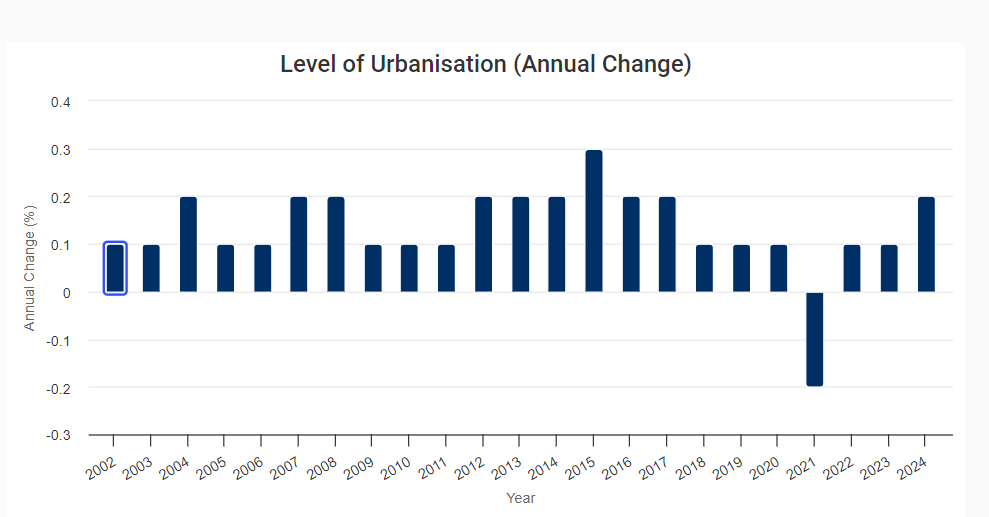
Source: (IBIS World, 2023)
The Trend and Key Characteristics of Urbanisation
Urbanization refers to a global phenomenon of population concentration in areas, which contributes to the changes in the quality of the populace, economic affairs, and lifestyles. Urbanization accompanied by urban agglomeration gives rise to unfolding new and pending repercussions (World Bank, 2023). One of the significant traits of urbanization is the phenomenon of concentration of population as cities become surrounded by all kinds of life experiences, financial activities and innovations, which in turn bring the world closer to each other. These living conditions cause any existing urban infrastructure to be overburdened, which requires the building of transportation, housing, water supply, and sanitation facilities to meet the needs of the expanding urban population (Masik et al., 2021).
Worldwide urbanization differs in size and tactics. They do, however, all target the same goal, which is a promotion of urban area development, which is sustainable and increases the quality of life in urban areas. Constitutional intelligent city programs that employ high-tech solutions to achieve greater efficiency, connectivity, and resource allocation in the cities would typify this kind of initiative (Masik et al., 2021). Once in a while, though, urbanization also brings lots of challenges, especially in developing nations where, among others, the speed of the cities’ development often overtakes the resources of the cities to provide the canopied services and infrastructures. The informal settlements and slums are often found in areas that are urbanizing fast so that they can provide homes for millions of people in pocketed land with little utilities like piped water, sanitation and basic healthcare (Wu et al., 2024).
Resolving the kaleidoscopic problems of urbanization is a complex task that goes beyond the scope of urban planning, which needs to be based on a multi-aspect view to include social, economic, and environmental issues (Masik et al., 2021). Governance systems, one of the hallmarks of intelligent cities as they introduce digital tools into urban infrastructure management, evoke acute hope and expectation for the future of cities through the provision of means for more sustainable and efficient management. These include a variety of solutions: smart grids, transport (as in intelligent transportation systems), and data-driven tools used to make public decisions better(Wu et al., 2024). Nevertheless, innovative city initiatives and intelligent city implementation have problems with privacy, the cyber divide, and equitable access to technology, and they need to use inclusive and participatory approaches while planning cities (Masik et al., 2021).
Application of the Trend to the context of regional Areas in Australia
In Australia, the impacts of urbanization on tourism, hospitality, and events are acutely experienced in the same way as the country’s growth centres, such as New South Wales (NSW) and Victoria, which are characterized by highly populated cities like Sydney and Melbourne. These metropolitan areas have previously been subject to considerable tourism, with institutions and icons of the city, such as the Sydney Opera House and Melbourne’s laneway cafes, being the major tourist attractions. Although COVID-19 may be unstable, it destabilizes the pattern of travel, bringing a meagre rate of tourist arrival and expenditures. As one example, in the 2020 and 2021 period, Australia recorded a severe decline in overseas tourist figures, which had a profound effect on businesses that depended on tourism income as a source of turnover (Statista, 2024). The ability of urban tourism hubs to recover from the pandemic is entirely dependent on their tendencies to change and accommodate the new types of habits and preferences formed during the COVID-19 outbreak.
Figure 2: Growth of tourism GDP in Australia from financial year 2006 to 2023
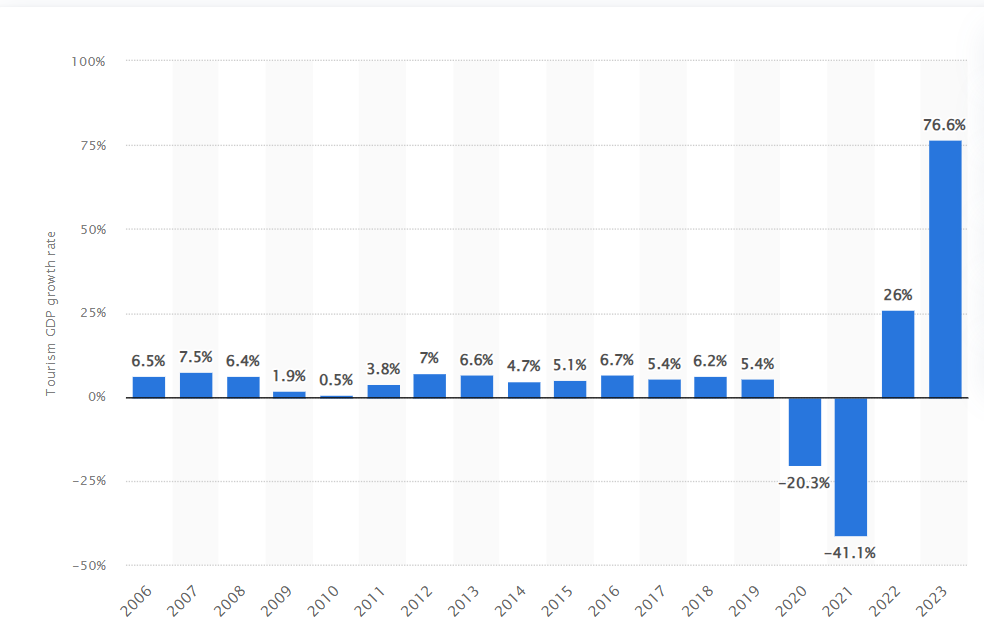
Source: Statista 2024
Following the pandemic, both the natural and cultural destinations in urban locations are looking more at sustainable tourism models and community engagement initiatives towards turning around their tourism. The city of Sydney has also taken the green initiative approach; for example, the Circular Quay precinct has put measures into place to reduce waste and use renewable energy with the aim of attracting eco-friendly tourists (Sydney Opera House, 2023). Likewise, the cultural institutions of Melbourne have reallocated their resources and started offering virtual tours and online events in order to interact with visitors inside the city when travel restrictions are enforced. Through sustainable and innovative principles, urban areas encourage their cities to keep the attraction as active tourism destinations and even respond to environmental issues while supporting the surrounding communities as well.
The centralization of touristic activities in urban areas produces a challenge for rural and regional destinations that strive to be diverse and attract a broader range of visitors. In places like Queensland and Western Australia, where there are many busy natural monuments, the initiative is to advertise the area close to the cities rather than major urban areas. For example, Queensland’s “Good to Go” campaign is aimed at enticing tourists to the area’s regional attractions, including the Great Barrier Reef and the Daintree Rainforest National Park (Queensland Government, 2021). Also, “Wander out Yonder” focuses on unique facts in isolated places such as Kimberley and Astral Pool (Tourism Research Australia, 2023). Through presenting the wide range of the good things of rural Australia, not just the ones in the cities, these campaigns seek to provoke economic growth in the country while also creating jobs which are not just in the cities.
Conclusion
In a nutshell, urbanization has profound effects on regional areas in Australia as it involves economic difficulties and social segregation. With urban centres improving, one challenge that rural communities face is keeping their cultural identity in check and attracting the price of investment to the less developed areas. Awareness of the issues and their addressing emerge as the crucial element of the future of regional communities. This demands a lot of work on the part of the policymakers, industry stakeholders, and the local community to make way for sites where the cultural heritage is and also to improve the economic resilience of small towns that lie far from the big cities. Tackling such challenges will guarantee the perpetuity and prosperity of regional Australia into the uncertain future.
References
IBISWorld . (2023). Industry Market Research, Reports, and Statistics. Www.ibisworld.com. https://www.ibisworld.com/au/bed/level-of-urbanisation/25029/
Liu, Y., Zhang, R., Li, M., & Zhou, C. (2020). What Factors Influence Rural-to-urban Migrant Peasants to Rent out Their Household Farmland? Evidence from China’s Pearl River Delta. Land, 9(11), 418. https://doi.org/10.3390/land9110418
Masik, G., Sagan, I., & Scott, J. W. (2021). Smart City strategies and new urban development policies in the Polish context. Cities, 108, 102970. https://doi.org/10.1016/j.cities.2020.102970
Queensland Government. (2021). Good to go. TEQ Corporate. https://teq.queensland.com/au/en/industry/what-we-do/marketing/good-to-go
Statista. (2023). Statista – The Statistics Portal. Statista; Statista. https://www.statista.com/aboutus/our-research-commitment
Sydney Opera House. (2023). Vivid LIVE | Sustainability. Sydney Opera House. https://www.sydneyoperahouse.com/vivid-live/sustainability
Tourism Research Australia. (2023). Home | Tourism Research Australia. Tra.gov.au. https://www.tra.gov.au/
World Bank. (2023). Urban Development. World Bank. https://www.worldbank.org/en/topic/urbandevelopment
Wu, P., Zhang, Z., Peng, X., & Wang, R. (2024). Deep learning solutions for smart city challenges in urban development. Scientific Reports, 14(1), 5176. https://doi.org/10.1038/s41598-024-55928-3
 write
write